"Without GPS, a drone navigates on memory and faith; the planner's job is to know when both are running out."
A Field-Tested Control Loop
A drone mission is a route-planning problem, a trajectory-generation problem, a perception problem, and a safety problem at the same time. The right abstraction depends on whether the drone is choosing where to inspect, how to fly there, or how to recover when the state estimate degrades.
Routes, Trajectories, And Commands
A route is an ordered set of mission goals. A trajectory is a time-parameterized path with position, velocity, acceleration, yaw, and sometimes snap. A command is what the flight stack can actually accept at the current interface: position setpoint, velocity setpoint, attitude target, body rate, or actuator command.
Minimum-snap trajectory generation is useful because quadrotors can track smooth high-order trajectories. For polynomial segment $p(t)$, the optimizer often minimizes an integral such as $\int \lVert p^{(4)}(t) \rVert^2 dt$ subject to waypoint, velocity, acceleration, and continuity constraints.
Sending waypoints to PX4 is safer and less expressive than sending body-rate commands. Sending body-rate commands gives the autonomy stack more authority, but also more ways to violate assumptions.
GPS-Denied Autonomy
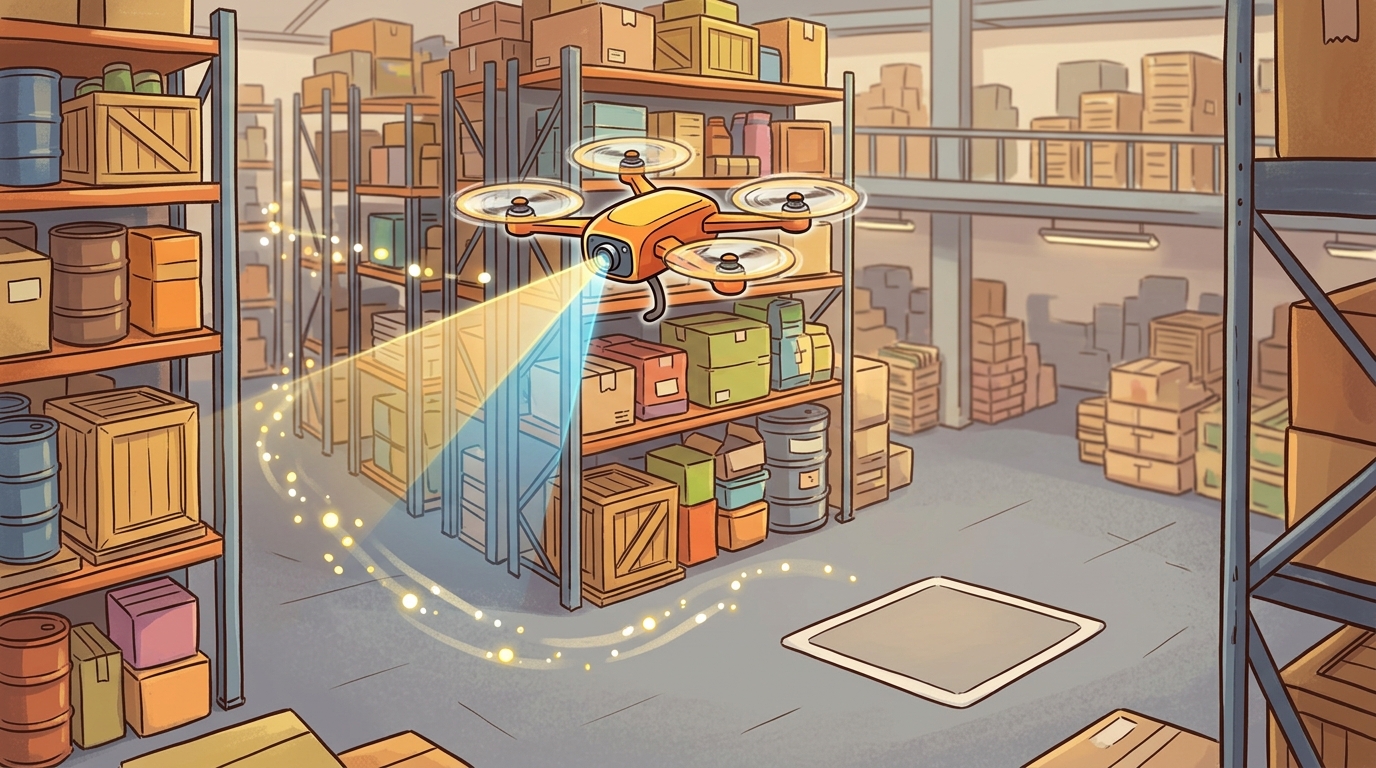
Indoor inspection, tunnels, warehouses, forests, and disaster sites often require autonomy without reliable GPS. The stack then depends on visual-inertial odometry, lidar odometry, SLAM, loop closure, obstacle avoidance, and health monitoring. The mission planner must know when localization confidence is too weak for continued flight.
The fragile details are frame convention, timestamp alignment, estimator fusion, relocalization, and failsafe behavior. A camera plus IMU pose estimate that is delayed, expressed in the wrong frame, or fused without covariance discipline can look smooth in a plot while pushing the drone into a wall.
| Interface | Use When | Main Risk |
|---|---|---|
| Mission waypoints | The environment is known and safety envelope is simple | Poor local obstacle response |
| Offboard velocity | The companion computer handles local planning | Latency and estimator drift |
| Trajectory setpoints | The route requires smooth aggressive motion | Infeasible timing or thrust |
| Body-rate targets | Research needs direct agile control | Thin safety margin |
Inspection And Coverage Planning
Inspection planning adds coverage constraints: each surface, asset, or viewpoint should be observed with sufficient angle, distance, resolution, and overlap. Multi-drone planning adds communication, collision avoidance, task allocation, and battery-aware return-to-home constraints.
Expected output: the scalar should go up when a new viewpoint improves coverage enough to justify its added energy and risk, and it should drop when a candidate path becomes too expensive or too exposed. If the score improves after adding a high-risk waypoint that the vehicle cannot safely localize around, your mission objective is missing a GPS-denied safety term.
For bridge inspection, require each candidate path to specify camera distance, viewing angle, overlap, battery reserve, wind limit, geofence margin, localization source, relocalization trigger, and emergency landing zones. Those fields are what prevent a visually complete route from becoming a flight-control surprise once VIO confidence starts to drift.
Use PX4 offboard mode, ROS 2, MAVLink, QGroundControl, VIO or lidar SLAM packages, and simulation-first evaluation. Avoid deprecated trajectory interfaces and verify current flight-stack support before teaching an API.
For United States operations, Remote ID, visual-line-of-sight rules, geofencing, emergency landing, return-to-land behavior, and staged SITL-to-hardware testing belong in the mission design. For non-US deployment, replace this with the local aviation authority and operational risk framework.
For trajectory generation and gps-denied missions, the useful test is simple: could a teammate point to the log line, plot, or trace that proves the idea changed the agent's next action?
The hard frontier for drone missions is not only better path search. It is combining semantic inspection goals, uncertain localization, wind-aware trajectory generation, and multi-agent deconfliction without losing real-time safety guarantees.
Can you separate the mission route, smooth trajectory, flight-stack command interface, localization source, and emergency behavior for a GPS-denied inspection task?
Design a GPS-denied warehouse inspection mission. Specify localization, map representation, trajectory interface, geofence, battery reserve, emergency behaviors, and the scenario panel used before hardware flight.
A route is not enough. A flyable drone mission needs localization confidence, smooth feasible trajectories, current flight-stack interfaces, and explicitly tested failsafes.
Section References
MAVLink developer guide. https://mavlink.io/en/
Protocol reference for drone messaging and companion-computer integration.
MAVLink trajectory interface. https://mavlink.io/en/services/trajectory.html
Reference that notes older trajectory interface deprecation and reinforces current API verification.
Aerial Gym Simulator. https://ntnu-arl.github.io/aerial_gym_simulator/
Parallel aerial robot simulation reference.
Mellinger and Kumar. "Minimum snap trajectory generation and control for quadrotors." https://doi.org/10.1109/ICRA.2011.5980409
Classic trajectory-generation reference for smooth quadrotor waypoint flight.
PX4 visual inertial odometry. https://docs.px4.io/main/en/computer_vision/visual_inertial_odometry
Official PX4 reference for VIO integration and GPS-denied flight context.
FAA Remote ID, 14 CFR Part 89. https://www.ecfr.gov/current/title-14/chapter-I/subchapter-F/part-89
United States regulatory reference for Remote ID requirements.