"The outer loop dreams of waypoints; the inner loop keeps the aircraft from arguing with gravity."
A Field-Tested Control Loop
Drone autonomy begins with a harsh fact: the vehicle is underactuated, fast, energy-limited, and usually unable to stop safely in mid-failure. A serious drone chapter must therefore connect AI decisions to flight dynamics and flight-control interfaces.
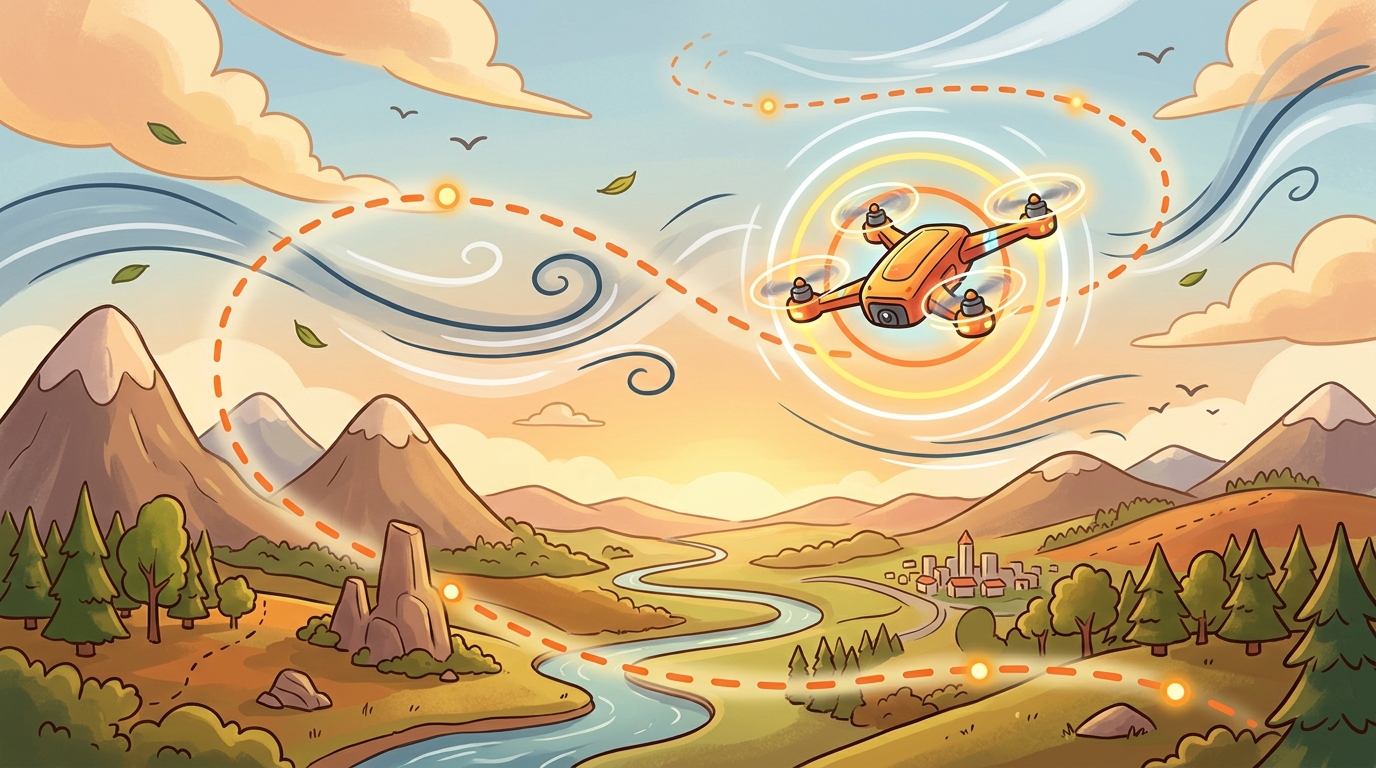
Quadrotor State And Forces
A quadrotor state can be written as position $p$, velocity $v$, attitude $R$, body angular velocity $\omega$, and rotor speeds $\Omega_i$. The translational and rotational dynamics are commonly summarized as:
$$m\dot v = mg e_3 - f R e_3 + d, \qquad J\dot\omega = \tau - \omega \times J\omega.$$
The total thrust $f$ and body torque $\tau$ come from rotor thrusts through an allocation matrix. For a plus or x quadrotor, the command vector $[f,\tau_x,\tau_y,\tau_z]^T$ is generated by squared rotor speeds, so the high-level planner is really choosing targets that must remain inside a polytope defined by rotor saturation, battery voltage, and motor dynamics. If the planner asks for a force or moment outside that envelope, the mission is already infeasible even if the waypoint list looks smooth.
A learned planner may choose waypoints or velocities, but the vehicle survives because fast attitude and rate loops stabilize the body. High-level AI should respect the timing and authority of the low-level flight controller.
Cascaded Flight Control
Most practical quadrotor stacks use cascaded control: position control produces velocity or acceleration targets, velocity control produces attitude and thrust targets, attitude control produces body-rate targets, and rate control produces motor commands. The outer loops can be slower. The inner loops must be fast, stable, and well tuned.
PX4 makes this hierarchy visible in its controller diagrams: multicopter position, attitude, and rate controllers are separate contracts with clear setpoints and saturation points. For a learning system, those boundaries are not implementation trivia. They decide whether the policy should command a waypoint, velocity, attitude, body rate, or direct actuator target.
| Loop | Typical Input | Typical Output | Failure To Log |
|---|---|---|---|
| Mission | inspection goal, geofence, battery budget | waypoints or coverage path | route infeasible |
| Position | pose estimate, waypoint | desired velocity or acceleration | tracking drift |
| Attitude | desired thrust direction | body-rate target | tilt or saturation |
| Rate | body-rate target | motor commands | oscillation or actuator limit |
| Safety | geofence, failsafe, health state | land, hold, return, abort | late intervention |
Geometric Control And MPC
Geometric control treats attitude directly on $SO(3)$, avoiding Euler-angle singularities. Nonlinear MPC adds constraints for thrust, tilt, obstacle clearance, geofences, and energy. The practical question is not which controller sounds more advanced, but which one meets the update deadline while keeping enough safety margin.
- Define mission goals, geofence, wind envelope, sensing mode, and emergency behaviors.
- Run a transparent cascaded PID or LQR baseline.
- Add a geometric or MPC controller on the same waypoint panel.
- Inject wind, latency, battery drop, sensor dropout, and obstacle perturbations.
- Compare tracking error, control saturation, near-collision margin, energy, and failsafe events.
# Drone control evidence record.
# Roll out one flight-test metric packet after a wind-perturbed run.
# The fields mirror what a PX4 or simulator experiment should save.
from dataclasses import dataclass, asdict

@dataclass
class DroneMissionMetric:
    controller: str
    wind_mps: float
    mean_tracking_error_m: float
    max_tilt_deg: float
    failsafe_events: int

    def as_row(self) -> dict[str, object]:
        return asdict(self)

metric = DroneMissionMetric("geometric_controller", 6.0, 0.21, 24.0, 0)
print(metric)Expected output: the printed record should show a controller name, a perturbation level, and at least one safety-relevant consequence such as tilt excursion or failsafe count. If your experiment logs only average tracking error, it hides the distinction between graceful recovery and a controller that briefly leaves the safe flight envelope.
Use PX4 for the flight stack, ROS 2 and MAVLink for companion-computer integration, uXRCE-DDS for current PX4 to ROS 2 middleware routing, gym-pybullet-drones and safe-control-gym for controlled learning tests, and Aerial Gym or Isaac Sim when parallel aerial simulation matters.
A high-level policy can command a trajectory that looks smooth but exceeds thrust, tilt, body-rate, or battery limits. Check actuator saturation before blaming the learning algorithm.
For a wind-disturbed inspection route, compare position error, body-rate saturation, return-to-land triggers, estimator innovation spikes, and geofence margin for each controller on the same waypoint panel. That comparison is where geometric control, gain-scheduled PID, and constrained MPC stop sounding like style choices and start revealing their actual safety margin.
When quadrotor dynamics and flight control feels abstract, ask what would be different in the next frame of video, the next robot state, or the next safety margin.
Aerial robot learning is moving toward parallel simulation, constraint-aware control, and learned perception under aggressive motion, but flight-stack integration remains the gate between a paper result and a safe aircraft.
Can you state which layer receives the learned command: waypoint, velocity, attitude, body rate, or actuator target?
Compare cascaded PID, geometric control, and MPC on the same square inspection route with wind, latency, and thrust saturation. Report tracking error, energy, saturation, and failsafe interventions.
Drone autonomy is credible when the mission planner, trajectory generator, flight controller, estimator, and failsafe behavior are evaluated as one physical stack.
Section References
PX4 Autopilot documentation. https://docs.px4.io/main/en/
Official open flight-stack documentation.
PX4 ROS 2 guide. https://docs.px4.io/main/en/ros2/
Official guide for ROS 2 integration with PX4.
gym-pybullet-drones. https://github.com/utiasDSL/gym-pybullet-drones
Gymnasium-style quadrotor learning environment.
Lee, Leok, and McClamroch. "Geometric Tracking Control of a Quadrotor UAV on SE(3)." https://arxiv.org/abs/1003.2005
Foundational reference for geometric quadrotor control on SE(3).
PX4 controller diagrams. https://docs.px4.io/main/en/flight_stack/controller_diagrams
Official PX4 reference for multicopter controller interfaces and loop structure.