"Safety for a human-scale robot begins where optimism about the demo ends."
A Deployment Safety Review
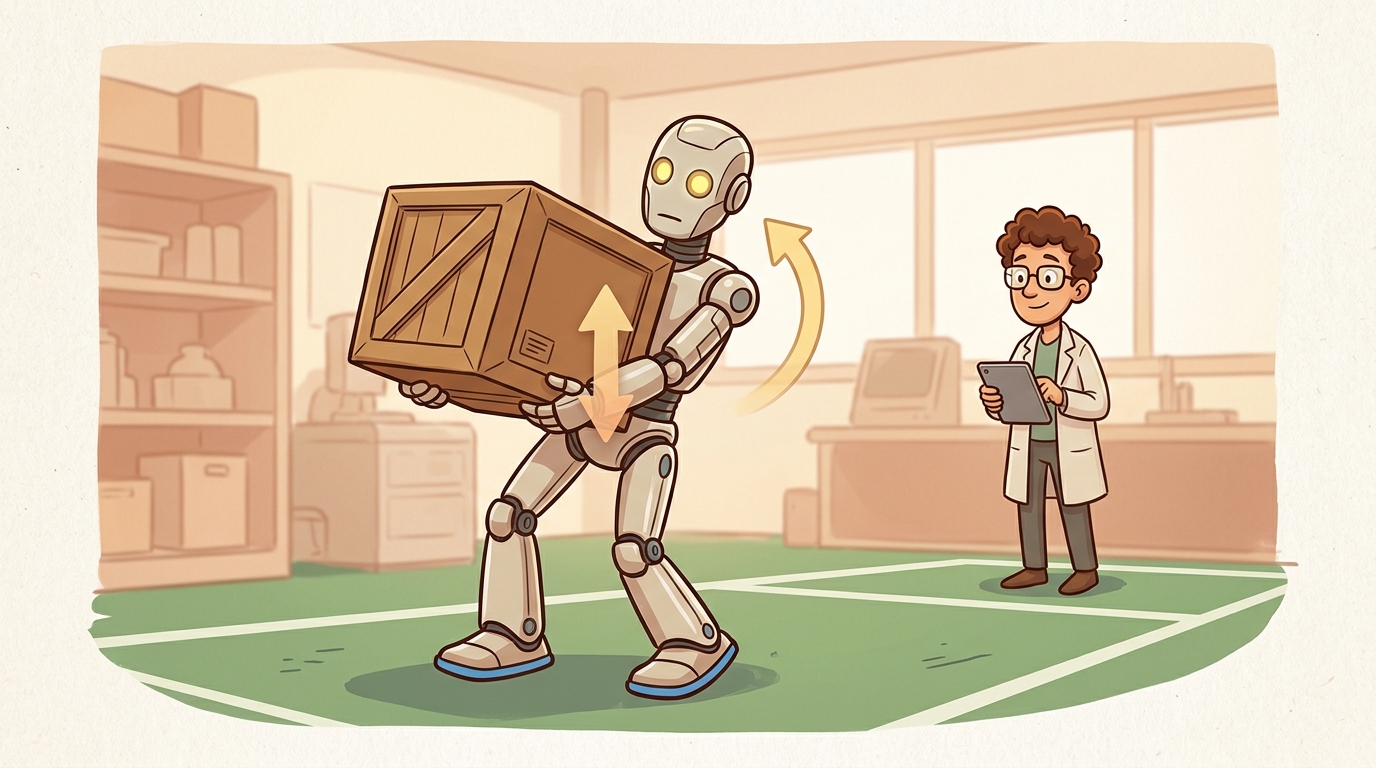
Safety for human-scale robots is not a wrapper around capability. It is a set of hard constraints that must govern perception, planning, control, teleoperation, and deployment telemetry together.
A common control-filter view is to solve $u^* = \arg\min_u \|u - u_{\mathrm{nom}}\|^2$ subject to a barrier-style safety constraint $\dot h(x, u) + \alpha h(x) \ge 0$, where $h(x)$ encodes a safe set boundary such as separation distance, fall margin, or joint-limit clearance.
For humanoids, the safe set is multi-layered. It includes reach envelopes, stop distance, contact force, pinch points, balance margin, and interaction-state uncertainty. That is why human-scale safety must be treated as a runtime systems problem, not just a planning problem.
A nice offline policy is irrelevant if the deployed robot cannot clamp unsafe motion quickly enough when humans or contact conditions change.
Theory
Safety monitoring has to operate across time scales. Fast loops catch imminent contact, torque spikes, or falls. Slower loops enforce workcell zones, task permissions, and operator confirmations. Neither layer can fully replace the other.
Humanoid safety is especially challenging because the body itself can create hazards through swinging limbs, falling mass, or unstable carried objects. A safe hand path is not enough if the torso or foothold plan creates risk elsewhere.
Evaluation should include false-negative rate, false-positive burden, intervention latency, degraded-task behavior, and post-stop recovery procedure.
- Estimate human distance, robot reach envelope, velocity, balance margin, and carried-object state at runtime.
- Evaluate a hierarchy of safety conditions from immediate collision risk to slower workcell and task rules.
- Modify or block nominal commands according to the active condition.
- Log every intervention with pre-state, cause label, and post-state.
- Replay interventions in simulation and classify which ones should become training, controller, or sensing improvements.
Worked Example
A simple supervisor log already shows whether a controller respects human-zone constraints without collapsing the task every time a person appears nearby.
events = [
    {"human_distance_m": 1.6, "cmd_scale": 1.0},
    {"human_distance_m": 0.9, "cmd_scale": 0.4},
    {"human_distance_m": 0.5, "cmd_scale": 0.0},
]
stops = sum(1 for e in events if e["cmd_scale"] == 0.0)
print({"stops": stops, "events": events})Expected output interpretation. The supervisor first slows and then stops as a human approaches. That graded response is usually preferable to either doing nothing or stopping at the slightest distant detection.
Use ROS 2 and controller-side safety hooks, keep the nominal controller instrumented, and store intervention logs so safety cases can be replayed rather than retold.
Practical Recipe
- Define the human-zone and robot-envelope hazards before tuning the task policy.
- Implement fast and slow safety layers with explicit responsibilities.
- Log every slowdown, clamp, and stop with a cause label.
- Evaluate false positives and task degradation alongside true safety benefit.
- Rehearse post-stop recovery, not only the stop event itself.
A safety system that only counts emergency stops can look good while quietly producing too many false slowdowns or missing risky near-misses.
A humanoid carrying a tote past a human coworker may need to slow, widen stance, lower arm speed, and change path simultaneously. Safety is a whole-body modification, not a single checkbox.
Safe humanoids are not the ones that never stop. They are the ones that know exactly when to stop and how to recover afterward.
The frontier combines formal safety filters, learned risk predictors, human-intention estimation, and field telemetry. The unresolved challenge is proving broad safety while preserving practical productivity.
What metric would tell you your supervisor is too permissive, and what metric would tell you it is too conservative?
This section is where embodied AI becomes accountable. Students should see that a safe system is not merely lower reward or lower speed. It is a system whose intervention logic is explicit, measured, and replayable.
It is also a place to connect safety to course pedagogy. Every advanced system introduced earlier should now be revisited through the lens of human-zone uncertainty, stop distance, and recovery procedures.
| Tool or Library | Role in the Topic | Builder Advice |
|---|---|---|
| ROS 2 safety and logging hooks | Runtime intervention recording | Make intervention causes structured, not free text. |
| Whole-body controller limits | Fast torque and balance protection | Safety cannot live only in the planner. |
| Simulation replay | Evaluate human-zone and fall scenarios safely | Promote every serious near-miss into the replay suite. |
This section prepares for safety validation and connects to teleoperation and whole-body dynamics.
Design a safety supervisor for a humanoid carry task in a shared workspace. Include graded slowdown, stop logic, and a restart procedure.
Most safety failures come from missing runtime context, missing intervention labels, or badly placed control authority. Put the guard where the unsafe command can actually be blocked.
Section References
Boston Dynamics Atlas product page. https://bostondynamics.com/products/atlas/
Relevant official framing because Atlas is positioned for industrial human environments.
GR00T Whole-Body Control documentation. https://nvlabs.github.io/GR00T-WholeBodyControl/
Current whole-body stack reference where runtime limits and control interfaces matter.
Drake project. https://drake.mit.edu/
Useful model-based platform for safe-set and verification reasoning.
Human-scale robot safety is a live control and monitoring problem, not a disclaimer attached after the demo.
Write the safety monitor specification for a humanoid moving a load through a shared aisle. Include the safe-set variables, intervention order, false-positive metric, and post-stop recovery rule.