"Foundation models matter for humanoids only when they know when to think and when to stay out of the way."
A Dual-System Architecture Review
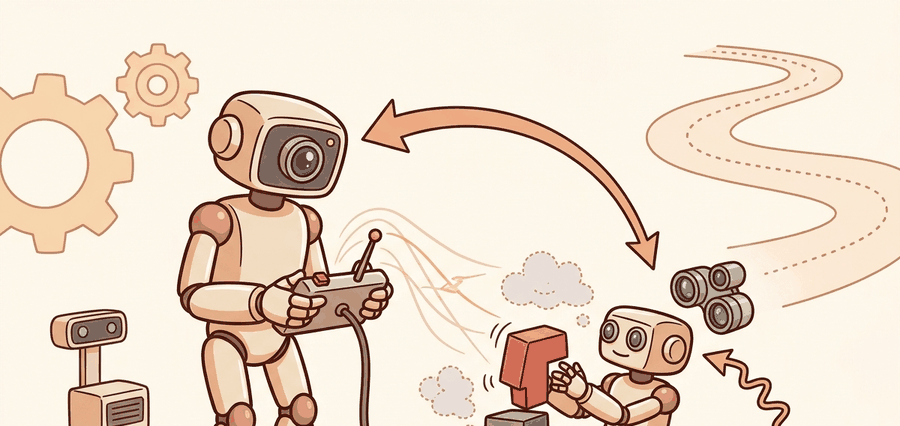
Dual-system humanoid foundation models connect language, vision, memory, and behavior priors to the whole-body stack. The central design question is routing: which decisions belong to the fast motor system, and which belong to the slower reasoning system.
A dual-system controller can be summarized by a routing variable $g_t \in \{\text{reflex}, \text{deliberative}\}$ that selects whether the next command comes from a fast local policy or a slower planner. In practice, $g_t$ depends on novelty, ambiguity, safety state, and latency budget.
The key systems contract is that the slow model proposes subgoals, contact-relevant intentions, or skill calls, while the fast whole-body layer ensures balance, timing, and force feasibility. If the slow model directly emits time-critical whole-body commands, the architecture usually collapses under latency and contact uncertainty.
The value of a humanoid foundation model is not raw eloquence. It is making better task decisions without destabilizing the fast embodied loop.
Theory
Humanoid foundation models are most credible when they operate over typed actions or skills rather than raw torque streams. The fast motor layer already has strong geometric and dynamic structure. The slow layer helps with task decomposition, semantic grounding, memory use, and exception handling.
This makes evaluation more specific. The right questions are whether the model chooses the correct skill, times handoff correctly, asks for clarification when needed, and improves recovery under novelty. The wrong question is whether it can narrate the task nicely.
A clean architecture also exposes failure provenance. Was the error in grounding, planning, skill selection, or low-level execution? Without that separation, whole-body foundation models become impossible to debug.
- Represent the slow layer output as typed subgoals, skill calls, or constraints rather than raw body commands.
- Detect novelty, ambiguity, or high-level exceptions that warrant planner intervention.
- Route stable repetitive segments to fast local control or learned skills.
- Log every handoff between planner and reflex, including why it happened.
- Evaluate on tasks that require both fast recovery and slow reasoning, such as instruction correction during manipulation.
Worked Example
A routing trace can tell you whether the foundation model improved behavior by choosing better skills or merely talked over a controller that already knew what to do.
events = [
    {"t": 0.0, "route": "reflex", "reason": "stable walk"},
    {"t": 3.2, "route": "planner", "reason": "instruction correction"},
    {"t": 4.1, "route": "reflex", "reason": "skill selected"},
]

planner_calls = sum(1 for e in events if e["route"] == "planner")
print({"planner_calls": planner_calls, "events": events})Expected output interpretation. The planner intervened only when the task semantics changed. That is the desired pattern. Constant planner involvement in stable locomotion would usually signal a bad system split.
Use VLA or planning stacks for typed subgoals, but keep the execution layer grounded in concrete tools such as Isaac Lab for simulation, ROS 2 for skill routing and logs, Drake for model-based checks, and Hugging Face LeRobot or related robot-data tooling for behavior traces. The whole-body layer should remain inspectable rather than dissolving into end-to-end textual wishfulness.
Practical Recipe
- Define the typed action or skill interface before plugging in a foundation model.
- Specify novelty or ambiguity triggers for planner involvement.
- Keep low-level balance and safety outside the slow model.
- Log handoffs and planner rationales as structured artifacts.
- Test on tasks with both semantic novelty and physical disturbance.
A dual-system label is meaningless if the slow model still emits latency-sensitive motor detail that belongs in the reflex layer.
A humanoid restocking task may route stable carrying and walking to reflexive skills, while using the slow model to interpret a changed shelf instruction or ask whether a blocked aisle implies rerouting.
The planner should be the navigator, not the ankle servo.
Current frontier systems, including vendor VLA stacks and emerging whole-body references, aim to combine semantic flexibility with reliable motor execution. The open question is how to preserve interpretability and safety as the slow layer becomes more capable.
What signal would convince you that a planner call was necessary rather than an architectural crutch for a weak skill library?
This section can teach a healthy respect for interface design. Strong embodied AI systems often improve more from clean task and skill interfaces than from a larger general model alone.
It also reinforces a central course theme: intelligence in embodied systems is distributed across state estimation, planning, control, and data structures. A foundation model is part of the stack, not the stack.
| Tool or Library | Role in the Topic | Builder Advice |
|---|---|---|
| VLA or planning stack | Slow semantic reasoning and subgoal generation | Emit typed actions, not raw joint commands. |
| Whole-body control framework | Fast local execution and stabilization | Keep safety and balance local. |
| Structured logs | Handoff and rationale tracing | Without routing logs, dual-system claims are hard to verify. |
This section ties back to vision-language-action models and robot foundation models, then forward to deployment monitoring.
Define a task where the planner should intervene exactly twice and the reflex layer should dominate the rest. Then instrument whether the architecture behaves that way.
Dual-system failures often come from poor routing boundaries, missing typed interfaces, or a slow layer that does not know when to abstain.
Section References
Figure Helix official page. https://www.figure.ai/helix
Current official example of a humanoid VLA framing.
GR00T Whole-Body Control documentation. https://nvlabs.github.io/GR00T-WholeBodyControl/
Relevant current whole-body execution layer for dual-system thinking.
Gemini Robotics technical report. https://arxiv.org/abs/2503.20020
Recent reference point for embodied multimodal reasoning and action.
A humanoid foundation model is useful when it improves task-level choices while leaving the fast physical loop clean and reliable.
Specify a dual-system interface for a humanoid pick-and-carry task. Name the typed actions, the routing trigger for planner intervention, and the logs you would inspect after a failure.