"Operational space is the wish. Whole-body control is the bill."
A Field-Tested Control Loop
Boston Dynamics-class humanoids are not walking chatbots. They are underactuated, contact-rich, human-scale machines that must coordinate balance, momentum, manipulation, perception, force limits, thermal limits, timing, and safety in one closed loop.
Why The Specialist Layer Matters
Earlier sections introduced platforms, teleoperation, whole-body control, and foundation models. This section adds the mechanical depth required for a serious humanoid researcher: reduced-order models for planning, full multibody dynamics for execution, contact mode reasoning, and controllers that remain stable when hands, feet, hips, and torso all matter.
The key abstraction is a hierarchy of models. A planner may reason over center of mass, centroidal momentum, footstep locations, and hand contact targets. A whole-body controller then maps those targets into joint torques or position commands while satisfying contact, friction, joint, actuator, and balance constraints.
A centroidal model is not a toy replacement for full dynamics. It is an interface between high-level task planning and whole-body execution: simple enough to optimize quickly, but physical enough to expose balance, angular momentum, and contact feasibility.
Centroidal Dynamics And Balance
For a humanoid of mass $m$, center of mass position $c$, total linear momentum $l$, and angular momentum $k$, the centroidal dynamics summarize the whole robot as:
$$\dot c = \frac{1}{m}l, \qquad \dot l = mg + \sum_i f_i, \qquad \dot k = \sum_i (p_i - c) \times f_i + \tau_i.$$
The contact point $p_i$, contact force $f_i$, and contact torque $\tau_i$ are the bridge from geometry to behavior. If the required force exits the friction cone, the plan is not merely suboptimal. It asks the robot to push on the world in a direction the world will not support.
- Estimate base pose, joint state, contact state, object state, and human-zone constraints.
- Choose task targets: center of mass, torso, feet, hands, gaze, and object pose.
- Build equality constraints for rigid contacts and task accelerations.
- Build inequality constraints for friction cones, joint limits, torque limits, velocity limits, and safety zones.
- Solve a quadratic program for joint accelerations, contact forces, and torques.
- Send commands through the low-level controller, then log solver status, tracking error, contact slip, and recovery actions.
Contact-Rich Loco-Manipulation
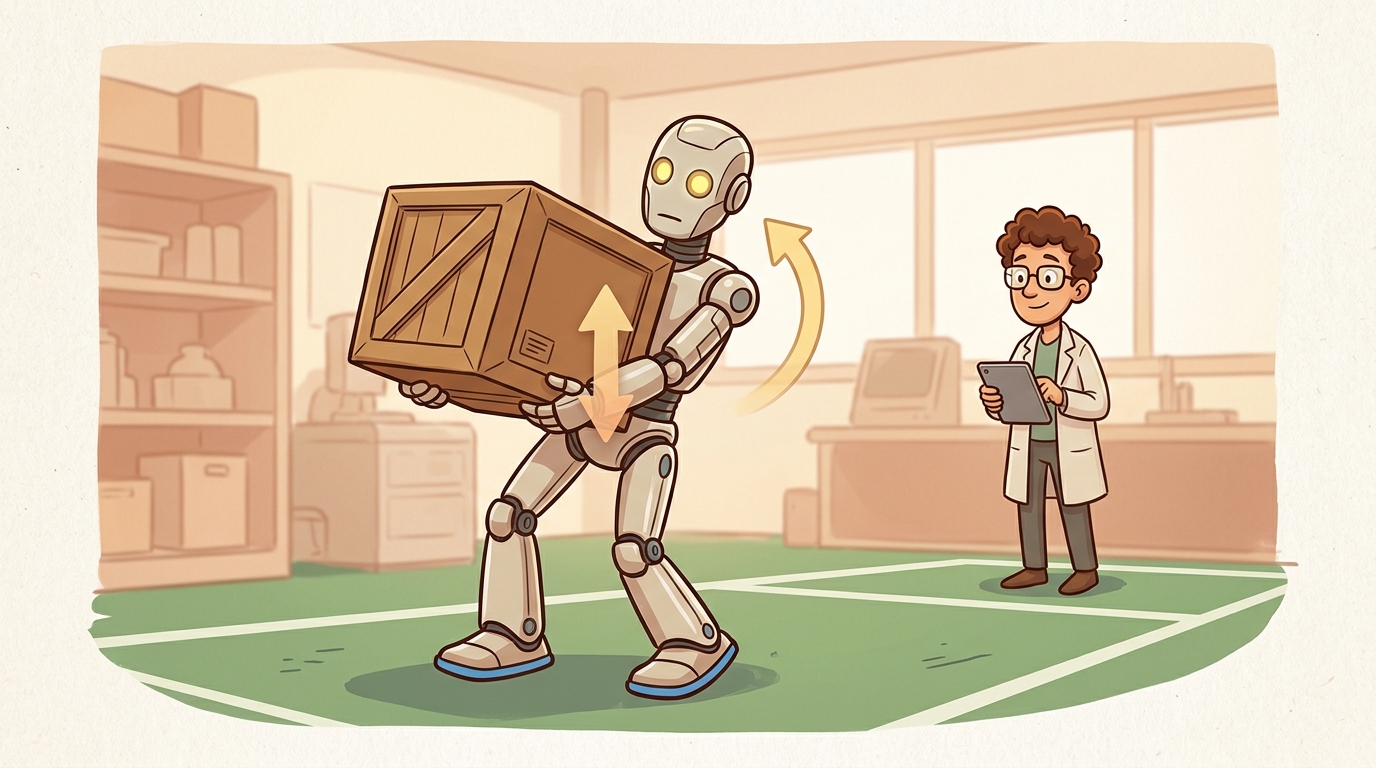
Loco-manipulation begins when walking and manipulation stop being separable. Carrying a heavy object changes the support polygon, the feasible torso motion, the footstep plan, and the hand force budget. Opening a door may require one hand to pull, one foot to reposition, the torso to rotate, and the controller to maintain balance while the door hinge imposes a moving constraint.
A serious system therefore treats limbs as resources. A hand may be an end-effector, a brace, a sensor, or a temporary support. A foot may be a locomotion contact, a push contact, or a stabilizing anchor. Interlimb coordination is the policy that assigns these roles over time.
| Layer | Technical Content | Evidence Artifact |
|---|---|---|
| Reduced model | CoM, centroidal momentum, ZMP, capture region, footstep timing | Feasible contact and momentum plan |
| Whole-body controller | Operational-space control, inverse dynamics, constrained QP, torque limits | Solver trace, torque trace, contact wrench trace |
| Learning policy | RL, imitation, motion priors, domain randomization, sim-to-real | Scenario panel with perturbations and recovery labels |
| Contact perception | Tactile hands, force feedback, object state estimation, slip detection | Contact event log and manipulation outcome |
| Deployment layer | Runtime supervision, human-zone limits, task validation, fleet metrics | Safety case and field reliability dashboard |
Practical Recipe
- Start with a constrained task, such as pick, carry, place, or door traversal.
- Write the contact schedule and identify which contacts are required, optional, or forbidden.
- Plan footsteps, hand contacts, and object motion with centroidal feasibility checks.
- Use Drake, MuJoCo, MJX, Isaac Lab, or Pinocchio to verify dynamics and constraints.
- Train or adapt a policy only after the model-based baseline exposes the physical limits.
- Evaluate with pushes, payload changes, object pose shifts, friction changes, and perception latency.
A hand-built centroidal controller can teach the mechanism, but production work should use Drake, Pinocchio, MuJoCo, MJX, Isaac Lab, and ROS 2 control to keep multibody dynamics, solver status, contact constraints, and logs inspectable.
# Minimal evidence schema for whole-body humanoid research.
from dataclasses import dataclass, asdict

@dataclass
class HumanoidTrial:
    task: str
    contact_schedule: list[str]
    controller: str
    perturbation: str
    metrics: dict[str, float]

    def as_row(self) -> dict[str, object]:
        return asdict(self)

trial = HumanoidTrial(
    task="carry object while stepping over a low obstacle",
    contact_schedule=["left_foot", "right_foot", "left_hand_object", "right_hand_object"],
    controller="centroidal planner plus whole-body QP",
    perturbation="payload shifted by 8 cm during mid-step",
    metrics={"com_error_cm": 3.4, "max_foot_slip_cm": 0.7, "recovery_time_s": 0.42},
)
print(trial.as_row())Expected output interpretation. The printed record is valuable because it binds the contact schedule, controller class, perturbation, and recovery metrics into one artifact. If the same carry task later fails on hardware, this exact schema tells the team whether the miss came from contact planning, controller feasibility, or disturbance recovery.
A humanoid demo can look successful while hiding an impossible control budget. Always inspect contact forces, torque saturation, solver failures, emergency stops, and recovery events, not only final task completion.
For a humanoid moving a loaded tote, the same hand target can be feasible or unsafe depending on foot placement, payload shift, floor friction, and torso posture. The controller should log those variables together rather than treating grasp success as the whole task.
For advanced humanoid dynamics and contact mechanics, the useful test is simple: could a teammate point to the log line, plot, or trace that proves the idea changed the agent's next action?
The frontier is mixed model-based and learning-based whole-body control: reduced models expose momentum and contacts, while learned policies supply agile recovery, manipulation priors, and hardware-specific robustness.
Can you identify the contact schedule, centroidal state, whole-body constraints, actuator limits, and recovery metric for a humanoid carry task?
Design a same-panel comparison between a pure learned policy and a centroidal-planner plus whole-body-QP stack for a heavy-object carry task. Specify contacts, perturbations, metrics, and the failure taxonomy.
Humanoid control becomes research-grade when contact feasibility, whole-body constraints, learning behavior, and recovery evidence appear in the same trace.
Section References
MIT Underactuated Robotics humanoids chapter. https://underactuated.mit.edu/humanoids.html
Reference for underactuated legged robots, ZMP, footstep planning, and humanoid control concepts.
Drake robotics toolbox. https://drake.mit.edu/
Model-based robotics tooling for multibody dynamics, optimization, and control.
NVIDIA Isaac Lab whole-body control update. https://developer.nvidia.com/blog/streamline-robot-learning-with-whole-body-control-and-enhanced-teleoperation-in-nvidia-isaac-lab-2-3/
Current tool reference for whole-body control and teleoperation workflows.