An override is complete only when the robot reaches a verified safe state.
A Safety-Critical Controls Researcher
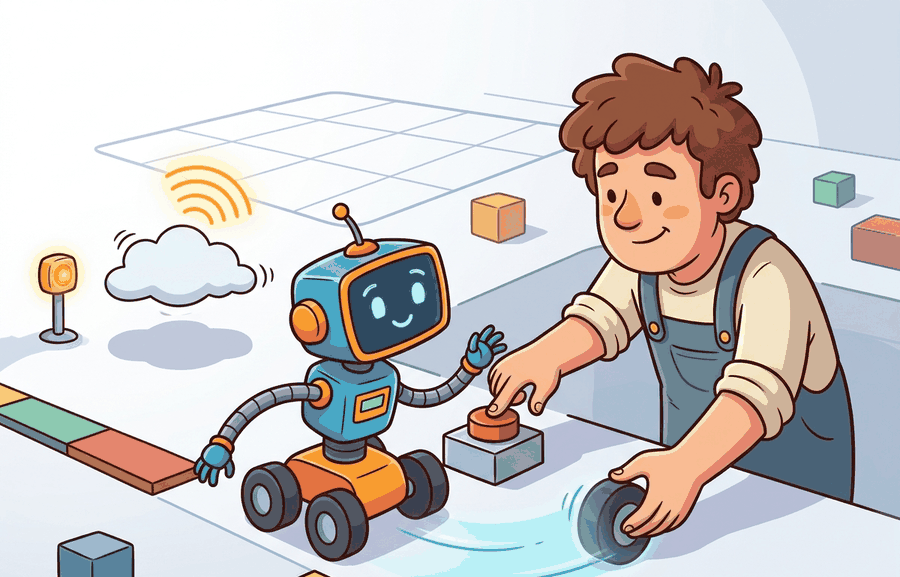
Human override is part of the safety architecture, not an embarrassing backup plan. If the system depends on people to recover from uncertain states, the interface and latency of that intervention must be designed and tested explicitly.
Why This Matters
Human override and safety testing sits at the boundary between learning and safety engineering. The question is not whether the policy usually behaves well, but whether dangerous states are detected, blocked, or exited fast enough to protect people, equipment, and mission goals.
One useful statistic is the mean time to intervention $$\mathrm{MTTI} = \frac{1}{N}\sum_{i=1}^{N}(t_i^{override} - t_i^{hazard}),$$ paired with a success-after-override rate. Override quality is about both speed and whether the system enters a truly safe state afterward.
A human override path that exists on paper but is hard to trigger under cognitive load is not a real mitigation. Safety testing has to include the operator as part of the system.
- Specify who can override, through which interface, and under what authority transitions.
- Measure the time from hazard onset to alert, to operator awareness, to override completion, and to safe-state confirmation.
- Test override during realistic workload, not only in calm scripted demos.
- Record false alarms, missed alerts, and confusing interface states.
- Update training, interface, and autonomy boundaries based on observed intervention failures.
Worked Example
A teleoperated humanoid may have an emergency stop button, but if the operator cannot tell which control mode is active or whether the button was accepted, the mitigation is weaker than it appears in a requirements sheet.
events = [
    {"hazard_s": 10.2, "override_s": 11.1, "safe_state_s": 11.9},
    {"hazard_s": 22.5, "override_s": 24.0, "safe_state_s": 25.8},
]
metrics = []
for e in events:
    metrics.append({
        "override_delay_s": round(e["override_s"] - e["hazard_s"], 2),
        "safe_state_delay_s": round(e["safe_state_s"] - e["hazard_s"], 2),
    })
print(metrics)
[{'override_delay_s': 0.9, 'safe_state_delay_s': 1.7}, {'override_delay_s': 1.5, 'safe_state_delay_s': 3.3}]Expected output: The second event reaches safe state much later even though override still occurred. That distinction matters because override authority is only half the story; the platform must also settle safely.
Structured test matrices, HIL setups, ROS 2 telemetry, and interface event logs make human override tests reproducible instead of anecdotal.
Human override and safety testing require measuring the achieved physical state, not just the command timestamp. Hazard logs define the emergency condition, ROS 2 lifecycle nodes implement authority transitions, and replay evidence records stop distance, residual velocity, manipulator force, or flight drift after intervention.
Safety testing should include degraded sensing, workload, ambiguous alerts, and repeated interventions. Otherwise the operator interface may look robust only because the test removed the stress that makes it fail.
The test artifact is an override timing budget with detection time, communication delay, controller acceptance, actuator response, and final safe state. It is the difference between an emergency-stop button and an emergency-stop system.
A common failure is to measure emergency-stop latency but not verify the achieved state. Some platforms accept the override command quickly yet continue coasting, swinging, or drifting long enough to remain unsafe.
Cross-References
This section supports Section 54.6 on deployment approval and Section 54.7 on assurance cases, because override evidence often becomes part of the release dossier.
Run a tabletop or simulated override campaign with at least three hazard types. Measure alert timing, operator reaction, safe-state timing, and post-intervention confusion or recovery quality.
Do not treat operator training as a substitute for interface design. If the interface hides mode, state, or acknowledgment, no amount of training fully repairs the architecture.
In autonomous vehicles, the challenge may be takeover requests and driver state. In warehouse robots, it may be which worker has authority to stop or restart. In drones, it may be RC fallback or return-to-home confirmation under poor connectivity.
Important open questions include shared autonomy under uncertainty, better alert design under workload, and safety testing that captures real operator cognition instead of idealized lab reactions.
Can you name the full chain from hazard onset to safe-state confirmation for your system? If not, the override path is not testable yet.
Human override is part of embodied control. It deserves timing budgets, interface design, and evidence just as much as the policy itself.
Design an override test matrix for one embodied platform. Include at least three hazard types, one workload manipulation, and the metrics you would report to a release board.
An E-stop button that nobody has tested under real task pressure is not a safety feature. It is a decoration that instills confidence in exactly the wrong people.
Section References
NHTSA Voluntary Safety Self-Assessment. https://www.nhtsa.gov/automated-driving-systems/voluntary-safety-self-assessment
A practical reference for operational safety evidence and human factors discussion.
FAA Remote ID and UAS safety guidance. https://www.faa.gov/uas
Useful deployment-facing references for intervention and operational control expectations.
Section 54.6 assembles these safety layers into deployment approval gates and structured safety cases.