A shield earns trust when every blocked action leaves an auditable trace.
A Safety-Critical Controls Researcher
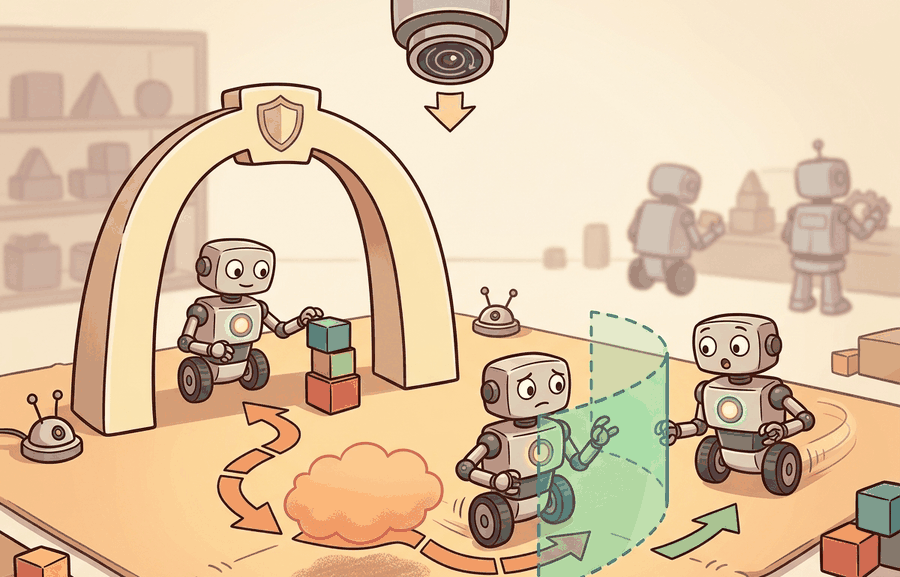
A shielded policy architecture separates nominal competence from intervention authority. The policy proposes an action; the shield checks whether that action is admissible under current state, rules, and monitor status.
Why This Matters
Shielded policies and safety filters sits at the boundary between learning and safety engineering. The question is not whether the policy usually behaves well, but whether dangerous states are detected, blocked, or exited fast enough to protect people, equipment, and mission goals.
A simple safety filter solves $$u_t^{safe} = \arg\min_{u \in \mathcal{U}_{safe}(x_t)} \|u - u_t^{nom}\|^2,$$ which keeps the deployed command close to the nominal proposal while forcing it to remain inside the safe action set.
The shield is not a post-hoc penalty. It is a runtime contract that explicitly decides when the policy’s authority ends.
- Define the nominal action interface and the safe action set in the same coordinates and units.
- Evaluate the nominal command against geometric, probabilistic, or rule-based safety checks.
- Project, replace, or veto the command when it leaves the admissible set.
- Log nominal action, safe action, veto reason, and monitor state together.
- Audit the veto distribution to see whether the underlying policy is learning unsafe tendencies or whether the filter is too conservative.
Worked Example
A language-conditioned mobile manipulator may suggest a long reach through a crowded area. The shield can cap speed, reroute motion primitives, or require confirmation instead of trusting the proposal directly.
nominal = {"vx": 0.8, "vy": 0.0}
limits = {"vx_max": 0.4, "vy_max": 0.2}
safe = {
    "vx": max(min(nominal["vx"], limits["vx_max"]), -limits["vx_max"]),
    "vy": max(min(nominal["vy"], limits["vy_max"]), -limits["vy_max"]),
}
print({"nominal": nominal, "safe": safe, "intervened": nominal != safe})
{'nominal': {'vx': 0.8, 'vy': 0.0}, 'safe': {'vx': 0.4, 'vy': 0.0}, 'intervened': True}Expected output: The shield preserves the command direction but reduces its magnitude to stay within the allowed envelope. The boolean intervention flag is crucial for later audit and policy improvement.
Safety wrappers, controller-side filters, and runtime supervisors provide reusable infrastructure for shield logic. The point of the maintained stack is consistency and auditability, not just shorter code.
Shielded policies need interface-level testing. cvxpy and OSQP implement candidate filters, hazard logs define the blocked actions, ROS 2 lifecycle nodes hold override authority, and replay bags verify that policy outputs, shield inputs, and actuator commands share frames and units.
A good shield produces two kinds of value. First, it prevents immediate unsafe action. Second, it generates a dataset of vetoed proposals that tells you where the nominal policy is systematically misaligned with safe behavior.
The deployment artifact is a shield trace: raw action, filtered action, active constraint, coordinate frame, latency, and post-filter state. That trace catches filters that appear active while acting on stale or mismatched variables.
One major failure mode is to deploy a shield whose safe-action coordinates do not match the policy output coordinates. Unit mismatches and stale transforms can make the filter appear active while still letting unsafe commands through.
Cross-References
This section connects naturally to Section 54.3 on barrier-based corrections and Section 54.5 on override testing.
Wrap a simple nominal controller with a projection filter, then log how often the filter intervenes under nominal and stress-test panels. Decide whether the underlying policy needs retraining or the filter needs redesign.
Do not evaluate shielded systems using only final safe actions. Without the nominal command log, you cannot tell whether the policy itself is becoming safer or whether the shield is doing all the work.
For a drone, a shield may clip velocity near no-fly boundaries. For a manipulator, it may project a pose command into a joint-safe or force-safe subspace. For autonomous driving, it may veto accelerations that violate a rule set.
The frontier includes probabilistic shields, learned safe-set approximations, and filters that reason jointly about intent uncertainty, constraints, and human preferences.
Can you describe one situation where the shield should modify the action and one where it should fully veto it? If not, the intervention policy is still underspecified.
Shielded policies work because they formalize the boundary between nominal intelligence and enforced safety authority.
Design a shield for one embodied action interface. Specify the nominal command, safe set, modification rule, veto rule, and the logs you would save after every intervention.
A shield earns trust when every blocked action leaves an auditable trace.
Section References
Alshiekh, M. et al. "Safe Reinforcement Learning via Shielding." (2018). https://ojs.aaai.org/index.php/AAAI/article/view/11741
A classic shielded-RL reference.
Wabersich, K. P. et al. "Safe Reinforcement Learning Using Probabilistic Shields." (2023). https://arxiv.org/abs/2210.00746
A modern update on shielding strategies under uncertainty.
Section 54.5 shifts from automatic safety intervention to human override paths and the test campaigns that prove they work under pressure.