Safety begins by naming the physical harm path, not by lowering a benchmark score.
A Safety-Critical Controls Researcher
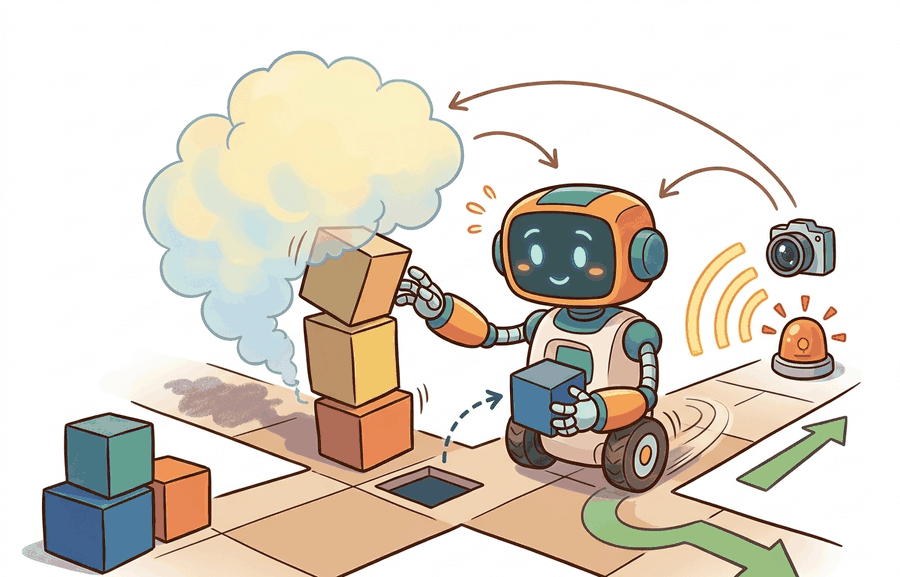
Embodied safety is different because mistakes become forces, impacts, blockages, spills, and near-misses in the physical world. The system must therefore reason about hazard severity and intervention authority, not only task reward.
Why This Matters
Why embodied safety is different (physical harm) sits at the boundary between learning and safety engineering. The question is not whether the policy usually behaves well, but whether dangerous states are detected, blocked, or exited fast enough to protect people, equipment, and mission goals.
A common hazard-ranking surrogate is $$r = S \times E \times C,$$ where $S$ is severity, $E$ is exposure, and $C$ is uncontrollability or low controllability. This does not replace deeper methods like STPA or formal verification, but it disciplines the review.
The same policy error can have trivial consequences in simulation and unacceptable consequences on hardware. Safety analysis therefore starts from harm pathways, not from model internals.
- List hazardous states and actions before choosing mitigation mechanisms.
- Rank each hazard by severity, exposure, and controllability.
- Attach each major hazard to a sensor, monitor, or override path that can detect or interrupt it.
- Define residual risk and restricted operating conditions explicitly.
- Save the hazard log together with rollout evidence and intervention traces.
Worked Example
A service robot instructed to hurry through a corridor can remain task-optimal while becoming unsafe because it now violates human-clearance and stop-distance assumptions.
hazards = [
    {"name": "pinch", "severity": 5, "exposure": 2, "controllability": 2},
    {"name": "blocked_exit", "severity": 4, "exposure": 3, "controllability": 3},
]
for h in hazards:
    h["risk_score"] = h["severity"] * h["exposure"] * h["controllability"]
print(hazards)
[{'name': 'pinch', 'severity': 5, 'exposure': 2, 'controllability': 2, 'risk_score': 20}, {'name': 'blocked_exit', 'severity': 4, 'exposure': 3, 'controllability': 3, 'risk_score': 36}]Expected output: The blocked-exit hazard outranks the pinch hazard under this crude scheme because exposure and controllability are worse. The exact numbers are less important than making the ranking auditable and discussable.
Hazard logs, FMEA tables, and structured ODD cards reduce the temptation to hold safety assumptions only in people’s heads. The maintained tools help because safety work is documentation and coordination as much as computation.
Physical-harm safety starts with a hazard log tied to robot energy, contact geometry, speed, payload, and human proximity. FMEA tables rank severity and detectability, ROS 2 lifecycle nodes enforce intervention authority, and the assurance case links each hazard to a concrete log or replay artifact.
Safety reviews should ask what the robot can do physically, how quickly, around whom, and with which fallback. Those questions often reveal risks long before one reaches policy architecture details.
The useful stack for this section is deliberately mixed: structured hazard review for what can go wrong, runtime monitors for when it is going wrong, and release evidence that names the exact experiment showing the mitigation works on the target platform.
A common failure is to treat safety as a final acceptance test. By then the interfaces, latency budgets, and intervention authority may already be too rigid to fix cheaply.
Cross-References
This section motivates Section 54.2 on constrained learning, Section 54.5 on override testing, and Section 54.7 on assurance arguments.
Write a small hazard log for one embodied task with five hazards, their rankings, detection paths, and residual-risk notes. Then identify which hazards the nominal policy cannot mitigate by itself.
Do not confuse low probability with low consequence. Rare harms can still dominate the release decision when severity and uncontrollability are high.
For a warehouse robot, blocked aisles and blind-corner collisions may outrank many manipulation mistakes because they couple to human traffic and emergency movement.
Current work is trying to connect robot learning more tightly with classic safety engineering, so hazard analysis, runtime monitoring, and learned control share a common evidence language.
Can you name one hazard that comes from the environment and one that comes from the robot’s own action authority? If not, the safety analysis is still too generic.
Embodied safety starts with harm pathways and intervention authority. Model quality matters, but hazards and mitigations define the release gate.
Take one embodied application and write three hazards that would remain even if the policy were more accurate. Then propose the mitigation layer for each.
A robot that scores 99 percent accuracy but has no collision stop, no force limit, and no human override is not a safe robot. It is a very confident one, which is arguably more concerning.
Section References
Koopman, P., and Wagner, M. "Challenges in Autonomous Vehicle Safety." (2017). https://arxiv.org/abs/1705.01284
A useful systems view of safety as more than model accuracy.
UL 4600 overview. https://users.ece.cmu.edu/~koopman/ul4600/index.html
A practical assurance anchor for autonomous-system release arguments.
Section 54.2 now asks how to learn or explore while respecting hard limits instead of treating violations as ordinary data collection.