"Platform choice decides which research questions are real and which ones are just impossible on your hardware."
A Humanoid Lab Procurement Meeting
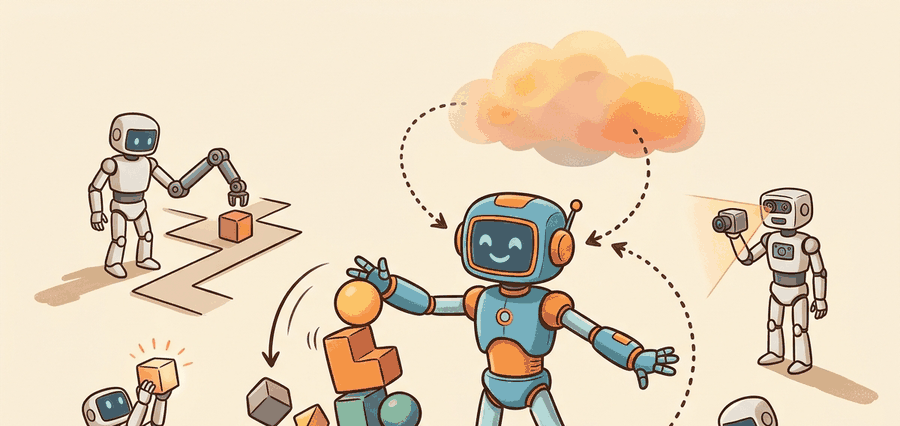
Humanoid platform selection is a stack decision. Joint torque, sensing, hand capability, SDK openness, and teleoperation hooks determine which locomotion, manipulation, and learning claims are even testable.
A useful platform comparison uses a capability vector $p = [n_{\mathrm{dof}}, \tau_{\max}, m_{\mathrm{payload}}, s_{\mathrm{perception}}, h_{\mathrm{dexterity}}, o_{\mathrm{sdk}}]$. The point is not to pretend these numbers collapse neatly into one score. The point is to make the tradeoffs explicit enough that a research program can choose a platform on purpose.
Publicly documented platforms already differ in strategic ways. Unitree G1 emphasizes affordability and force-controlled hands. Unitree H1 is full-sized with stronger legs and richer onboard sensing. Atlas targets industrial mobile manipulation. 1X NEO emphasizes home-facing autonomy and supervised expert mode. Apptronik Apollo targets general-purpose industrial work. Figure couples humanoid hardware to a strong VLA narrative. Tesla Optimus remains comparatively closed in public technical documentation, which matters if your project depends on inspectable interfaces.
A platform is useful to researchers when it exposes enough state, control, and data interfaces to turn failures into artifacts.
Theory
Humanoid platforms should be compared by capability surfaces rather than by single numbers. A body with lower raw torque may still be superior for research if it offers better teleoperation, more stable software, or clearer access to state and control loops.
The platform decision also determines benchmark compatibility. Some whole-body tasks need dexterous hands, wrist cameras, or rich force sensing. Others mainly need robust locomotion and payload handling. Treating all humanoids as interchangeable destroys experimental clarity.
For research, a closed but impressive platform can be the wrong choice if it prevents controller inspection, synchronized logging, or low-level safety instrumentation.
- List the target tasks and the minimum hand, perception, and locomotion requirements.
- Rate each platform on actuation, sensing, dexterity, SDK openness, teleoperation route, and benchmark compatibility.
- Penalize undocumented or closed interfaces if the project depends on controller or state inspection.
- Prototype one critical task in simulation before buying into the full platform stack.
- Keep a platform risk register with spare-part, software, and safety unknowns.
Worked Example
A simple capability table already explains why two humanoid teams with similar goals can rationally choose different hardware.
platforms = {
    "Unitree_G1": {"dexterity": 4, "locomotion": 3, "sdk": 4},
    "Unitree_H1": {"dexterity": 3, "locomotion": 5, "sdk": 4},
    "Atlas": {"dexterity": 4, "locomotion": 5, "sdk": 2},
    "NEO": {"dexterity": 4, "locomotion": 3, "sdk": 3},
}

weights = {"dexterity": 0.4, "locomotion": 0.4, "sdk": 0.2}
scores = {name: round(sum(vals[k] * weights[k] for k in weights), 2) for name, vals in platforms.items()}
print(scores)
print(max(scores, key=scores.get))Expected output interpretation. Under this toy weighting, H1 and Atlas are close because locomotion is priced heavily. If SDK openness were more important, the ranking could flip. This is the exact point of writing the weights down.
Use official platform docs for hardware facts, Isaac Lab or HumanoidBench for simulated task proxies, and low-level dynamics tools such as Pinocchio or Drake to test whether the published body can support your intended controller class.
Practical Recipe
- Write a capability matrix before looking at vendor demo videos.
- Match each task to required locomotion, manipulation, and sensing primitives.
- Price interface openness and logging access explicitly.
- Prototype on simulation and small data flows before full commitment.
- Update the scorecard as public documentation changes.
Do not compare a public open stack to a closed vendor demo as if they expose the same research surface. They do not.
A lab focused on whole-body industrial manipulation may value Atlas-style industrial robustness or Apollo-style deployment framing. A lab focused on reproducible academic learning may prefer a more open and accessible platform such as G1 or H1, even if raw capability is lower.
The best platform is the one that lets your team learn, debug, and publish, not the one with the most cinematic trailer.
The current frontier is converging around reference humanoid stacks that mix vendor hardware, open simulation, and maintained whole-body control frameworks. The opportunity is faster iteration. The risk is inheriting stack assumptions you did not inspect.
Which platform attribute matters more for your project: raw locomotion performance, dexterous hand capability, or inspectable software interfaces, and why?
This section can teach strong research taste. Platform comparisons should include what is unknown. Missing interface documentation, unclear safety APIs, and uncertain teleoperation hooks are all part of the technical evaluation, not procurement trivia.
It is also a good place to emphasize that benchmark fit matters. A platform built for home assistance and one built for industrial tote handling can both be 'general purpose' in marketing language while being very different research instruments.
| Tool or Library | Role in the Topic | Builder Advice |
|---|---|---|
| Official platform pages | Source of documented hardware claims | Prefer official specs over secondary summaries when writing the book. |
| HumanoidBench | Benchmark proxy for platform-task fit | Map each platform to the tasks it can plausibly support. |
| Pinocchio or Drake | Feasibility checks for controller assumptions | Use model-based tools to test whether published morphology supports your plan. |
This section supports whole-body control, teleoperation, and enterprise research tracks.
Build a platform scorecard for three current humanoids and one non-humanoid baseline. Explain how the ranking changes when you switch from a home-assistance task panel to an industrial one.
Platform-selection failures usually come from missing interfaces, not from missing hype. If the controller cannot be instrumented, the benchmark cannot be trusted.
Section References
Unitree G1 official page. https://www.unitree.com/g1
Current official description of G1 hardware and learning framing.
Unitree H1 official page. https://www.unitree.com/h1
Current official description of full-size H1 sensing and torque profile.
Figure Helix official page. https://www.figure.ai/helix
Current official view of Figure's humanoid VLA stack.
1X NEO official page. https://www.1x.tech/neo
Official description of NEO, Redwood AI, and supervised expert mode.
Apptronik Apollo official page. https://apptronik.com/apollo
Official industrial framing for Apollo.
Boston Dynamics Atlas product page. https://bostondynamics.com/products/atlas/
Official industrial framing for electric Atlas.
Platform choice is a research-method choice because it decides which signals, controllers, and safety cases you can actually inspect.
Choose one public humanoid platform for academic research and one for industrial pilot work. Justify each choice with a capability matrix and at least one explicit tradeoff you are accepting.