"Humanoids became interesting when data, hardware cost, and human-shaped environments finally started pointing in the same direction."
A Systems Strategy Memo
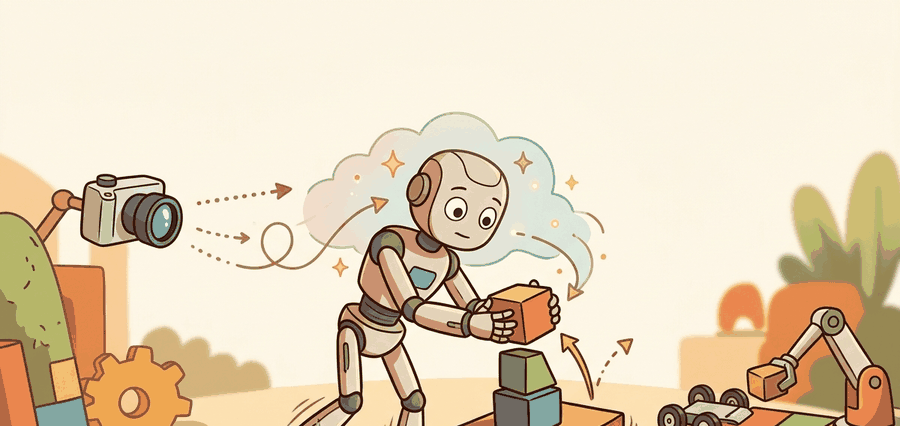
Why humanoids became the focus is a chapter-opening systems argument. The appeal is not a vague dream of human likeness. It is the alignment between morphology, teleoperation data, existing workspaces, and growing whole-body learning stacks.
Humanoids are attractive because the world is already instrumented for the human body. Stairs, shelving, door handles, carts, bins, hand tools, and workstation heights create a large prior in favor of bipedal reach and dual-arm manipulation. That prior reduces environment redesign cost, even if it increases control complexity.
The second driver is data. Teleoperation, motion capture, video-to-motion pipelines, and imitation learning provide richer supervision when the robot body and human body share coarse kinematic affordances. The third driver is hardware economics: actuators, onboard compute, and simulation tools have improved enough that whole-body learning is no longer only a flagship lab exercise.
Humanoids win when reusing human spaces and human data is worth the control and safety complexity they introduce.
Theory
A useful decomposition is task reuse, data reuse, and infrastructure reuse. Task reuse means existing job definitions map naturally to two arms, two legs, and a torso. Data reuse means human demonstrations or videos provide meaningful supervision. Infrastructure reuse means doors, shelves, ladders, tools, and aisles do not need wholesale redesign.
These benefits compete with the floating-base control problem. Humanoids are underactuated, contact-rich, and safety-critical. So the right question is always comparative: does a humanoid solve enough more valuable tasks than a mobile manipulator or fixed arm to justify the added complexity?
Serious programs therefore maintain a task panel that includes what a humanoid can do uniquely, what a cheaper morphology can already do, and what remains unsafe or economically unjustified.
- List the tasks that truly require human-shaped reach, stair access, crouching, or dual-arm whole-body coordination.
- Estimate how much human demonstration data can be transferred to the candidate body.
- Compare workspace modification cost against controller and safety complexity cost.
- Run at least one baseline with a non-humanoid alternative, such as a wheeled manipulator.
- Promote the humanoid choice only if the evidence shows higher useful task coverage under acceptable supervision burden.
Worked Example
A task-coverage ledger is often more revealing than a hardware spec sheet when deciding whether a humanoid body is the right research or deployment choice.
task_panel = {
    "stairs_and_catwalks": {"humanoid": 1, "mobile_manipulator": 0},
    "bin_picking_on_flat_floor": {"humanoid": 1, "mobile_manipulator": 1},
    "door_and_ladder_service": {"humanoid": 1, "mobile_manipulator": 0},
    "fixed_station_assembly": {"humanoid": 1, "mobile_manipulator": 1},
}

coverage = {name: sum(v[name] for v in task_panel.values()) for name in ["humanoid", "mobile_manipulator"]}
print(coverage)
print({"coverage_advantage": coverage["humanoid"] - coverage["mobile_manipulator"]})Expected output interpretation. The ledger says the humanoid wins on task coverage in this panel, but the result is only meaningful if the extra tasks are valuable enough to justify increased control, maintenance, and safety burden.
Use Isaac Lab or HumanoidBench for broad simulated task panels, LeRobot or teleoperation pipelines for data collection, and Drake or Pinocchio when feasibility questions need model-based answers.
Practical Recipe
- Enumerate tasks that truly need stairs, crouching, bimanual whole-body manipulation, or narrow human workspaces.
- Estimate the available human data channel: teleop, video, motion capture, or language-conditioned demonstration.
- Compare against a simpler morphology baseline with the same evaluation panel.
- Record supervision and safety overhead explicitly, not as a hidden cost.
- Treat vendor claims as hypotheses until the task panel is reproduced.
Humanoids are easy to justify rhetorically because human environments are everywhere. They are harder to justify scientifically if the task panel could be handled by a simpler body with lower risk.
An automotive plant with catwalks, narrow stations, and mixed cart manipulation may justify a humanoid. A sterile warehouse with flat floors and standardized bins may favor wheeled mobile manipulators instead.
The humanoid question is not, 'can it walk like us?' It is, 'does walking like us buy enough useful work to pay for itself?'
The frontier mixes foundation models, whole-body control, teleoperation data, and large simulation panels. The strategic open question is not only capability, but where the humanoid economic boundary actually sits relative to simpler robots.
Can you name one environment feature, one data feature, and one economic feature that push a project toward a humanoid body rather than away from it?
This opening section works best when it teaches skepticism as well as excitement. The same body plan that reuses human infrastructure also inherits human-scale safety hazards and underactuated contact complexity.
It is also an opportunity to connect embodied AI to product strategy. In research, the right question is often scientific coverage. In deployment, the right question is cost of useful work under supervision, downtime, and safety constraints.
| Tool or Library | Role in the Topic | Builder Advice |
|---|---|---|
| HumanoidBench | Task-coverage simulation panel | Use it to compare capabilities across locomotion and manipulation settings. |
| LeRobot and teleop pipelines | Human demonstration data path | Record whether the body can actually absorb the available supervision. |
| Drake or Pinocchio | Feasibility checks for full-body tasks | Use model-based checks before assuming the body can execute the task safely. |
This section ties to teleoperation and data collection, robot foundation models, and locomotion and mobility.
Build a task panel comparing a humanoid and a mobile manipulator on at least six tasks. Score useful coverage, intervention burden, and workspace modification cost.
If the humanoid case collapses, ask whether the failure came from overvaluing human-shaped tasks, underestimating safety complexity, or ignoring a simpler competing morphology.
Section References
Boston Dynamics Atlas product page. https://bostondynamics.com/products/atlas/
Official product framing for industrial humanoid deployment.
HumanoidBench official site. https://humanoid-bench.github.io/
Primary benchmark reference for whole-body humanoid task evaluation.
NVIDIA Isaac GR00T reference humanoid announcement, June 2026. https://investor.nvidia.com/news/press-release-details/2026/NVIDIA-Announces-NVIDIA-Isaac-GR00T-Reference-Humanoid-Robot-for-Academic-Research/default.aspx
Current signal that vendor stacks are converging on research-focused whole-body humanoid platforms.
Humanoids became central because morphology, data, and software started reinforcing each other, not because human shape is automatically optimal.
Write a one-page decision memo that argues for or against a humanoid body in one deployment domain. Include the competing non-humanoid baseline and the exact task panel you would use to settle the argument.