"More fingers buy options, not free competence."
A Whole-Hand Design Review
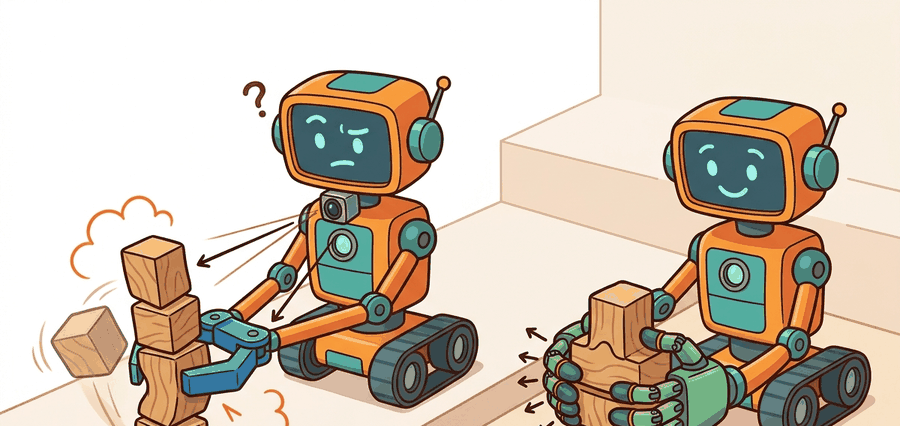
The choice between parallel-jaw grippers and multi-finger hands is not philosophical. It is an engineering tradeoff across contact geometry, control complexity, sensing, speed, reliability, and recovery.
This section contrasts parallel-jaw grippers with multi-finger hands in terms of grasp representation, reachable contact set, force control, in-hand manipulation capacity, and operational reliability.
It clarifies why many production cells still prefer simple grippers while dexterous research platforms invest in richer hands and tactile feedback.
A multi-finger hand increases the space of possible contacts, but it also increases the estimation, calibration, and control burden. Dexterity is purchased with systems complexity.
Theory
Parallel-jaw grippers simplify contact reasoning by constraining the grasp family, which makes perception and planning cheaper. Multi-finger hands expand the contact manifold and can support in-hand manipulation, but they raise the dimension of the control and sensing problem dramatically.
The right comparison therefore is not human likeness. It is task match: object diversity, required reorientation, tolerance to uncertainty, and acceptable system complexity.
$$ \mathrm{rank}(G) \uparrow \Rightarrow \text{richer wrench control},\qquad \dim(a_{\text{hand}}) \gg \dim(a_{\text{parallel-jaw}}),\qquad \text{system cost} \propto \text{sensing} + \text{calibration} + \text{control} $$
The designer picks an end effector whose contact family matches the task envelope, then builds perception, control, and recovery around that choice. The log should make end-effector constraints visible, because many downstream failures are really hardware-design mismatches.
- List the object set, required reorientations, and disturbance environment before choosing the hand.
- Match the hand to the minimum contact family that supports the task reliably.
- Quantify the added sensing and controller burden if moving from parallel-jaw to multi-finger.
- Benchmark hardware choices on the same object panel and recovery conditions, not on different demos.
Worked Example
# Choose an end effector from task complexity and reorientation demand.
task = {"object_diversity": 0.8, "reorientation_needed": True, "throughput_priority": 0.4}

score_hand = 0.6 * task["object_diversity"] + 0.8 * float(task["reorientation_needed"])
score_parallel = 0.9 * task["throughput_priority"] + 0.3 * (1.0 - task["object_diversity"])

choice = "multi_finger_hand" if score_hand > score_parallel else "parallel_jaw"
print({"parallel_jaw_score": round(score_parallel, 2), "multi_finger_score": round(score_hand, 2), "choice": choice})Expected output: The expected result chooses the multi-finger hand because reorientation is required and object diversity is high. In a high-throughput structured cell, the same heuristic would often flip back to a simple gripper.
MoveIt can support both hardware classes at the planning level, but the sensing and control stacks diverge quickly. Parallel-jaw workflows often pair well with Dex-Net style scoring, while multi-finger hands usually demand tactile and contact-rich policy loops.
Practical Recipe
- Write the task envelope before discussing hand morphology.
- Benchmark at least one structured and one adversarial object set.
- Account for calibration, maintenance, and controller tuning time as real system cost.
- Measure reorientation success separately from first-contact grasp success.
- Prefer the simpler hand unless the task truly needs the extra contact modes.
Teams often underestimate the software tax of multi-finger hands. The fingers are not just more actuators. They are more contacts, more failure modes, and more state that has to be sensed and controlled.
In warehouse picking, a parallel-jaw gripper often wins on throughput and reliability. In electronics assembly or in-hand tool reorientation, the multi-finger hand may justify its complexity.
A five-finger hand can absolutely outperform a two-finger gripper, right after it finishes asking for better calibration, better tactile sensing, and several more weeks of control tuning.
Recent dexterous hands combine tactile skins, richer proprioception, and learned controllers. The central deployment question is still where that extra complexity pays back in task breadth or recovery power.
Could you explain the exact task that requires more fingers, or are you using dexterity as a synonym for ambition?
This section is useful pedagogically because it forces students to see embodiment as a design variable. The policy and dataset questions only make sense after the hardware contact family has been chosen.
It is also where whole-system cost becomes concrete. More contact richness can mean fewer task-specific fixtures and more general behavior, but it also means more sensing, more calibration drift, and a larger action space to learn or control.
| Tool or Library | Role in the Topic | Builder Advice |
|---|---|---|
| Parallel-jaw grippers | High-throughput stable grasps | Best when tasks are structured and reorientation demands are low. |
| Multi-finger hands | Rich contact and in-hand control | Best when reorientation, tool use, or delicate contact are central. |
| Tactile sensors | Contact observability | Almost mandatory for making the extra fingers pay off in real tasks. |
Create a decision table for three application scenarios and justify whether each should use a parallel-jaw gripper or a multi-finger hand, including recovery and maintenance costs.
If the hand repeatedly fails in the same way, ask whether the failure is controller weakness or embodiment mismatch. The latter is more common than teams like to admit.
Section References
Reference for grasping, hand kinematics, and wrench-space intuition.
Useful as a strong reference lineage for parallel-jaw grasping workflows.
Open tactile-processing library relevant once the hand design demands richer contact sensing.
Hand choice is a task-envelope decision shaped by contact needs, not a generic race toward higher finger count.
Pick one application where a multi-finger hand is truly justified and one where it is not. Support both choices with contact and recovery arguments.