"A grasp is a hypothesis about future contact stability."
A Reliable Bin-Picking Team
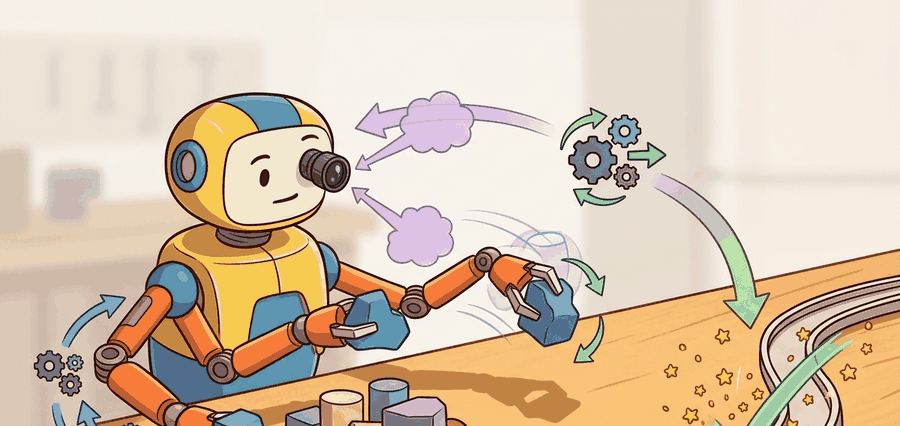
Grasp synthesis asks which contacts should be made, not only where the gripper should move. Analytic and learned methods differ in how they estimate grasp robustness, but both must answer the same contact question.
This section introduces antipodal and force-closure grasp reasoning, then shows how the Dex-Net and GQ-CNN lineage turns those ideas into large synthetic datasets and learned grasp scoring from depth images or point clouds.
It links contact mechanics to modern data-driven grasping. The bridge matters because learned grasp scores are only meaningful if the contact quality concept underneath them stays legible.
A grasp score is useful when it predicts whether the object will survive lift, transport, and small disturbances, not when it merely favors visually centered contact patches.
Theory
Analytic grasping starts from contact geometry and wrench closure. Learned grasping often starts from images or point clouds and predicts a proxy for that robustness. The methods differ, but the latent question is the same: does this contact set resist expected disturbances?
Dex-Net made this bridge concrete by generating massive synthetic grasp datasets labeled with analytic robustness metrics, then training networks such as GQ-CNN to predict grasp quality efficiently at runtime.
$$ \epsilon(g) = \max \{\epsilon : B_\epsilon \subseteq \mathrm{conv}(W(g))\},\qquad g^\star = \arg\max_g \hat Q_\theta(g, I)\,\mathbf{1}[\text{reachable}(g)] $$
The stack estimates object geometry from depth or point clouds, samples candidate grasps, scores them with an analytic metric or learned predictor, filters them through robot constraints, and verifies success with lift and disturbance tests.
- Sample candidate grasps in image or object space and convert them into robot-frame contacts.
- Score each candidate with a robustness proxy such as epsilon quality or a learned GQ-CNN output.
- Reject grasps that are unreachable, collision-prone, or incompatible with downstream placement.
- Validate the selected grasp on hardware with lift and mild disturbance checks, not only closure success.
Worked Example
# Rank parallel-jaw grasps by learned score and reachability.
grasps = [
    {"id": "g1", "gqcnn": 0.88, "reachable": True},
    {"id": "g2", "gqcnn": 0.94, "reachable": False},
    {"id": "g3", "gqcnn": 0.81, "reachable": True},
]

ranked = []
for g in grasps:
    robust = round(g["gqcnn"] * float(g["reachable"]), 2)
    ranked.append((g["id"], robust))

ranked.sort(key=lambda row: row[1], reverse=True)
print(ranked)Expected output: The expected ranking demotes the unreachable high-score grasp to the bottom. In real cells, many grasping failures are exactly this mismatch between image-space confidence and robot-space feasibility.
The Dex-Net project and GQ-CNN package provide a mature reference lineage for synthetic grasp datasets and learned scoring. They help most when paired with modern motion planners and explicit lift verifiers.
Practical Recipe
- Choose a grasp representation that matches the hand: parallel-jaw contacts, suction poses, or multi-finger contacts.
- Keep analytic and learned scores in the same evaluation table on the same object panel.
- Filter by reachability and collision before spending time on refined ranking.
- After grasp closure, verify lift robustness with small disturbances or short transport motions.
- Save depth crop, chosen grasp pose, score, and lift outcome together in one artifact.
A grasp that closes cleanly is not necessarily a stable grasp. Closure without disturbance testing often overestimates quality badly, especially for thin, shiny, or partial-view objects.
Bin-picking systems in logistics still rely heavily on parallel-jaw grasp synthesis because the object flow is large and the best engineering return often comes from better scoring and filtering rather than more fingers.
A perfectly centered grasp on a slippery shampoo bottle can still become an expensive lesson in rigid-body optimism.
The current frontier mixes synthetic supervision, richer point-cloud encoders, tactile feedback, and downstream task-aware grasp scoring. The stable idea underneath is still robust contact selection under disturbance.
Do you know what disturbance model your grasp score is trying to resist, or is the score just a number with good marketing?
One of the best didactic uses of Dex-Net is that it makes contact mechanics visible to machine learning students and dataset scale visible to classical robotics students. The bridge runs both ways.
This section also clarifies why grasp synthesis never stands alone. A grasp score that ignores reachability, placement, or sensor uncertainty is not wrong in theory, but it is incomplete in a real manipulation system.
| Tool or Library | Role in the Topic | Builder Advice |
|---|---|---|
| Dex-Net | Synthetic grasp dataset generation | Use it to connect analytic robustness labels to scalable supervised training. |
| GQ-CNN | Runtime grasp scoring | Useful for fast grasp ranking from depth imagery. |
| MoveIt 2 | Embodiment feasibility | Use it to filter learned or analytic grasps through reachability and collision checks. |
Evaluate grasp proposals on a small object set using both a simple analytic metric and a learned score. Compare the top candidate after reachability filtering.
When a chosen grasp fails, separate contact quality from perception quality and embodiment feasibility. Those three causes tend to require different fixes and different data.
Section References
Canonical project page for synthetic grasp datasets and robust-grasp planning.
Official package documentation for learned grasp scoring in the Dex-Net lineage.
Useful for reachability, collision checking, and execution after grasp ranking.
Grasp synthesis succeeds when contact robustness, embodiment feasibility, and lift verification stay in the same loop.
Define one disturbance model for a grasp benchmark and explain how your scoring method, analytic or learned, is supposed to predict resistance to it.