Generate the whole future as one object, then bend it toward high reward with a guidance gradient; the plan and the optimizer become the same forward pass.
A Trajectory-Level Planner
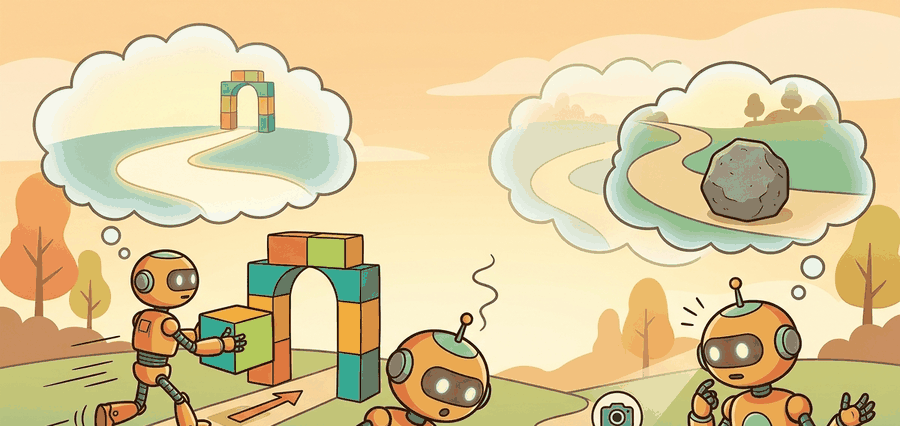
Generating Scenes And Synthetic Experience matters because embodied intelligence is a closed loop. The agent must sense, represent, predict, decide, act, observe the consequence, and revise its belief before the next action.
Planning with generative models reframes the planner as a sampler. Diffuser (Janner et al., 2022) generates a full trajectory at once by diffusion, then steers that generation toward high reward with classifier guidance, so the act of planning and the act of optimizing collapse into the same denoising forward pass. Decision Diffuser instead conditions on a desired return-to-go for offline reinforcement learning, sampling trajectories that the dataset suggests will achieve that return. The same generative machinery also produces candidate futures and synthetic scenes that planners and learners can consume.
The catch is shared across all of these uses: generated trajectories and scenes help only when they stay near the real control regime, and the guidance that makes them high-reward can also pull them off the data manifold. The right framing is generation as a proposal engine whose proposals must survive a feasibility check, whether the proposal is a planned trajectory or a synthetic training scene.
A model earns its place only when it improves action. In Generating Scenes And Synthetic Experience, the reader should keep asking which decision changes, which uncertainty is exposed, and which failure mode becomes easier to diagnose.
Theory
Diffuser denoises an entire trajectory $\tau$ and biases sampling toward high reward using classifier (or classifier-free) guidance. At each reverse step the unconditional noise prediction is combined with a conditional one to form a guided estimate
$$ \tilde\epsilon_\theta = (1+w)\,\epsilon_\theta(\tau_t, t, c) - w\,\epsilon_\theta(\tau_t, t), $$
where $c$ is the conditioning (a goal or a high-return signal) and $w$ is the guidance weight. With $w=0$ the sample is unconditional; larger $w$ pushes harder toward the conditioned objective. The trade-off is direct: strong guidance shapes more goal-directed plans but can drag samples off the data manifold into dynamically infeasible trajectories, which is why a feasibility filter still sits downstream. Decision Diffuser uses this same conditioning mechanism with the return-to-go as $c$, turning offline reinforcement learning into conditional trajectory generation.
A practical cost note frames the rest of the chapter: generative planning pays 20 to 50 denoising steps at inference for every plan, against a single forward pass for a deterministic policy. That latency is the price of multimodality and guidance, and it is exactly what the speedup work in Section 41.5 attacks.
When generated trajectories are reused as training data, a dataset mixes real trajectories $\mathcal{D}_r$ with generated ones $\mathcal{D}_g$ under a weight $\alpha$, $\mathcal{L}(\theta)=\mathbb{E}_{\mathcal{D}_r}[\ell_\theta] + \alpha\,\mathbb{E}_{\mathcal{D}_g}[\ell_\theta]$. The hard part is not the mixture; it is ensuring $\mathcal{D}_g$ adds coverage near task-relevant but underrepresented states rather than injecting trajectories that violate real embodiment dynamics.
Classifier-free guidance trains one network to produce both conditional and unconditional noise predictions (by randomly dropping the condition during training), then combines them at sampling time with weight $w$. No separate classifier is needed, and $w$ becomes a single inference-time dial that trades goal adherence against on-manifold realism.
Worked Example
The probe below shows classifier-(free)-guidance trajectory planning and the guidance-weight trade-off Diffuser depends on. From the same noisy start it runs a guided denoising loop at three values of $w$, combining a conditional denoiser (pulls the endpoint to the goal) with an unconditional one (pulls toward an on-manifold prior). We report the endpoint, its distance to the goal, and whether it stays inside a feasible reach radius.
# Guided trajectory denoising (Diffuser-style).
# eps_tilde = (1 + w) eps_cond - w eps_uncond ; w trades goal-pull vs on-manifold pull.
import numpy as np

H = 5
goal = np.array([1.0, 0.0])
feasible_radius = 1.15           # endpoints beyond this are dynamically infeasible

def eps_uncond(tau):             # stand-in: pull toward a smooth on-manifold prior
    prior = np.stack([np.linspace(0.0, 0.6, H), np.zeros(H)], axis=1)
    return tau - prior

def eps_cond(tau, c):            # stand-in: pull the trajectory toward the goal c
    target = np.stack([np.linspace(0.0, c[0], H), np.linspace(0.0, c[1], H)], axis=1)
    return tau - target

for w in [0.0, 1.0, 4.0]:
    rng = np.random.default_rng(4)        # same start for every w
    tau = rng.normal(size=(H, 2)) * 0.3
    for _ in range(8):                     # guided reverse steps
        eps_tilde = (1 + w) * eps_cond(tau, goal) - w * eps_uncond(tau)
        tau = tau - 0.2 * eps_tilde
    endpoint = tau[-1]
    dist = float(np.linalg.norm(endpoint - goal))
    feasible = float(np.linalg.norm(endpoint)) <= feasible_radius
    print(f"w={w:>3}: endpoint={endpoint.round(3).tolist()} "
          f"dist_to_goal={dist:.3f} feasible={feasible}")
w=0.0: endpoint=[0.751, 0.012] dist_to_goal=0.249 feasible=True
w=1.0: endpoint=[1.084, 0.012] dist_to_goal=0.085 feasible=True
w=4.0: endpoint=[2.083, 0.012] dist_to_goal=1.083 feasible=FalseThe three rows are the whole story of guidance. At $w=0$ the plan stays comfortably feasible but stops short of the goal; at $w=1$ it reaches the goal and is still feasible; at $w=4$ it overshoots far past the feasible reach radius. This is why Diffuser pairs guidance with a feasibility check: turning $w$ up makes plans more goal-directed right up to the point where they leave the manifold of trajectories the robot can actually execute. Decision Diffuser swaps the goal condition for a return-to-go target, but the same dial and the same risk apply.
For Generating scenes and synthetic experience, the hand-built probe exposes the planning assumption; Diffuser-style or Decision-Diffuser-style tooling should preserve the same logging and evaluation fields.
Practical Recipe
- Write the observation, action, horizon, and success metric before choosing a model.
- Build a baseline that is simple enough to debug by inspection.
- Add the maintained implementation only after the baseline behavior is understood.
- Save one artifact containing configuration, seed panel, traces, metrics, and failure labels.
- Run at least one perturbation test before trusting the result.
For Generating scenes and synthetic experience, evaluate the generated or predicted object through the closed loop that consumes it, because interface failures often dominate component scores.
A home-robot team has very few real examples of dropped utensils sliding under furniture. They generate physically plausible scenes and replay trajectories around those failures, then use the synthetic set only to train a retrieval head and recovery policy proposal model. The synthetic data is valuable because it covers a rare corner of the task, not because it replaces the real distribution.
Synthetic experience is useful fertilizer, not a substitute for the plant.
The active frontier is selective synthetic data generation: produce scenes or episodes exactly where real coverage is sparse, then validate them with learned realism filters, simulator checks, and held-out transfer panels. That is much more defensible than dumping huge volumes of synthetic rollouts into the training mix.
For Generating scenes and synthetic experience, connect diffusion-policy tooling, MPC baselines, and safety constraints by recording the planner input, sampled plan, feasibility check, and executed action.
Can you state the observation, state estimate, action, prediction horizon, success metric, and most likely failure mode for Generating scenes and synthetic experience? If not, the system boundary is still too vague.
The most reliable pattern is to use generation as a data proposal engine and keep a conservative verifier downstream. Scene generators propose clutter, lighting, camera poses, or long-horizon futures; simulators, geometric filters, and held-out hardware tests decide whether those proposals are worth learning from.
For teaching and production alike, insist on one artifact that records real-sample count, synthetic-sample count, weighting, realism checks, and transfer outcome. Without that bookkeeping, synthetic data stories are nearly impossible to audit.
| Tool or Library | Role in This Topic | Builder Advice |
|---|---|---|
| Diffuser | Supports trajectory denoising, conditional planning, synthetic experience, and generated-action risk control. | Use it after the from-scratch probe states the same observation, action, metric, and failure tag. |
| Decision Diffuser | Supports trajectory denoising, conditional planning, synthetic experience, and generated-action risk control. | Use it after the from-scratch probe states the same observation, action, metric, and failure tag. |
| Diffusion Policy | Supports trajectory denoising, conditional planning, synthetic experience, and generated-action risk control. | Use it after the from-scratch probe states the same observation, action, metric, and failure tag. |
| PyTorch | Supports trajectory denoising, conditional planning, synthetic experience, and generated-action risk control. | Use it after the from-scratch probe states the same observation, action, metric, and failure tag. |
| Gymnasium | Supports trajectory denoising, conditional planning, synthetic experience, and generated-action risk control. | Use it after the from-scratch probe states the same observation, action, metric, and failure tag. |
For Generating scenes and synthetic experience, keep one inspectable probe for the model assumption, then use maintained libraries without changing the artifact schema used for baseline comparison.
- Write the observation, action, state estimate, success metric, and rejection criterion.
- Run a deterministic smoke test on one seed and save the complete configuration.
- Add one perturbation tied to the section topic: delay, noise, horizon length, contact change, distractor object, or generated-scene shift.
- Compare only methods evaluated by the same script, split, seed panel, and metric definition.
- Record a postmortem that assigns failures to perception, representation, dynamics, planning, control, data coverage, timing, or evaluation.
When Generating scenes and synthetic experience fails, do not collapse the result into a single method verdict. Assign the failure to the interface that broke, rerun one controlled perturbation, and keep the trace next to the metric. That habit turns a disappointing rollout into a reusable diagnostic asset.
Generating Scenes And Synthetic Experience is useful when it improves a measured closed-loop decision, exposes its uncertainty, and leaves behind an artifact that another reader can replay.
Design a minimal experiment for Generating scenes and synthetic experience. Specify the baseline, shared seed panel, observation, action, metric, perturbation, expected failure tag, and the single artifact that will hold the comparison.
Bibliography & Further Reading
Primary References And Tools
Janner, M. et al.. "Planning with Diffusion for Flexible Behavior Synthesis." (2022). https://arxiv.org/abs/2205.09991
Diffuser is the core trajectory-denoising reference for planning. It shows how sampling and conditioning can replace a hand-designed optimizer in some offline decision problems.
Ajay, A. et al.. "Is Conditional Generative Modeling All You Need for Decision Making." (2022). https://arxiv.org/abs/2211.15657
Decision Diffuser frames decision making as conditional generation. It is useful for comparing return conditioning, goal conditioning, and trajectory feasibility.
Chi, C. et al.. "Diffusion Policy: Visuomotor Policy Learning via Action Diffusion." (2023). https://arxiv.org/abs/2303.04137
Diffusion Policy is the practical robotics anchor for action diffusion. It helps readers connect planning-style denoising with continuous robot control from visual observations.
Huang, Z. et al.. "DiffuserLite: Towards Real-Time Diffusion Planning." (2024). https://arxiv.org/abs/2401.15443
DiffuserLite focuses on planning frequency and sample efficiency. It is relevant whenever a diffusion planner must fit into a real control loop rather than an offline demonstration.
Yang, R. et al.. "What Makes a Good Diffusion Planner for Decision Making." (2025). https://arxiv.org/abs/2503.00535
This large empirical study examines design choices in diffusion planning. It is a useful guardrail against treating denoising as a universal planner without checking architecture, guidance, and evaluation details.