Stop learning to reverse a thousand noising steps; learn the straight-line velocity that carries noise to an action in one smooth flow.
A Flow-Matching Action Expert
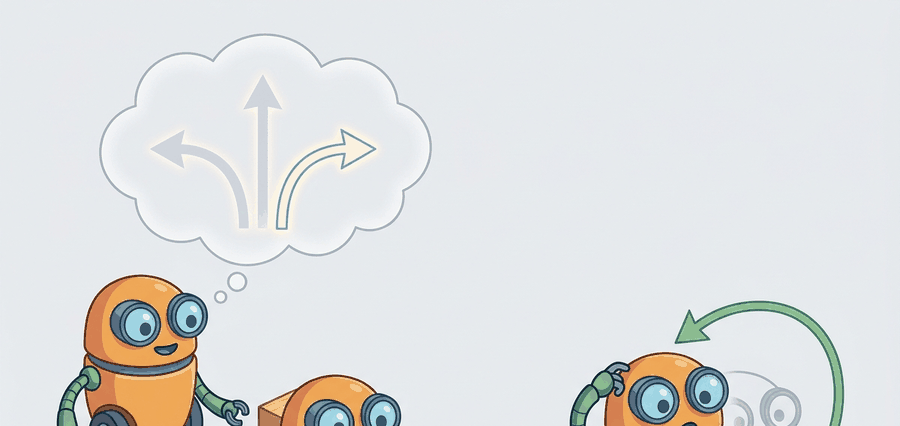
Generative Trajectory Planning And Scoring matters because embodied intelligence is a closed loop. The agent must sense, represent, predict, decide, act, observe the consequence, and revise its belief before the next action.
Diffusion learns to reverse a noising process step by step. Flow matching learns something simpler and often faster: a velocity field that transports a noise sample to a data sample along a smooth path, sampled by integrating an ordinary differential equation (ODE). For action generation this matters because the ODE can be integrated in a handful of steps, and the training target is a clean regression on velocity rather than on noise across a long schedule.
This section connects flow matching for action generation to the scoring problem that any generative planner must still solve. A flow-matching expert proposes actions cheaply; receding-horizon execution then scores and filters those proposals at every observation refresh rather than once at episode start.
A model earns its place only when it improves action. In Generative Trajectory Planning And Scoring, the reader should keep asking which decision changes, which uncertainty is exposed, and which failure mode becomes easier to diagnose.
Theory
Flow matching defines a time-indexed path $x_t$ for $t\in[0,1]$ that starts at a noise sample $x_0\sim\mathcal{N}(0,I)$ and ends at a data sample $x_1$ (an action or action chunk). A learned velocity field $v(x_t, t, c)$ generates the sample by integrating the ODE
$$ dx_t = v(x_t, t, c)\,dt, $$
from $t=0$ (noise) to $t=1$ (action), conditioned on context $c$. Conditional Flow Matching chooses the simplest possible path: a straight line between a paired noise sample and data sample, $x_t = (1-t)\,x_0 + t\,x_1$. Differentiating gives a constant target velocity $x_1 - x_0$, so the training objective is the regression
$$ \mathcal{L}_{\text{CFM}} = \mathbb{E}_{t, x_0, x_1}\left[\left\lVert v_\theta(x_t, t, c) - (x_1 - x_0)\right\rVert^2\right]. $$
This is markedly simpler than DDPM training: no noise schedule to tune, no variance terms, and straight-line paths that integrate accurately in few Euler steps. Once an expert proposes actions this cheaply, the planner still faces the scoring problem. For $k$ candidate trajectories a practical scoring rule is $S(\tau^{(k)}) = \lambda_r R - \lambda_c C - \lambda_d D - \lambda_\ell L$, combining task reward $R$, collision or constraint penalty $C$, dynamics mismatch $D$, and latency or effort $L$; the planner keeps the highest-scoring candidate that also passes a hard feasibility filter.
At inference, draw $x_0$ from a Gaussian, then take a few Euler steps $x \mathrel{+}= v_\theta(x, t, c)\,\Delta t$ from $t=0$ to $t=1$. Because the trained path is nearly straight, even 4 to 10 steps land close to a valid action, which is why flow-matching action experts can hit higher control rates than long DDPM chains.
Worked Example
The probe below shows a flow-matching forward pass and a few-step ODE integration. We interpolate linearly between a noise sample $x_0$ and a target action $x_1$, read off the constant target velocity $x_1 - x_0$, then integrate the ODE from noise to action with a handful of Euler steps. In a trained system the constant velocity is replaced by the learned field $v_\theta(x_t, t, c)$, but the path geometry and the integration loop are identical.
# Conditional flow matching: straight-line path from noise to action.
# x_t = (1 - t) x0 + t x1 ;  target velocity v = x1 - x0  (constant along the line).
import numpy as np

rng = np.random.default_rng(2)
x1 = np.array([1.0, 0.0])               # target action (data sample)
x0 = rng.normal(size=2)                 # noise sample

print("forward path and target velocity:")
for t in np.linspace(0.0, 1.0, 6):
    x_t = (1.0 - t) * x0 + t * x1       # point on the path at time t
    v = x1 - x0                         # CFM regression target
    print(f"  t={t:.1f}  x_t={x_t.round(3).tolist()}  v={v.round(3).tolist()}")

# Inference: integrate dx = v dt from t=0 (noise) to t=1 (action) with Euler steps.
x = x0.copy()
dt = 0.2
for _ in range(5):
    v_theta = x1 - x0                   # a trained v_theta(x, t, c) would go here
    x = x + v_theta * dt
print("integrated endpoint:", x.round(3).tolist(), " target:", x1.tolist())
forward path and target velocity:
t=0.0 x_t=[0.189, -0.523] v=[0.811, 0.523]
t=0.2 x_t=[0.351, -0.418] v=[0.811, 0.523]
t=0.4 x_t=[0.513, -0.314] v=[0.811, 0.523]
t=0.6 x_t=[0.676, -0.209] v=[0.811, 0.523]
t=0.8 x_t=[0.838, -0.105] v=[0.811, 0.523]
t=1.0 x_t=[1.0, 0.0] v=[0.811, 0.523]
integrated endpoint: [1.0, -0.0] target: [1.0, 0.0]The velocity is constant along the straight path, which is the whole appeal: the network only has to regress a stable target, and five Euler steps reach the action exactly. Replace the constant velocity with $v_\theta(x_t, t, c)$ and the same loop becomes a real action sampler. The proposed action still enters the scoring stack, so raw proximity to a target is never the final word: an embodied planner only commits once feasibility and effort penalties agree.
For Generative trajectory planning and scoring, the hand-built probe exposes the planning assumption; Diffuser-style or Decision-Diffuser-style tooling should preserve the same logging and evaluation fields.
Practical Recipe
- Write the observation, action, horizon, and success metric before choosing a model.
- Build a baseline that is simple enough to debug by inspection.
- Add the maintained implementation only after the baseline behavior is understood.
- Save one artifact containing configuration, seed panel, traces, metrics, and failure labels.
- Run at least one perturbation test before trusting the result.
For Generative trajectory planning and scoring, evaluate the generated or predicted object through the closed loop that consumes it, because interface failures often dominate component scores.
A mobile manipulator navigating a tight aisle samples trajectories that all reach the target shelf. The decisive difference is scoring: some plans arrive with poor final orientation, some violate forklift-clearance margins, and some demand steering curvature the base cannot track. Generative planning only becomes useful once those penalties are part of the scoring stack, not added after the fact.
Sampling proposes the future, scoring negotiates with reality.
Black et al., "pi_0: A Vision-Language-Action Flow Model for General Robot Control" (2024). pi_0 pairs a vision-language model (VLM) backbone with a flow-matching action expert, so high-level perception and instruction-following come from the VLM while continuous actions are generated by integrating a learned velocity field. A single model is trained across many manipulation embodiments and tasks, then fine-tuned to specific robots. The design point worth absorbing: flow matching is the action decoder that makes high-rate continuous control compatible with a large pretrained semantic backbone, because few-step ODE integration is cheap enough to run in the control loop.
The frontier is moving toward action experts that combine flow-matching speed with explicit search, differentiable collision penalties, and learned value guidance, all behind a shared semantic backbone. The hard part is keeping guidance strong enough to shape good plans without collapsing the generator into one brittle mode, and keeping integration step counts low enough for real-time control.
For Generative trajectory planning and scoring, connect diffusion-policy tooling, MPC baselines, and safety constraints by recording the planner input, sampled plan, feasibility check, and executed action.
Can you state the observation, state estimate, action, prediction horizon, success metric, and most likely failure mode for Generative trajectory planning and scoring? If not, the system boundary is still too vague.
The right mental model is proposal plus filter. Let the generator provide diversity, then use fast learned scorers and hard geometric checks to remove plans that are dynamically or spatially impossible. This usually beats asking the diffusion model alone to internalize every safety rule.
That is also the cleanest teaching pattern. Students can inspect the sampled plans, the scorer output, and the feasibility filter separately, which makes failure attribution far less mysterious than treating the planner as a single opaque block.
| Tool or Library | Role in This Topic | Builder Advice |
|---|---|---|
| Diffuser | Supports trajectory denoising, conditional planning, synthetic experience, and generated-action risk control. | Use it after the from-scratch probe states the same observation, action, metric, and failure tag. |
| Decision Diffuser | Supports trajectory denoising, conditional planning, synthetic experience, and generated-action risk control. | Use it after the from-scratch probe states the same observation, action, metric, and failure tag. |
| Diffusion Policy | Supports trajectory denoising, conditional planning, synthetic experience, and generated-action risk control. | Use it after the from-scratch probe states the same observation, action, metric, and failure tag. |
| PyTorch | Supports trajectory denoising, conditional planning, synthetic experience, and generated-action risk control. | Use it after the from-scratch probe states the same observation, action, metric, and failure tag. |
| Gymnasium | Supports trajectory denoising, conditional planning, synthetic experience, and generated-action risk control. | Use it after the from-scratch probe states the same observation, action, metric, and failure tag. |
For Generative trajectory planning and scoring, keep one inspectable probe for the model assumption, then use maintained libraries without changing the artifact schema used for baseline comparison.
- Write the observation, action, state estimate, success metric, and rejection criterion.
- Run a deterministic smoke test on one seed and save the complete configuration.
- Add one perturbation tied to the section topic: delay, noise, horizon length, contact change, distractor object, or generated-scene shift.
- Compare only methods evaluated by the same script, split, seed panel, and metric definition.
- Record a postmortem that assigns failures to perception, representation, dynamics, planning, control, data coverage, timing, or evaluation.
When Generative trajectory planning and scoring fails, do not collapse the result into a single method verdict. Assign the failure to the interface that broke, rerun one controlled perturbation, and keep the trace next to the metric. That habit turns a disappointing rollout into a reusable diagnostic asset.
Generative Trajectory Planning And Scoring is useful when it improves a measured closed-loop decision, exposes its uncertainty, and leaves behind an artifact that another reader can replay.
Design a minimal experiment for Generative trajectory planning and scoring. Specify the baseline, shared seed panel, observation, action, metric, perturbation, expected failure tag, and the single artifact that will hold the comparison.
Bibliography & Further Reading
Primary References And Tools
Janner, M. et al.. "Planning with Diffusion for Flexible Behavior Synthesis." (2022). https://arxiv.org/abs/2205.09991
Diffuser is the core trajectory-denoising reference for planning. It shows how sampling and conditioning can replace a hand-designed optimizer in some offline decision problems.
Ajay, A. et al.. "Is Conditional Generative Modeling All You Need for Decision Making." (2022). https://arxiv.org/abs/2211.15657
Decision Diffuser frames decision making as conditional generation. It is useful for comparing return conditioning, goal conditioning, and trajectory feasibility.
Chi, C. et al.. "Diffusion Policy: Visuomotor Policy Learning via Action Diffusion." (2023). https://arxiv.org/abs/2303.04137
Diffusion Policy is the practical robotics anchor for action diffusion. It helps readers connect planning-style denoising with continuous robot control from visual observations.
Lipman, Y. et al.. "Flow Matching for Generative Modeling." (2022). https://arxiv.org/abs/2210.02747
Introduces conditional flow matching and straight-line probability paths. It is the methodological basis for treating action generation as ODE integration of a learned velocity field.
Black, K. et al.. "pi_0: A Vision-Language-Action Flow Model for General Robot Control." (2024). https://arxiv.org/abs/2410.24164
pi_0 combines a VLM backbone with a flow-matching action expert across manipulation embodiments. It is the anchor for flow-matching action generation at the scale of general-purpose robot control.
Huang, Z. et al.. "DiffuserLite: Towards Real-Time Diffusion Planning." (2024). https://arxiv.org/abs/2401.15443
DiffuserLite focuses on planning frequency and sample efficiency. It is relevant whenever a diffusion planner must fit into a real control loop rather than an offline demonstration.
Yang, R. et al.. "What Makes a Good Diffusion Planner for Decision Making." (2025). https://arxiv.org/abs/2503.00535
This large empirical study examines design choices in diffusion planning. It is a useful guardrail against treating denoising as a universal planner without checking architecture, guidance, and evaluation details.