"Interactivity is a stronger test than next-frame quality: every extra action reveals whether the world model preserved causal state or only visual momentum."
A World That Responds To You
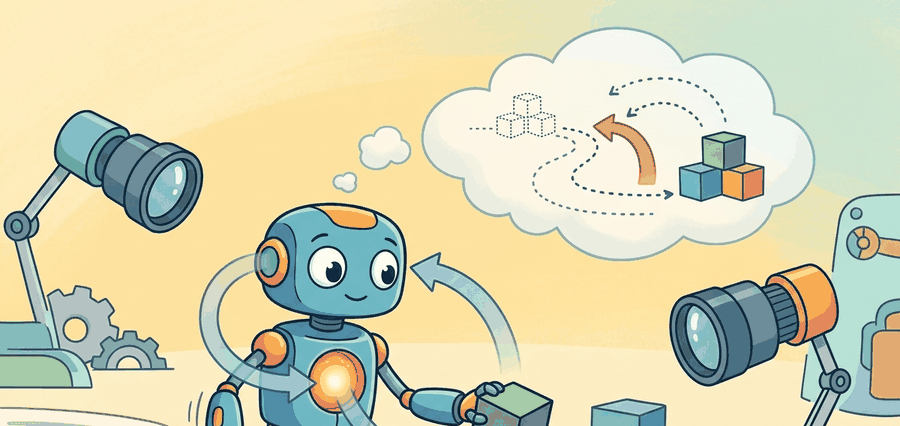
The Genie line is important because it makes interactivity explicit. Instead of merely predicting the next frame, it asks whether a generated world can be stepped through, controlled, and kept coherent as actions accumulate.
Read this section as a lineage. Genie begins with learned latent actions from video, expands into large-scale interactive world generation in Genie 2, and then moves toward photorealistic real-time exploration in Genie 3 and Project Genie.
Interactivity is a stronger test than next-frame quality. Every extra action exposes whether the world model actually preserved causal state or only short-term visual momentum.
Problem First
Many video models can continue a clip, but a world model for embodied AI must do something stricter: respond to the user's or agent's actions while keeping the environment coherent. Genie matters because it frames interactivity, not only fidelity, as the main benchmark for progress.
Core Model
The early Genie formulation learns a latent action interface from unlabeled videos: $$p(o_{t+1} \mid o_{\le t}, u_t),$$ where $u_t$ is a learned latent action that stands in for the unknown control responsible for the next frame. This is powerful because internet videos rarely come with button presses or motor torques attached.
Later systems move toward explicit or user-facing interactivity. Genie 2 is presented by Google DeepMind as a large-scale foundation world model for diverse 3D environments, while Genie 3 is described as a general-purpose interactive world model capable of generating photorealistic environments that can be explored in real time. The conceptual progression is from inferred latent control to more explicit, controllable world simulation.
The important scientific point is that interactivity is a much stronger demand than next-frame prediction. The model must preserve state variables over many steps, respond causally to actions, and avoid drifting into visually plausible but unplayable nonsense. In a practical benchmark, that means replaying the same action script through Genie-like systems, Project Genie interfaces, or other interactive generators and checking whether later states still encode the same intended control semantics, uncertainty, and controllability objective.
Another way to say this formally is that the state-space dynamics induced by the generator should preserve the policy-relevant variables over horizon, not only the pixels. If the uncertainty over latent action consequences grows faster than the useful horizon, the interactive world stops being a trustworthy training environment.
Initialize the world from a prompt or context frame, apply an action sequence, render the resulting trajectory, then check whether the state transition pattern matches the intended action semantics over many steps rather than only the first step.
Minimal Probe
The tiny evaluation loop below mirrors what makes the Genie family interesting: repeated action following. It accumulates a score across multiple steps, because single-step obedience is much easier than long-horizon interactive consistency.
# Score whether an interactive world follows actions over time.
# A few good first steps do not rescue long-horizon drift.
intended = ["left", "left", "jump", "right"]
observed = ["left", "left", "jump", "idle"]
step_scores = [int(i == o) for i, o in zip(intended, observed)]
action_follow_rate = sum(step_scores) / len(step_scores)
print({"step_scores": step_scores, "action_follow_rate": round(action_follow_rate, 2)})
{'step_scores': [1, 1, 1, 0], 'action_follow_rate': 0.75}
Expected behavior: The sequence shows why interactive evaluation is sequential. The world followed the first three actions correctly and then drifted on the last step. A polished screenshot from the first frame would miss the exact failure that matters for agent training.
There is no fully open one-line Genie SDK for all versions, so the practical shortcut is conceptual rather than purely programmatic: use the official Project Genie or Google DeepMind materials to define the interaction contract, then wrap that contract inside your own benchmark harness. The maintained tool handles generation; your code should handle action scripts, scoring, replay storage, and if needed token-level analysis with PyTorch, JAX, and standard transformer tooling.
Practical Recipe
- Evaluate with action scripts, not free-form visual inspection.
- Report how performance decays with horizon, because many interactive models fail gradually.
- Separate prompt diversity from control fidelity; a model can be creative and still be a weak simulator.
- Keep latent-action systems and explicit-action systems in distinct tables so readers do not confuse the control interfaces.
A generated world that follows the first few commands well can still become unusable when horizons extend. Early-step success should not be mistaken for a stable interactive simulator.
A warehouse-navigation agent trained in an interactive generated world may learn useful avoidance behavior if doors, shelves, and people remain persistent under actions. If the world reinterprets the same joystick command differently from one step to the next, the resulting policy learns to exploit generative quirks rather than real navigation structure.
The immediate frontier is richer, longer, more controllable interactive worlds. The deeper frontier is interface design: how should language, joystick commands, robot actions, and latent actions be represented so that generated environments remain causally stable enough for serious agent research?
For action-conditioned video as a policy-learning substrate, connect this section to Chapter 22. For simulation and benchmark concerns, revisit Chapter 12. For the broader world-model taxonomy, compare with Section 39.4 on Cosmos.
The Genie line matters because it makes a missing assumption visible. Much of classic video prediction quietly assumes the action stream is known. Internet video does not provide that. By learning or inferring a control interface, Genie opens a path from passive observation datasets toward interactive world models, while Project Genie and later Google DeepMind demos expose how that interface behaves under repeated user control, replay monitoring, and success-rate style evaluation.
That does not mean the problem is solved. The more interactive a generated world becomes, the more it exposes its weaknesses: state drift, identity swaps, and ambiguous control semantics. In this sense, interactivity is not only a capability showcase. It is a stronger microscope for world-model failure.
Can you explain the difference between a latent-action world model trained from raw video and an interactive world model exposed directly to user or agent commands?
The real advance in the Genie family is not prettier video but stronger interactivity, because a world model that cannot be steered cannot train or evaluate agents reliably.
Design a benchmark script for an interactive world model with four fixed action sequences. Which metrics would tell you whether the environment is merely reactive at one step or genuinely coherent over time?
Bibliography & Further Reading
Primary References And Tools
Edwards, A. et al.. "Genie: Generative Interactive Environments." (2024). https://arxiv.org/abs/2402.15391
The original Genie paper introduces latent actions learned from video and frames the interactive-environment problem clearly.
Google DeepMind. "Genie 2: A Large-Scale Foundation World Model." (2024). https://deepmind.google/blog/genie-2-a-large-scale-foundation-world-model/
Genie 2 is the official source for the large-scale 3D environment direction.
Google DeepMind. "Genie 3: A New Frontier for World Models." (2025). https://deepmind.google/blog/genie-3-a-new-frontier-for-world-models/
Genie 3 is the current official reference for real-time, photorealistic interactive worlds in this family.