"Model rollouts earn their compute only when the model is accurate in the regions the policy actually visits."
A Playable Future Must Still Obey The Task
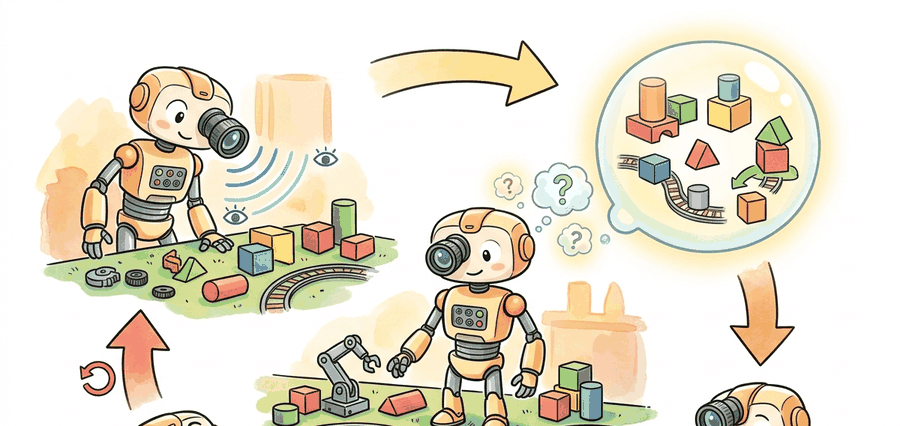
A generative model becomes a simulator only when actions can steer it, state can persist across time, and the generated future supports the same decisions the real environment would require.
Start by separating renderer from simulator. Then ask which control signals enter the generator, which state variables must remain consistent over long horizons, and how you would detect a beautiful but useless video model.
Simulation quality is bottlenecked by the weakest control-relevant property, not by the prettiest frame in the rollout.
Problem First
Video models can now produce visually striking futures, but robotics and autonomous systems care about more than plausibility. A simulator must preserve action consequences, reset logic, persistent objects, and failure modes. This section defines the standard that keeps generative world models from being mistaken for cinematic renderers.
Core Model
A learned simulator models future observations conditioned on action and context: $$p(o_{t+1:t+H} \mid o_{\le t}, a_{t:t+H-1}, c).$$ The context $c$ can include text, maps, embodiment state, or scene metadata. To be useful for control, the generated futures must satisfy more than image quality: they must preserve state continuity and causal response to action.
That leads to a simulator-focused evaluation vector rather than a single fidelity score: $$s = (\text{controllability}, \text{temporal consistency}, \text{object persistence}, \text{reset reproducibility}, \text{task validity}).$$ A model that is strong on only the first component, visual plausibility, is still weak as a simulator.
In embodied settings, the strongest claim a generative model can make is not “this looks real,” but “a planner or policy trained on these futures learns something that transfers back to the real task.” That is a much harder objective. Teams therefore track success rate, risk, monitor-trigger statistics, and out-of-distribution behavior, not just visual preference.
Condition on the current world state and action stream, generate a future, then score whether actions changed the right parts of the future, whether state stayed coherent across frames, and whether a downstream task policy benefited from training or evaluation on that future.
Minimal Probe
The probe below turns that idea into a simple scorecard. It does not ask whether the video looks impressive; it asks which simulator property is the weakest and therefore likely to fail first in a control pipeline.
# Score a generative world model as a simulator, not as a renderer.
# The weakest component usually reveals the deployment bottleneck.
metrics = {
    "controllability": 0.71,
    "temporal_consistency": 0.83,
    "object_persistence": 0.64,
    "reset_reproducibility": 0.76,
}
weakest = min(metrics, key=metrics.get)
simulator_ok = min(metrics.values()) > 0.65
print({"weakest_axis": weakest, "simulator_ok": simulator_ok})
{'weakest_axis': 'object_persistence', 'simulator_ok': False}
Expected behavior: The model fails the simulator gate because object persistence is too weak even though the other axes look decent. That is the right conclusion for control: a missing object or identity swap breaks planning long before a slightly blurry texture does.
The diagnostic above is about 10 lines. In practice, the same evaluation harness can be paired with maintained platforms such as NVIDIA Cosmos, Project Genie interfaces, or open video-model tooling built on diffusers, then logged through PyTorch, TensorBoard, or Weights & Biases dashboards. Those systems handle generation and batching; your job is still to keep the simulator gate explicit and comparable across runs.
Practical Recipe
- Score controllability and persistence separately from aesthetic quality.
- Test reset reproducibility because planners and evaluators rely on repeatable initial conditions.
- Run a downstream task or policy-transfer probe whenever possible; simulation value is ultimately instrumental.
- Keep the real-world baseline in the same report so the simulator is never judged only against itself.
A visually convincing model can still be a dangerous simulator if object identity, action semantics, or resets drift under rollout. Never let aesthetics stand in for causal validity.
An autonomous-driving team may generate heavy-rain scenes that look convincing but silently drop a cyclist after two seconds of occlusion. A perception benchmark might still look fine frame by frame. A closed-loop planner, however, would learn the wrong threat model. That is exactly why simulator metrics must include persistence and action-conditioned consistency.
The research frontier is shifting from passive video generation toward interactive world models with explicit action channels, persistent agents, and embodied evaluation protocols. The hard unresolved question is how to prove that the generated futures preserve the decision boundaries that matter for the downstream robot or vehicle.
For synthetic-data pipelines and domain randomization, see Chapter 13. For robot evaluation hygiene, connect to Chapter 52. For latent state models that do not decode photorealistic video, compare this section with Chapter 38.
The central conceptual shift is from generative quality to decision quality. A renderer can hallucinate around the edges and still impress a viewer. A simulator cannot, because the missing or inconsistent detail often changes what the agent should do next. That is why embodied AI researchers increasingly treat world-model demos from systems such as Sora, Genie, or Cosmos as hypotheses that need task-grounded validation rather than as finished evidence.
This also explains why the best generative simulators are often paired with old-fashioned bookkeeping: structured prompts, reset manifests, object-identity checks, and downstream transfer tests. The glamorous part is video generation; the reliable part is evaluation discipline, often implemented in custom replay harnesses plus maintained generation backends such as Diffusers or Cosmos.
Can you list two properties that make a video model look realistic and two stricter properties that make it usable as a simulator for policy learning or evaluation?
A generative model is a simulator only when its futures are steerable, persistent, and useful for the same decisions the real environment demands.
Define a five-axis simulator scorecard for one embodied application you care about. Which axis would you expect to fail first, and how would you measure it with one reproducible artifact?
Bibliography & Further Reading
Primary References And Tools
OpenAI. "Video Generation Models as World Simulators." (2024). https://openai.com/index/video-generation-models-as-world-simulators/
The Sora report is a key statement of the world-simulator framing from the video-generation side.
NVIDIA. "Physical AI with World Foundation Models." (2026). https://www.nvidia.com/en-us/ai/cosmos/
The Cosmos platform is a current primary source for physical-AI oriented simulator claims.
Google DeepMind. "Genie 3: A New Frontier for World Models." (2025). https://deepmind.google/blog/genie-3-a-new-frontier-for-world-models/
Genie 3 represents the interactive-world-model line that explicitly pushes beyond passive videos.