"A trajectory is not transferable until every hidden unit, frame, and control rate has been made painfully explicit."
An Embodiment Auditor
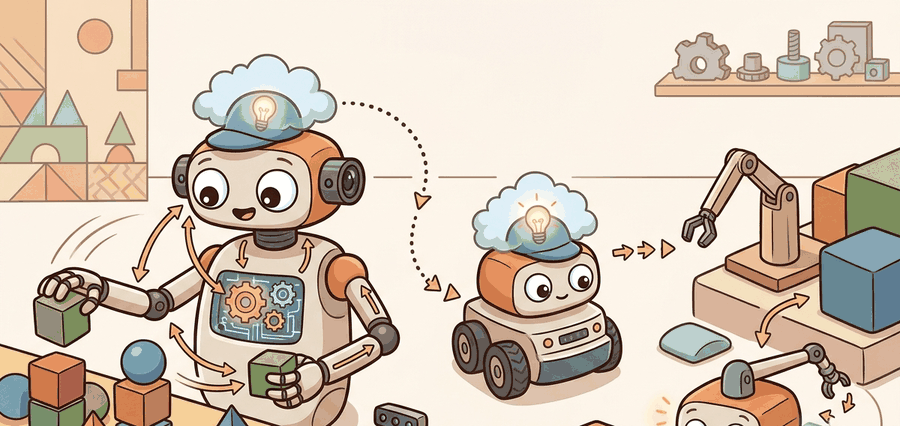
Cross-embodiment learning tries to pool experience from robots with different bodies, cameras, and controllers. The gain comes from diversity. The danger is semantic drift: one robot's "close gripper" or "move +x" may not mean what another robot's logs imply.
The Real Problem Is Not Data Volume, It Is Data Meaning
Pooling demonstrations from many robots only helps if the shared learner sees comparable events. A mixed dataset can silently combine different camera frames, different control frequencies, different action saturations, and different success definitions. When that happens, the model spends capacity learning translation noise instead of task structure.
This is why cross-embodiment training lives at the boundary between datasets and policy design. The data schema is part of the model architecture. If the schema is wrong, bigger models simply memorize the wrong equivalences more efficiently.
Robot body, camera pose, control rate, action units, and success definition are not bookkeeping. They are the side information that tells the learner what two trajectories are allowed to share.
A Canonical Latent Interface
A common pattern is to map robot-specific observations and actions into a canonical latent contract:
$$z_t = E_\text{obs}(o_t, m_r), \qquad a_t^{\text{can}} = N_r(a_t), \qquad \hat a_t = A_r^{-1}(\pi_\theta(z_t, q_t)).$$
Here $m_r$ is embodiment metadata, $N_r$ normalizes robot-specific actions into a canonical representation, and $A_r^{-1}$ maps the canonical action back into robot-specific commands. The policy $\pi_\theta$ only works if those adapters preserve the semantics that matter for transfer.
Code Fragment 1 shows the smallest useful version of that normalization idea. The point is not numerical sophistication. The point is to make the unit conversion visible.
# Normalize position and gripper commands from two robots into one canonical range.
# The policy can only share data when these conventions are explicit.
robots = {
    "arm_a": {"xyz_scale_cm": 1.0, "gripper_closed": 0.0},
    "arm_b": {"xyz_scale_cm": 2.5, "gripper_closed": -1.0},
}

def normalize_command(robot_name: str, dx_cm: float, gripper_value: float) -> tuple[float, float]:
    meta = robots[robot_name]
    canonical_dx = dx_cm / meta["xyz_scale_cm"]
    canonical_gripper = 1.0 if gripper_value == meta["gripper_closed"] else 0.0
    return canonical_dx, canonical_gripper

print(normalize_command("arm_a", dx_cm=1.0, gripper_value=0.0))
print(normalize_command("arm_b", dx_cm=2.5, gripper_value=-1.0))
(1.0, 1.0)
(1.0, 1.0)
The expected output is matching canonical commands for two different robots after embodiment-specific decoding and normalization. If these tuples diverged for the same semantic command, pooled training would quietly mix incompatible actions and poison cross-embodiment transfer.
The from-scratch adapter above is only 12 lines. LeRobot dataset features, RT-X style manifests, and openpi training configs give you a maintained place to store embodiment metadata, action normalization, and camera fields. The library handles schema plumbing so the builder can audit whether the chosen canonical interface is actually stable.
Where Transfer Usually Breaks
| Failure point | What it looks like | Typical fix |
|---|---|---|
| Action aliasing | The same canonical action decodes to different physical motions. | Refine adapters, add embodiment tokens, or split the action subspace. |
| Observation mismatch | One robot uses wrist RGB, another uses a static camera, yet both are pooled without camera metadata. | Store camera topology explicitly and condition encoders on it. |
| Success mismatch | "Place object" means gentle release in one dataset and mere object displacement in another. | Version the task definition and evaluate per-task slices. |
| Rate mismatch | High-rate trajectories dominate the loss because they contribute more timesteps. | Chunk actions, reweight sequences, or normalize by control rate. |
The table above is why cross-embodiment papers talk so much about metadata. Transfer is usually lost at the interface, not at the optimizer.
A large pooled dataset can improve the average metric while hurting a specific embodiment. Always report per-robot slices before calling the mixture a success.
Open X-Embodiment made the field pay attention to robot-data heterogeneity because it surfaced how much embodiment alignment work has to happen before a large mixture becomes useful. That lesson reappears in newer open stacks: the training recipe is inseparable from the dataset contract.
Cross-embodiment training is a potluck where every robot brings a dish labeled "motion." The host still has to figure out which ones are soup, sauce, and molten metal.
If you merged two robot datasets tomorrow, which five metadata fields would you refuse to proceed without? If control rate and action units are not on your list, your canonical interface is under-specified.
FAST+, GR00T, Gemini Robotics, and other recent systems all push toward broader cross-embodiment reuse, but they do so with different interface choices: action tokenizers, diffusion heads, embodiment tokens, or motion-transfer mechanisms. The unresolved question is which abstraction gives the best trade-off between universality and auditability.
Cross-embodiment transfer is not "throw more robot logs into one bucket." It is the disciplined design of a canonical contract that preserves task meaning while exposing where local adaptation still has to happen.
Take two real or hypothetical robot platforms and design a canonical action interface for them. List the normalization functions, embodiment metadata, and the first three failure slices you would evaluate before trusting pooled training.
What's Next?
Section 35.3 studies dual-system architectures, where one subsystem reasons more slowly about tasks and context while another generates motor actions on a faster control clock.
The main reference for heterogeneous robot-data mixtures and cross-embodiment learning across institutions.
Khazatsky et al. (2024). "DROID: A Large-Scale In-The-Wild Robot Manipulation Dataset."
DROID matters because it brings in-the-wild collection practices and realistic heterogeneity into the transfer conversation.
LIBERO is useful for evaluating whether a purportedly shared policy keeps skills across tasks rather than merely overfitting one narrow setting.
LeRobot Dataset v3 documentation.
A practical reference for dataset schemas, metadata, and community robot-data packaging.