"A robot prior earns the word foundation only when it reduces the cost of the next real adaptation."
A Practical Robot Theorist
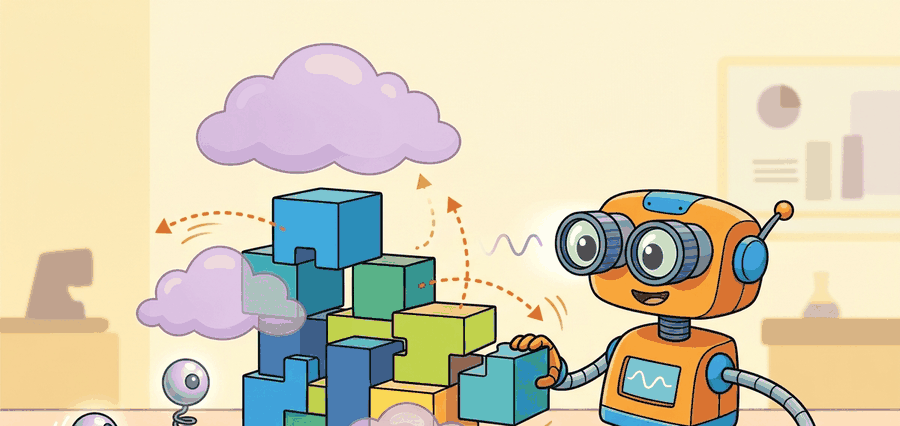
A robot foundation model is a reusable prior over perception, language, state, and action. The point is not to own the largest parameter count. The point is to start a new robot or task from a policy that already knows useful regularities about objects, contact, and short-horizon behavior.
The Problem Foundation Models Solve
Training a separate robot policy for every robot, sensor stack, and task wastes data. Many embodiments still need the same subskills: localizing objects, recognizing task language, predicting contact-rich motion, and recovering from small perturbations. A foundation model tries to absorb those invariants once, then expose them through a shared latent space or policy backbone.
The motivating failure mode is familiar from earlier imitation-learning chapters: a narrow policy can look excellent on the one setup it saw during data collection and collapse as soon as the camera moves, the gripper changes, or the object geometry shifts. A foundation model is an attempt to turn those brittle one-off policies into an adaptation problem rather than a full retraining problem.
Foundation status is earned by transfer. If a model needs nearly full retraining for every new embodiment, it is a large robot policy, not a robot foundation model.
Formal View: Pretrain Once, Adapt Many Times
A useful abstraction separates the shared backbone from the robot-specific adaptation layer:
$$\theta^*=\arg\min_\theta \sum_{r \in \mathcal{R}} \lambda_r \; \mathbb{E}_{\tau \sim D_r}[\ell(f_\theta, \tau)], \qquad \phi_{r'}^*=\arg\min_\phi \; \mathbb{E}_{\tau \sim D_{r'}}[\ell(f_{\theta^*,\phi}, \tau)] + \lambda \lVert \phi \rVert_2^2.$$
The first stage learns a shared prior across training robots $\mathcal{R}$. The second stage adapts that prior to a new robot $r'$. The adaptation term $\phi$ might be a LoRA block, an action adapter, an embodiment token, or a small amount of post-training data. The operational question is whether the sample count and wall-clock needed for adaptation drop enough to matter in practice.
Code Fragment 1 turns that idea into a numeric transfer audit. The point is not the arithmetic itself. The point is to make the "foundation" claim observable as a reduction in adaptation data.
# Compare scratch training against adaptation from a shared prior.
# The adaptation gain is the ratio that matters, not the absolute count alone.
robots = {
    "tabletop_arm": {"scratch_demos": 1800, "adapt_demos": 220},
    "mobile_manipulator": {"scratch_demos": 2600, "adapt_demos": 410},
    "bimanual_platform": {"scratch_demos": 5200, "adapt_demos": 900},
}

for name, stats in robots.items():
    gain = stats["scratch_demos"] / stats["adapt_demos"]
    print(f"{name}: adaptation_gain={gain:.1f}x")
tabletop_arm: adaptation_gain=8.2x
mobile_manipulator: adaptation_gain=6.3x
bimanual_platform: adaptation_gain=5.8x
The expected output is a transfer audit where every embodiment shows an adaptation gain comfortably above 1x. These values suggest that the shared prior is buying real sample-efficiency, not merely shifting where the same amount of tuning work is paid.
The manual transfer audit is about 10 lines. In practice, LeRobot dataset manifests and training reports let you log adaptation-data volume, checkpoints, and evaluation panels in a maintained format. The library handles media decoding, batching, checkpoint loading, and report structure, so the builder can focus on whether the transfer claim is real.
What Gets Shared, What Stays Local
| Usually shared | Usually adapted locally | Why the boundary matters |
|---|---|---|
| Object semantics, instruction grounding, short-horizon scene understanding | Joint limits, control rates, gripper geometry, camera extrinsics | These local fields decide whether a good semantic plan becomes a physically valid motion. |
| Reusable manipulation motifs such as reach, align, close, lift | Action scaling, torque limits, stop conditions, safety envelopes | The same skill can be expressed through very different low-level command conventions. |
| Recovery patterns for small disturbances | Emergency stop logic, operator handoff, hardware watchdogs | Deployment safety remains embodiment-specific even when the policy prior is shared. |
The table above is the central systems lesson. A robot foundation model does not erase embodiment. It changes where embodiment enters the stack.
A model that transfers semantics but still needs a custom low-level adapter on every robot can still be useful. The mistake is claiming "general robot intelligence" when the measured win is really "better semantic initialization plus substantial local retuning."
Suppose a lab moves from a Franka arm to a lower-cost SO-101 platform. The shared model may keep object recognition, instruction following, and grasp staging, while the local adaptation block remaps action scales, camera timing, and gripper closure thresholds. That is still a valuable transfer result, because it shortens the engineering path to the new platform.
A robot foundation model is less like one master key and more like a master locksmith. It still has to cut a local key, but it starts from the right blank.
Name one capability that should live in the shared prior and one capability that must stay robot-specific. If both of your answers sound equally global, the embodiment boundary is still blurry.
Open systems such as OpenVLA, Octo, SmolVLA, and openpi make the transfer story inspectable, while frontier systems such as GR00T, Helix, and Gemini Robotics test how far a shared prior can stretch across richer embodiments. The open question is not whether larger priors help, it is which abstractions remain stable when camera stacks, hands, locomotion, and control rates all change at once.
Foundation models matter for robotics when they convert a new robot from a full-training problem into a bounded adaptation problem with measurable savings in data, time, and failure analysis effort.
Pick two robots with different action interfaces. Write a one-page transfer plan that separates shared priors, local adapters, evaluation slices, and the exact metric that would justify calling the result a foundation-model transfer.
What's Next?
Section 35.2 makes the embodiment boundary explicit by studying how cross-embodiment training works, which metadata have to travel with each trajectory, and where action normalization breaks.
The canonical reference for heterogeneous robot-data mixtures and cross-embodiment training. Read it to see what metadata must accompany each trajectory.
Octo Model Team et al. (2024). "Octo: An Open-Source Generalist Robot Policy."
Octo is the clearest open example of a pretrained generalist robot policy used as a starting point for downstream adaptation.
The codebase shows how an open VLA organizes datasets, training, fine-tuning, and inference around a reusable policy backbone.
Hugging Face (2025). "SmolVLA."
SmolVLA is useful for understanding the affordable, community-data path toward open robot foundation models.