A Careful Control Loop
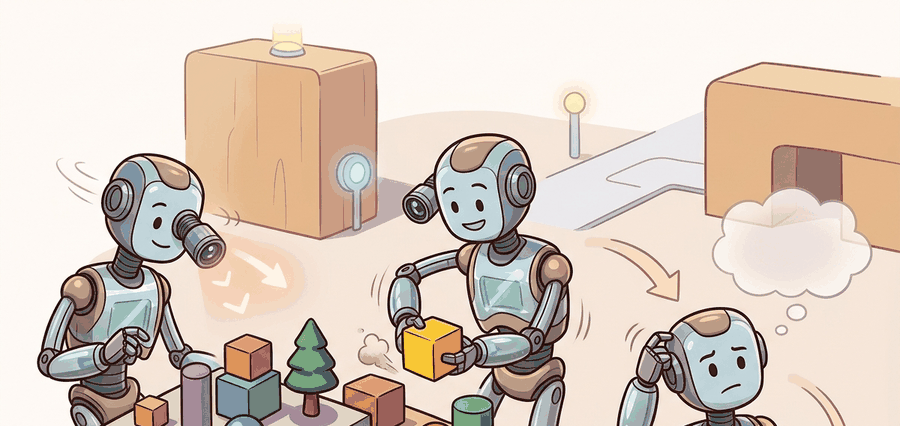
Read the figure as a question-answering safety check. A scene description matters only when the answer is grounded to visible evidence, bounded by uncertainty, and routed to a planner that can refuse unsupported commands.
Build And Evaluation Checklist
Curriculum, depth, and self-containment. VQA and scene description are diagnostic tools for environment understanding. They become embodied only when answers update state, trigger a skill, or reject an unsafe plan. For Visual question answering and scene description in environments, the practical reading is to pin down the interface, assumptions, concrete example, and failure mode before comparing methods.
Production and evaluation contract. Use scene descriptions as structured evidence, not as the action policy itself. For Visual question answering and scene description in environments, treat the diagram, code, table, exercise, warning, and references as one evidence packet: boundary, artifact, tool choice, transfer check, failure mode, and source grounding.
Before accepting a Visual question answering and scene description in environments result, name the loop variable that changed, the tool that makes it reproducible, the failure that would fool the metric, and the source that backs the claim.
Write the evidence row around answer grounding: user question, image crop or frame ID, textual answer, cited visual evidence, allowed action, refusal condition, and the rollout consequence of a wrong answer.
VQA and scene description are best treated as diagnostic perception tools, not as action policies. The practical question is not "can the model answer about the scene?" but "can the answer be converted into a structured state field that a planner or controller can safely consume?"
Captioning Is Not State Estimation
A caption like "A mug sits near the sink" is useful context, but an embodied agent typically needs a structured assertion such as {target: mug_2, relation: left_of_sink, confidence: 0.68, source_frame: 1842}. The first form is descriptive prose. The second form can be fused with memory, checked against geometry, and invalidated when the scene changes.
This is why VQA belongs near language-guided agent interfaces and belief updating. The model's answer must become evidence, not just commentary.
The most useful VQA systems for robotics do not aim for literary richness. They aim for typed answers, explicit uncertainty, and abstention when the observation does not support a safe action.
Question Answering As Conditional Inference
Formally, VQA asks for an answer $z_t$ conditioned on image $I_t$ and query $q_t$,
$$ p(z_t \mid I_t, q_t). $$For embodied use, the answer should usually be factored into a structured state proposal $y_t$ plus an uncertainty score $u_t$. A simple selective-answering rule is
$$ \hat y_t = \begin{cases} \arg\max_y p(y \mid I_t, q_t), & \text{if } \max_y p(y \mid I_t, q_t) \ge \tau, \\ \text{ABSTAIN}, & \text{otherwise}. \end{cases} $$The threshold $\tau$ is not cosmetic. It encodes a system decision about when the robot should ask another question, change viewpoint, or escalate to a safer fallback.
The language model is only the first step. The stronger pattern is: ask a targeted question, parse the answer into typed slots, attach a confidence score, then let the planner decide whether that evidence is enough to act.
Worked Example
Code Fragment 1 converts candidate VQA answers into a structured state field with abstention. The point is not to build a full model in a compact example, but to show the discipline embodied systems need at the interface.
# Convert VQA candidates into an action-ready state field with abstention.
# The planner consumes a typed answer only if the confidence clears a threshold.
# Otherwise the robot should reobserve or ask a narrower question.
answers = [
    {"value": "left_of_sink", "prob": 0.62},
    {"value": "on_counter", "prob": 0.27},
    {"value": "unknown", "prob": 0.11},
]
threshold = 0.70
best = max(answers, key=lambda item: item["prob"])

state_update = {
    "relation": best["value"] if best["prob"] >= threshold else "ABSTAIN",
    "confidence": round(best["prob"], 2),
}
print(state_update)The expected output is an abstaining state update rather than a forced relation label, because the confidence stays below the 0.70 gate. That behavior is the point of the example: a good embodied VQA interface should surface uncertainty in a way a planner can act on, not quietly convert every plausible answer into a brittle world-state assertion.
Notice what changed: the model's job was not to produce eloquence, but to update a typed relation. This is the same transition from language to control-relevant structure that appears in Chapter 33 on planners and controllers.
The abstention logic above teaches the interface in 11 lines. In production, modern multimodal chat models can emit the same structured object in a few lines when prompted with a schema or JSON instruction. The maintained model API saves prompt packing and decoding code, but it does not remove the need for typed outputs and confidence gates.
Code Fragment 2 shows the maintained pattern with a multimodal generation interface.
# Ask a multimodal model for a structured relation answer.
# pip install transformers pillow torch
# The response should be parsed into typed fields before planning uses it.
from PIL import Image
from transformers import AutoProcessor, AutoModelForImageTextToText

model_id = "google/paligemma-3b-mix-224"
processor = AutoProcessor.from_pretrained(model_id)
model = AutoModelForImageTextToText.from_pretrained(model_id)

image = Image.open("kitchen_scene.png")
prompt = "Answer with JSON: relation of the red mug to the sink."
batch = processor(images=image, text=prompt, return_tensors="pt")
output_ids = model.generate(**batch, max_new_tokens=32)
print(processor.batch_decode(output_ids, skip_special_tokens=True)[0])The expected output is one short JSON-style answer with both a typed relation and a confidence that clears the local action gate. A reader should interpret this as "the model produced something the planner could plausibly consume," not as proof that the relation is globally true forever, which is why timestamping and later invalidation still matter.
Latency And Resolution Tradeoffs
VQA becomes fragile in a real robot loop when the model is slow enough that the scene changes before the answer arrives. A larger resolution or larger model may improve descriptive accuracy while degrading action accuracy because the answer is late. The right metric is often answer usefulness under a control deadline, not raw answer quality.
Teams often evaluate VQA offline on saved frames, then deploy it online where objects and cameras move. The answer remains linguistically plausible, but it now refers to a past world state. Without timestamps and refresh rules, a correct answer can still cause the wrong action.
An assistive robot can use scene description to explain why it paused, for example "the path to the mug is blocked by a chair." That explanation helps the human operator. The planner, however, should consume the underlying structured facts, not the whole sentence.
Good embodied VQA answers behave less like a storyteller and more like a careful field medic: short, specific, timestamped, and willing to say "I do not know yet."
A major current direction is moving from free-form VQA toward grounded, controllable multimodal reasoning that can emit boxes, points, masks, or typed state updates rather than only text. Another frontier is uncertainty calibration for multimodal answers so abstention is learned instead of bolted on afterward.
If your current VQA answer cannot be stored in memory as typed state with a timestamp and uncertainty, what exactly would the planner do with it?
The best chapter-level diagnostic for this topic is to log the raw image, the question, the free-form answer, the structured parse, the confidence score, and the downstream action decision together. That artifact reveals where the value really came from. Many systems appear to succeed because a human evaluator likes the answer wording even when the structured state is still too ambiguous for planning.
| Output style | Best use | Risk |
|---|---|---|
| Free-form caption | Human monitoring, logs, demos | Hard to parse, easy to overtrust |
| Short VQA answer | Binary checks and relation queries | May hide ambiguity |
| Typed JSON-style state | Planning, memory, policy routing | Needs schema design and calibration |
For embodied systems, VQA is valuable when it updates typed, timestamped, uncertainty-aware state. A beautiful sentence is only a bonus.
Write three robot-scene questions that should return typed answers, not prose. For each, specify the schema, the abstention threshold, and the control decision that would consume the result.
Liu et al. (2023). "Visual Instruction Tuning."
The LLaVA paper is a useful reference for turning multimodal perception into instruction-following answers.
Relevant here because it shows how language-grounded scene understanding can be tied directly to robot actions.
Google (2024-2026). "PaliGemma model card."
A practical current source for multimodal question answering and structured prompting with an openly documented checkpoint family.
Chen et al. (2024). "Qwen-VL and multimodal instruction-following developments."
Useful for comparing instruction-following multimodal answer behavior against more explicitly grounded robotics interfaces.