For NeRF: implicit radiance fields, geometry earns its place when it changes reachability, clearance, grasping, exploration, or recovery in the log.
A Patient Embodied AI Agent
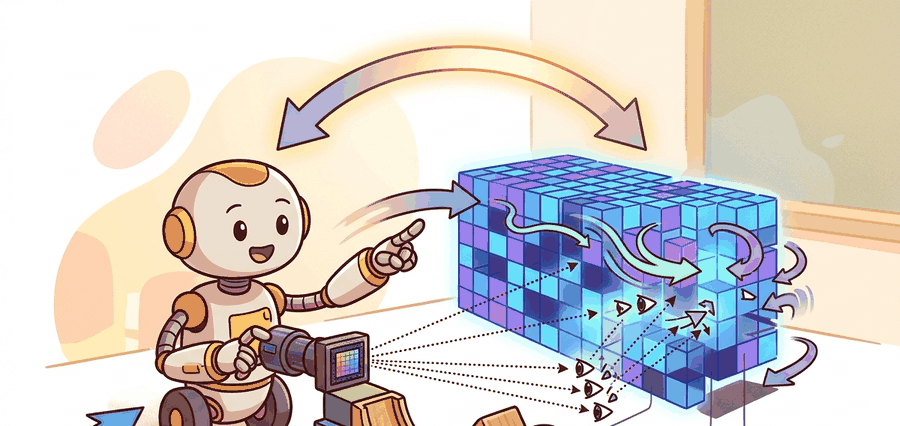
NeRF: implicit radiance fields represents a scene as a continuous function that predicts color and density from 3D position and view direction. It is excellent for view synthesis, but robotics must ask which parts are actionable for control.
Problem First: Why This Representation Exists
For NeRF-style fields, the action contract must include camera poses, scale recovery, rendering latency, surface extraction or affordance query, and uncertainty. A photorealistic view is not enough if geometry is late or mis-scaled. Treat the representation as a typed state estimate, not as a visualization.
For NeRF: implicit radiance fields, the representation is embodied only when it changes an admissible action, safety margin, exploration request, or recovery path.
Figure 28.5.1 should be read as the NeRF: implicit radiance fields handoff diagram: sensor evidence, geometric representation, uncertainty, latency, and action consumer are separate failure points.
Mathematical Core
A NeRF renders a pixel by accumulating colors along a camera ray weighted by transmittance and density.
$C(r)=\int_{t_n}^{t_f}T(t)\sigma(r(t))c(r(t),d)\,dt,\quad T(t)=\exp\left(-\int_{t_n}^{t}\sigma(r(s))ds\right)$
Density $\sigma$ controls how much a sample blocks the ray, color $c$ controls emitted appearance, and transmittance $T$ controls how much light survives from earlier samples. This is a rendering equation, not automatically a collision-checking equation.
- Train or load the radiance field from posed images.
- Validate camera poses, scale, and reconstruction quality in task-relevant regions.
- Extract or query geometry only where the robot needs action predicates.
- Use a control-suitable representation, such as mesh, point cloud, occupancy, or signed distance, for collision and contact.
| Design Choice | Use When | Control Risk |
|---|---|---|
| Novel view synthesis | Teleoperation, inspection, data replay | Rendered realism does not guarantee metric safety. |
| Implicit density | Dense appearance and occluded reasoning | Density is not a contact model by itself. |
| Geometry extraction | Planning after meshing or SDF conversion | Extraction thresholds can move surfaces. |
Worked Miniature
Code Fragment 28.5.1 computes a discrete volume-rendering weight sequence. This tiny calculation is the mechanism hidden inside neural rendering frameworks.
# Compute discrete volume-rendering weights along one ray.
# High density absorbs the ray and shifts weight toward nearby samples.
import numpy as np

sigma = np.array([0.1, 0.3, 2.0, 0.4])
delta = 0.5
alpha = 1 - np.exp(-sigma * delta)
transmittance = np.cumprod(np.r_[1.0, 1 - alpha[:-1]])
weights = transmittance * alpha
print(np.round(alpha, 3))
print(np.round(weights, 3))The expected output has a first row for local opacity and a second row for what actually contributes to the rendered pixel after transmittance is applied. The third sample dominates the view, so a robotics reader should infer that most of the color comes from one narrow depth region rather than from a solid, planner-ready surface model.
Nerfstudio can train and inspect NeRF-style models through maintained commands and configuration files. That shortcut handles datasets, cameras, optimization, and visualization, while robot builders still validate scale, latency, and control-suitable exports.
Do not send a controller directly against a pretty NeRF render. First extract or query geometry in a representation that has conservative collision semantics.
A real-estate inspection robot may use NeRF views for remote supervision, while its local navigation still uses occupancy or signed-distance maps for safety-critical motion.
For NeRF: implicit radiance fields, the perception result must answer what action changed, what uncertainty changed, and what log would reproduce the decision. Otherwise the output is still visualization, not embodied evidence.
Debugging And Evaluation
For NeRF: implicit radiance fields, evaluate the representation inside the consuming action loop with calibration, frame transform, representation version, latency, selected action, and failure label.
For NeRF: implicit radiance fields, perturb exactly one geometric assumption, such as depth dropout, scale, occlusion, pose drift, motion, or calibration, then record the action change.
Neural fields are moving from offline view synthesis toward robotics memory, active reconstruction, and policy conditioning. The open challenge is making them updateable, metric, and conservative enough for interaction.
Two 2024 results bring Gaussian-splatting representations into simultaneous localization and mapping. SplaTAM (Keetha et al., CVPR 2024) performs real-time 3D Gaussian-splatting SLAM with simultaneous tracking and map densification, achieving dense color and geometry reconstruction at interactive frame rates. MonoGS (Matsuki et al., CVPR 2024) extends Gaussian-splatting SLAM to the monocular case using photometric and depth loss, enabling dense neural mapping from a single consumer camera without a depth sensor. Both systems demonstrate that the explicit, editable nature of Gaussian splats is well suited to the incremental updates that SLAM requires. The key open problem is that Gaussian-splatting SLAM assumes a static scene; handling dynamic objects and moving cameras simultaneously in the same map remains unsolved and is an active area of 2025 research.
Section 28.6 replaces the implicit neural field with explicit 3D Gaussians, gaining real-time rendering speed and direct editability while facing the same challenge of converting appearance primitives into conservative geometry for control.
Section References
Mildenhall, B. et al. NeRF: Representing Scenes as Neural Radiance Fields for View Synthesis. ECCV, 2020. https://arxiv.org/abs/2003.08934
Foundational paper for implicit radiance fields and volume rendering.
Nerfstudio documentation. https://docs.nerf.studio/
Maintained framework for neural field training, inspection, and exports.
Keetha, N. et al. (2024). SplaTAM: Splat, Track and Map 3D Gaussians for Dense RGB-D SLAM. CVPR 2024. https://arxiv.org/abs/2312.02126
Introduces real-time 3D Gaussian-splatting SLAM with simultaneous tracking and map densification. Read to understand how the explicit Gaussian representation enables fast incremental map updates and high-quality dense reconstruction for robot navigation.
Matsuki, H. et al. (2024). Gaussian Splatting SLAM. CVPR 2024. https://arxiv.org/abs/2312.06741
Extends Gaussian-splatting SLAM to monocular input using photometric and depth loss, removing the need for a depth sensor. Read to understand the trade-offs between monocular scale ambiguity and the dense color-geometry representation that Gaussian splats provide.
Can you name the representation, the consuming action, the uncertainty or freshness field, and the failure label for NeRF: implicit radiance fields? If any one is missing, the section is not yet ready for a robot replay log.
NeRF is a powerful rendering representation; robotics needs an additional step that converts or constrains it into action-safe geometry.
Name one task where a NeRF render is directly useful and one task where an extracted geometry representation is required before action.