"The best joystick for an arm is sometimes another arm that admits it is only pretending."
A Kinematic Twin
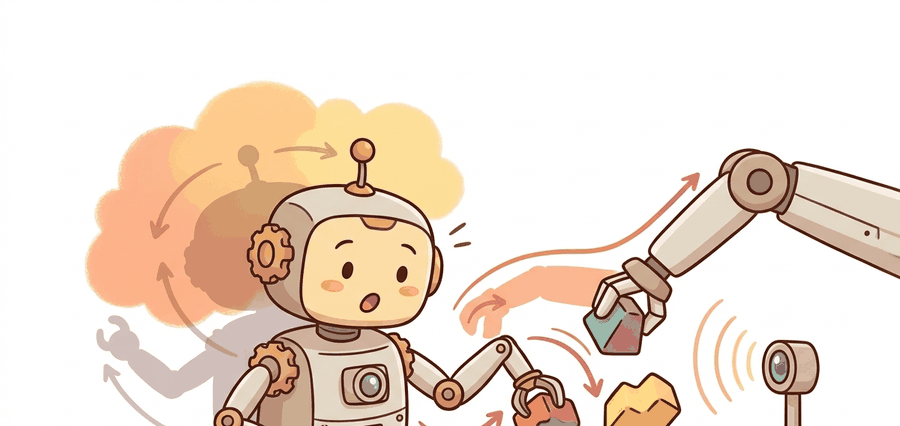
Leader-follower teleoperation maps a human-manipulated leader device to a robot follower. ALOHA and GELLO matter because they lower the translation burden between human intent and robot joint motion, which raises demonstration quality before any learning algorithm sees the data.
Kinematic Mapping
The cleanest leader-follower interface makes the leader configuration $q_L$ correspond to a follower configuration $q_F$. The simplest mapping is an affine calibration in joint space:
$$q_F = S(q_L - q_L^0) + q_F^0,$$
where $q_L^0$ and $q_F^0$ are neutral poses and $S$ contains joint sign and scale terms. More complex systems map end-effector poses through forward and inverse kinematics, but the principle is the same: the operator should not mentally solve geometry that the device can embody.
Imitation learning treats recorded actions as targets. A bad teleoperation interface injects extra noise into those targets, so policy training pays for interface design mistakes later.
Use the ALOHA and GELLO reference repositories as starting points for hardware wiring, ROS 2 integration, and calibration scripts rather than rebuilding a leader-follower stack from scratch. The right-tool move is to spend custom effort on task fixtures, safety checks, and logging fields.
Latency And Stability
Latency changes what the operator sees and what the robot executes. Let $\Delta t = t_{execute} - t_{observe}$. At 50 Hz, a control step is 20 ms; at 5 Hz, it is 200 ms. For contact-rich manipulation, that difference can decide whether the operator corrects a slip or records an avoidable failure.
The following snippet computes a latency budget and flags episodes that should not be used as clean expert data.
# Audit leader-follower timing so bad labels are not treated as expert actions.
# Episodes over the latency threshold should be labeled or excluded from clean splits.
episodes = [
    {"id": "ep001", "control_hz": 50, "network_ms": 18, "camera_ms": 12},
    {"id": "ep002", "control_hz": 10, "network_ms": 55, "camera_ms": 40},
]

for episode in episodes:
    control_ms = 1000 / episode["control_hz"]
    total_ms = control_ms + episode["network_ms"] + episode["camera_ms"]
    label = "clean" if total_ms <= 80 else "latency-risk"
print(episode["id"], round(total_ms, 1), "ms", label)The expected output distinguishes an episode that can be treated as clean supervision from one that needs a latency-risk label. That distinction matters because a delayed correction can look like a bad action in the dataset even when the operator made the right decision based on stale feedback. A serious collection pipeline keeps both rows, but routes them to different training or stress-evaluation uses.
| Design Axis | Good Sign | Failure Sign |
|---|---|---|
| Kinematic match | Operator motion resembles follower motion. | Operator must mentally remap axes or gripper orientation. |
| Calibration | Neutral poses, joint signs, and gripper ranges are checked daily. | Small offsets accumulate into contact errors. |
| Safety interlocks | Deadman switch, speed limits, workspace limits, and emergency stop are tested. | Operator can command unsafe motion during setup. |
| Synchronization | Video, robot state, and action commands share a clock or sync event. | Replay shows actions that do not match visual state. |
- Move leader and follower to neutral poses.
- Verify joint sign and scale against three known postures.
- Command a slow workspace sweep with speed limits enabled.
- Record a calibration episode and inspect replay alignment.
- Only then collect task demonstrations.
If the leader device fatigues the operator, later episodes may contain slower reactions and more conservative paths. Record operator, session order, and break timing so the dataset can distinguish task difficulty from human fatigue.
In an ALOHA-style bimanual task, the data card should record whether the demonstration came from static tabletop ALOHA or Mobile ALOHA. Mobility changes camera motion, whole-body coordination, collision risks, and the split that should test generalization.
Recent low-cost interfaces such as GELLO and Mobile ALOHA move teleoperation research from "can we control the robot" to "can many labs collect comparable data." The open problem is to standardize interface-quality metadata well enough that demonstrations from different devices can be pooled responsibly.
For a leader-follower episode, can you reconstruct the calibration version, control rate, camera latency, safety interlock status, operator identity, and split assignment? If not, the action labels are under-documented.
Leader-follower systems improve robot data when the hardware interface makes good actions natural and the logging pipeline records enough timing and calibration evidence to trust those actions later.
Design a calibration checklist for a two-arm leader-follower platform. Include one numeric latency threshold and one rule for excluding or relabeling risky episodes.
What's Next
Section 23.3 shifts from robot-shaped leaders to handheld in-the-wild collection, where the central problem is transferring human demonstrations into robot-executable trajectories.
Zhao, T. Z. et al. (2023). Learning Fine-Grained Bimanual Manipulation with Low-Cost Hardware.
Introduces ALOHA and ACT, making the connection between low-cost bimanual teleoperation, action chunking, and real-world manipulation data explicit.
A kinematically matched leader device study that directly compares teleoperation ergonomics and reliability against other low-cost interfaces.
Defines the handheld gripper approach, latency matching, and relative-trajectory action interface used in portable demonstration collection.
Cheng, X. et al. (2024). Open-TeleVision: Teleoperation with Immersive Active Visual Feedback.
A current reference for immersive visual feedback, active perception, and VR-style operator embodiment in data collection.
Hugging Face LeRobot Documentation.
Documents dataset conversion, policy training, and robot-control utilities that turn teleoperation logs into reusable learning artifacts.