"A robot dataset is not a pile of videos. It is a memory of what the body was allowed to try."
A Data-Hungry Manipulator
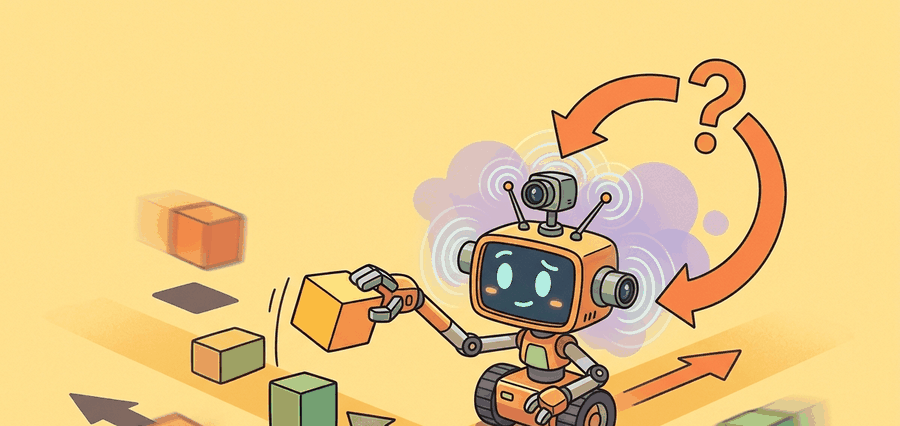
Robot data is expensive because each row is produced by a real body under time, safety, wear, and reset constraints. A web model can ingest text at datacenter speed; a manipulation policy must wait for cameras, motors, contact, human operators, and the next physical reset.
Why Physical Data Does Not Scale Like Text
A demonstration trajectory is a time-indexed sequence $ au = (o_0, a_0, r_0, o_1, a_1, \ldots, o_T)$. For imitation learning, the central supervised object is usually $(o_t, a_t)$, but the engineering object is larger: camera frames, robot state, commanded action, executed action, timestamps, calibration, operator identity, task description, reset condition, and outcome.
The bottleneck appears because useful coverage grows in a product space. If a task varies over objects $O$, poses $P$, backgrounds $B$, robot states $S$, and operators $H$, the coverage target is not $|O| + |P| + |B| + |S| + |H|$. The naive grid is closer to $|O||P||B||S||H|$, and the real world adds correlations and long-tail cases. This is why a thousand beautiful clips from one kitchen may still fail in a second kitchen.
The useful unit of robot data is not a trajectory count by itself. The useful unit is coverage of the variables that change the action a competent policy should choose.
For a dataset $D$, write each episode as $e_i = (x_i, u_i, y_i)$, where $x_i$ is the episode context, $u_i$ is the time-series trajectory, and $y_i$ is the outcome and labels. A split is valid only if the held-out set changes at least one context variable that deployment will actually change.
Use LeRobotDataset or RLDS-style episode containers after the coverage variables are named. The library handles video indexing, frame access, and metadata storage, but it cannot decide which deployment variables your validation split should hold out.
A Simple Coverage Metric
The following fragment computes a small coverage table from episode metadata. It is deliberately small: before building a foundation model, the team should be able to explain which objects, rooms, operators, and failure modes the data actually covers.
# Estimate metadata coverage for a small robot demonstration table.
# The point is to count deployment-relevant factors before model training.
episodes = [
    {"object": "mug", "room": "lab", "operator": "a", "result": "success"},
    {"object": "mug", "room": "kitchen", "operator": "b", "result": "slip"},
    {"object": "bowl", "room": "lab", "operator": "a", "result": "success"},
]

fields = ["object", "room", "operator", "result"]
coverage = {field: len({episode[field] for episode in episodes}) for field in fields}
grid_upper_bound = 1
for value in coverage.values():
    grid_upper_bound *= value

print(coverage)
print("observed episodes:", len(episodes))
print("factor-grid upper bound:", grid_upper_bound)The expected output should make the reader slightly suspicious: three episodes touch four distinct metadata fields, yet the simple factor grid already contains 16 possible combinations. The correct response is not to collect every grid cell blindly. It is to decide which factors are deployment-critical, then design train, validation, and stress splits that test those factors deliberately.
Practical Collection Protocol
- Write the task contract: objects, success state, reset rule, forbidden shortcuts, and stop condition.
- Choose the interface: kinesthetic teaching, joystick, VR, leader-follower, handheld gripper, or shared autonomy.
- Record synchronized streams: camera frames, robot state, actions, timestamps, calibration version, and operator events.
- Label failure modes at collection time, not weeks later when the replay context is gone.
- Freeze train, validation, held-out task, and stress splits before policy tuning begins.
| Bottleneck | Why It Hurts Learning | Mitigation |
|---|---|---|
| Reset cost | Rare failures are under-sampled because each reset consumes human time. | Scripted resets, fixture design, and explicit stress episodes. |
| Operator bias | The policy learns one person's preferred path rather than the task manifold. | Multiple operators, instruction randomization, and operator metadata. |
| Timing drift | Observation and action streams no longer describe the same instant. | Hardware timestamps, sync pulses, and dropped-frame labels. |
| Missing negatives | The learner sees successes but not the boundary of unsafe or ineffective behavior. | Intervention labels, failed attempts, and recovery demonstrations. |
If the dataset contains only smooth expert rollouts, the policy may never learn recovery. For contact-rich tasks, near-misses, slips, aborts, and human interventions are not embarrassing leftovers; they are supervision for the boundary of competence.
A team collecting dishwasher-loading demonstrations should not ask only how many episodes they have. They should ask how many rack layouts, plate sizes, lighting states, gripper approaches, human operators, and recovery cases appear in each split.
Open X-Embodiment, DROID, BridgeData V2, UMI, Mobile ALOHA, and LeRobot all attack the same bottleneck from different angles: shared data formats, cheaper collection hardware, broader scene diversity, and reusable policy training stacks. The frontier question is how to predict which additional episode is worth collecting next.
For one robot task you care about, list five deployment variables and mark which ones your current dataset actually covers. If the validation split does not change any of them, it is probably a comfort split rather than a generalization test.
Robot data is bottlenecked by physical coverage, not by storage. A strong collection plan names the deployment factors before it celebrates the episode count.
Design a metadata sheet for 50 demonstrations of a contact-rich task. Include at least four context variables, two failure labels, and one held-out split rule.
What's Next
Section 23.2 studies leader-follower systems such as ALOHA and GELLO, which reduce the cost of collecting precise, repeatable, high-quality demonstrations.
Zhao, T. Z. et al. (2023). Learning Fine-Grained Bimanual Manipulation with Low-Cost Hardware.
Introduces ALOHA and ACT, making the connection between low-cost bimanual teleoperation, action chunking, and real-world manipulation data explicit.
A kinematically matched leader device study that directly compares teleoperation ergonomics and reliability against other low-cost interfaces.
Defines the handheld gripper approach, latency matching, and relative-trajectory action interface used in portable demonstration collection.
Cheng, X. et al. (2024). Open-TeleVision: Teleoperation with Immersive Active Visual Feedback.
A current reference for immersive visual feedback, active perception, and VR-style operator embodiment in data collection.
Hugging Face LeRobot Documentation.
Documents dataset conversion, policy training, and robot-control utilities that turn teleoperation logs into reusable learning artifacts.