A Careful Control Loop
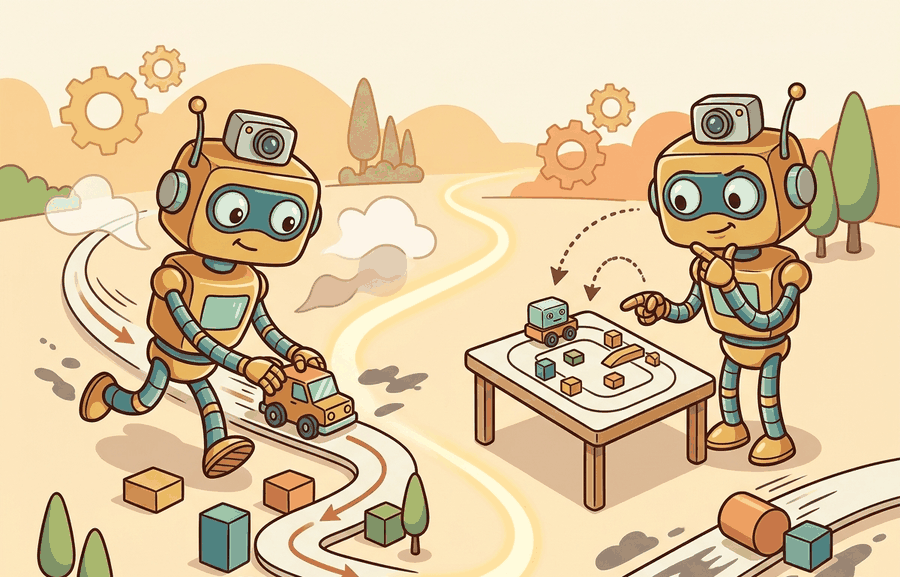
Model-free vs. model-based and on-policy vs. off-policy are two independent axes. One asks whether the learner represents dynamics; the other asks whether the data came from the policy being improved.
This section links back to Chapter 7: Control for AI Practitioners and Chapter 10: Environments with Gymnasium and PettingZoo, then prepares the policy-gradient work in Chapter 15: Policy Gradient Methods and PPO. The section separates two axes that are often blurred: whether the learner uses an explicit dynamics model, and whether it learns from data generated by the same policy it is improving.
This section develops the technical contract for model-free vs. model-based learning and on-policy vs. off-policy data. First we define each axis, then we introduce discounted occupancy, then we compute how two policies can see different parts of the same environment.
The key question is practical: is the learner improving from its own fresh rollouts, from another policy's data, or from an explicit model of what the world will do next?
Model-free and model-based describe what the algorithm represents. On-policy and off-policy describe where the training data came from.
Theory
A model-free method estimates a policy, value function, or action-value function without explicitly learning $P(s'\mid s,a)$ for planning. A model-based method learns or uses a transition and reward model, then chooses actions by planning, imagination rollouts, or dynamic programming. In robot tasks, model-based methods can reduce physical samples, but learned models can compound small prediction errors across imagined steps.
An on-policy method updates a target policy using data generated by that same policy. An off-policy method learns about a target policy $\pi$ from data generated by a behavior policy $\mu$. Off-policy learning is attractive because embodied data are expensive, but the mismatch between $\mu$ and $\pi$ must be measured rather than waved away.
The discounted occupancy measure makes this mismatch concrete:
$$d_\gamma^\pi(s,a)=(1-\gamma)\sum_{t=0}^{\infty}\gamma^t\Pr_\pi(S_t=s,A_t=a).$$
This quantity says how often policy $\pi$ visits each state-action pair when near-term visits receive more weight. If a dataset has high occupancy for careful approaches but the target policy wants fast contact-rich grasps, the dataset may contain too little evidence for the target behavior.
The mechanism is data distribution control. Model choice defines what the learner can predict or plan with; policy mismatch defines whether the collected evidence supports the policy being improved.
Worked Example
Code Fragment 1 computes a finite-horizon approximation to discounted occupancy for two policies in a two-state robot task. The behavior policy is cautious; the target policy is more aggressive about contact.
# Estimate discounted occupancy for behavior and target policies.
# The mismatch shows where off-policy data may undersupport learning.
gamma = 0.9
states = ["approach", "contact"]
actions = ["slow", "fast"]
policies = {
    "behavior_mu": {"approach": {"slow": 0.8, "fast": 0.2}, "contact": {"slow": 0.7, "fast": 0.3}},
    "target_pi": {"approach": {"slow": 0.3, "fast": 0.7}, "contact": {"slow": 0.2, "fast": 0.8}},
}

def next_state(state, action):
    return "contact" if action == "fast" else state

for name, policy in policies.items():
    state_distribution = {"approach": 1.0, "contact": 0.0}
    occupancy = {(s, a): 0.0 for s in states for a in actions}
    for t in range(5):
        weight = (1 - gamma) * (gamma ** t)
        next_distribution = {"approach": 0.0, "contact": 0.0}
        for state, state_prob in state_distribution.items():
            for action, action_prob in policy[state].items():
                prob = state_prob * action_prob
                occupancy[(state, action)] += weight * prob
                next_distribution[next_state(state, action)] += prob
        state_distribution = next_distribution
print(name, {f"{s}/{a}": round(v, 3) for (s, a), v in occupancy.items()})The expected output shows the coverage mismatch directly in the occupancy mass. behavior_mu spends most of its discounted weight on cautious approach actions, while target_pi places much more mass on contact/fast, which is exactly where off-policy support becomes weakest.
The example also clarifies model-based learning. If a reliable model predicted the transition from `approach` to `contact`, the learner could plan contact behavior before trying every variant on hardware. If the model predicts contact poorly, planning amplifies the error.
In practical experiments, replay buffers and offline datasets make off-policy learning convenient, while simulators and learned world models make model-based planning possible. The engineering shortcut is useful only when the artifact records which policy produced each transition and which policy the update is evaluating.
Practical Recipe
- Write the observation, action, and success metric before choosing a model.
- Build a baseline that is simple enough to debug by inspection.
- Add the library implementation only after the baseline behavior is understood.
- Record failures as structured cases: perception error, state error, planning error, control error, or evaluation error.
- Run at least one perturbation test before trusting the result.
The common mistake in Model-free vs. model-based; on- vs. off-policy is to celebrate the component score before checking the closed-loop handoff. The failure usually appears at the boundary: stale state, wrong frame, delayed action, saturated actuator, or metric that ignores the real task cost.
A warehouse robot team can train a model-free value function from a replay buffer, then compare it with a model-based planner in the same simulator panel. The comparison is valid only if both methods are evaluated on the same starts, object poses, latency profile, and success definition.
The replay buffer has a point of view. Off-policy learning starts by asking whose point of view it is.
Offline RL and model-based robot learning remain active because real interaction is expensive. The frontier question is how to exploit large prior datasets and learned models while preventing policies from choosing actions whose occupancy is poorly covered by the data.
Can you name the behavior policy, target policy, replay coverage, and whether the method plans with an explicit dynamics model? If not, the algorithm label is hiding the important assumption.
The two axes in this section answer different failure questions. If a model-based controller fails, inspect transition prediction, reward prediction, planning horizon, and model rollout error. If an off-policy learner fails, inspect whether the replay buffer actually covers the target policy's state-action occupancy.
For embodied agents, the strongest design often mixes categories. A system may learn a model for short-horizon contact prediction, learn a model-free value function for policy improvement, and use off-policy data from demonstrations. The label matters less than the evidence that each data source supports the update it is asked to make.
| Axis | Option | Primary Audit Question |
|---|---|---|
| Representation | Model-free | Does the value or policy estimate generalize to the deployment states? |
| Representation | Model-based | Does the dynamics model stay accurate across planned horizons and contact regimes? |
| Data source | On-policy | Is fresh rollout data affordable and safe enough for the update? |
| Data source | Off-policy | Does replay coverage support the target policy's occupancy? |
A robust implementation logs data provenance. Every transition should record the behavior policy, policy version, simulator or hardware source, reward version, and any model-generated rollout flag. Without those fields, an off-policy experiment cannot prove which distribution produced the evidence.
- State whether the update is on-policy or off-policy.
- State whether planning uses a learned, analytic, or simulator model.
- Estimate occupancy coverage for important state-action regions.
- Evaluate model rollout error separately from policy return.
- Compare algorithms only on one environment panel and one metric definition.
When a model-based method fails, run one-step prediction checks before judging the planner. When an off-policy method fails, inspect the occupancy mismatch before tuning the loss. These two diagnostics isolate different root causes.
For model-free, model-based, on-policy, and off-policy comparisons, co-compute success, return, model error, replay coverage, and safety cost on one environment panel. Do not compare a model-based planner's best simulator result with an off-policy learner's separate hardware run.
Model-free versus model-based is about what the learner represents. On-policy versus off-policy is about which policy produced the data.
Take a replay buffer from a cautious behavior policy and define a target policy that takes more contact-rich actions. List three state-action pairs whose occupancy you would audit before training off-policy.
What's Next?
This section made representation and data provenance explicit. Next, Section 14.5 explains why physical sample cost, reward proxies, and safety constraints make embodied RL unusually demanding.
The standard textbook for RL foundations. Read Part I for MDPs, value functions, and the Bellman equations; Part II for TD learning and eligibility traces; Part III for function approximation and policy gradient theory. It is the primary notation reference for this module.
Puterman, M. L. (1994). Markov Decision Processes: Discrete Stochastic Dynamic Programming. Wiley.
Provides the formal mathematical treatment of MDPs, Bellman equations, and the theory of optimal policies. Read Chapter 4 for policy evaluation and Chapter 6 for policy iteration; this is the reference to check when the intuitions from Sutton and Barto need formal grounding in existence and convergence proofs.
Brockman, G. et al. (2016). OpenAI Gym. arXiv.
Introduced the step/reset/render environment interface that became the standard for RL research. Read for the API contract; nearly every RL library and tutorial assumes this interface, and Gymnasium maintains it with minor extensions. Understanding it is prerequisite to using PettingZoo, Isaac Lab, or MuJoCo.
Towers, M. et al. Gymnasium documentation. Farama Foundation.
The actively maintained successor to OpenAI Gym with bug fixes, consistent seeding, and terminated/truncated distinction. Use this as the environment API reference throughout the chapter; the terminated/truncated split matters for bootstrap targets at episode boundaries.
Todorov, E., Erez, T., and Tassa, Y. (2012). MuJoCo: A physics engine for model-based control. IROS.
Describes the contact physics model, generalized coordinates, and constraint solver that make MuJoCo accurate and fast for robot learning. Read the original paper to understand why smooth contact gradients benefit model-based methods; in practice use the official docs for API, but this paper explains why MuJoCo physics behaves differently from game-engine simulators.