A Careful Control Loop
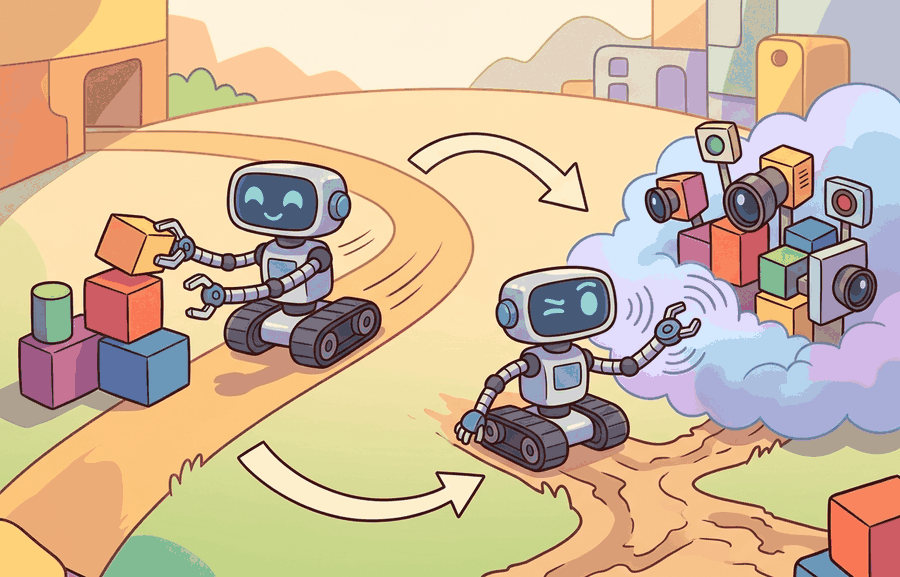
Exploration vs. exploitation names the cost of learning from action. A robot must gather information, but every exploratory action consumes time, reset labor, and safety margin.
This section links back to Chapter 7: Control for AI Practitioners and Chapter 10: Environments with Gymnasium and PettingZoo, then prepares the policy-gradient work in Chapter 15: Policy Gradient Methods and PPO. Exploration is the part of RL where the agent buys information with real actions, so it matters more in robots than in most offline benchmarks.
This section develops the technical contract for exploration vs. exploitation. First we state the conflict, then we formalize an epsilon-greedy policy, then we compute the short-term cost of exploration with concrete numbers.
The key question is practical: when should a robot use the action currently believed to be best, and when should it spend a trial on an action whose value is still uncertain?
Exploitation turns current value estimates into reward. Exploration improves the estimates that future exploitation will depend on.
Theory
The exploration problem appears because the agent only observes rewards for actions it actually takes. A grasping policy can estimate the value of side grasp, top grasp, and push only by trying them or by using data from a behavior policy that tried them earlier. Greedy action selection can freeze too early because the first lucky outcome for one action hides the true value of untested alternatives.
An epsilon-greedy policy makes the tradeoff explicit. Let $A^\*(s)=\arg\max_a Q(s,a)$ be the greedy action under the current estimates. With $|\mathcal A|$ available actions,
$$\pi_\epsilon(a\mid s)= \begin{cases} 1-\epsilon+\epsilon/|\mathcal A|, & a=A^\*(s),\\ \epsilon/|\mathcal A|, & a\ne A^\*(s). \end{cases}$$
The parameter $\epsilon$ is not a free tuning knob. It is a budget for controlled ignorance. A high value gathers more information but may spend physical trials on poor or unsafe actions; a low value protects near-term reward but can lock the agent into a biased estimate.
In embodied systems, exploration must be constrained by reset cost and safety. A simulated bandit arm can be pulled millions of times. A robot arm cannot collide with the table millions of times while calling the collisions "samples."
The mechanism is a probability distribution over actions, not a slogan about curiosity. Changing $\epsilon$ changes the data distribution collected by the agent, which later changes the value estimates and policy updates.
Worked Example
Code Fragment 1 uses three estimated grasp values to compute the action probabilities and expected immediate reward under different exploration budgets. The example is deliberately small so the effect of $\epsilon$ is visible without a simulator.
# Compare epsilon-greedy action probabilities for three grasp choices.
# The expected reward shows the near-term price paid for exploration.
actions = ["side_grasp", "top_grasp", "push_then_grasp"]
estimated_values = [0.40, 0.80, 0.70]

for epsilon in [0.0, 0.2, 0.6]:
    greedy_index = max(range(len(actions)), key=lambda i: estimated_values[i])
    probabilities = [epsilon / len(actions)] * len(actions)
    probabilities[greedy_index] += 1.0 - epsilon
    expected_reward = sum(p * v for p, v in zip(probabilities, estimated_values))
    print(f"epsilon={epsilon:.1f}, expected reward={expected_reward:.3f}")
print(dict(zip(actions, [round(p, 3) for p in probabilities])))The calculation exposes the design tradeoff. Exploration is not free, and in embodied systems the cost can include time, wear, human reset labor, and safety margin.
In practical experiments, Gymnasium wrappers and training libraries can schedule $\epsilon$ over time, but the schedule is only meaningful if it is tied to a task budget. For robot data collection, log exploration rate, reset count, safety stops, and failed contacts in the same artifact.
Practical Recipe
- Write the observation, action, and success metric before choosing a model.
- Build a baseline that is simple enough to debug by inspection.
- Add the library implementation only after the baseline behavior is understood.
- Record failures as structured cases: perception error, state error, planning error, control error, or evaluation error.
- Run at least one perturbation test before trusting the result.
The common mistake in Exploration vs. exploitation is to celebrate the component score before checking the closed-loop handoff. The failure usually appears at the boundary: stale state, wrong frame, delayed action, saturated actuator, or metric that ignores the real task cost.
A grasping team can begin with high exploration in simulation, replay the best candidates on hardware with a lower exploration rate, and keep a safety filter active throughout. The log should distinguish exploratory failures from policy failures because they require different fixes.
Exploration is the agent asking, "What if I am wrong?" Exploitation is the agent acting as if its current answer is good enough.
Safe exploration remains a live research problem for embodied agents. Current work often combines uncertainty estimates, offline datasets, simulation filters, and control barriers so that information gathering does not become an excuse for physically risky behavior.
Can you state what data distribution your exploration rule creates, and what physical cost each exploratory action can incur? If not, the exploration policy is underspecified.
Exploration changes the data distribution, not only the immediate action. A policy that explores top grasps more often will collect more top-grasp failures and successes, which changes future value estimates. This feedback loop is why early exploration choices can shape the whole learning run.
For embodied systems, exploration should be scheduled across risk zones. Use broad exploration in simulation, narrower exploration on hardware, and structured perturbation tests for states that matter to deployment. Randomness without a safety envelope is not a research method.
| Mechanism | What It Changes | Embodied Use |
|---|---|---|
| Epsilon-greedy | Injects uniform random actions with probability $\epsilon$. | Useful in discrete simulators; risky on hardware without an action shield. |
| Entropy bonus | Rewards policies for keeping action distributions broad. | Useful for policy gradients, but needs action-limit and safety monitoring. |
| Uncertainty-guided probing | Targets actions or states with uncertain value estimates. | Better aligned with costly robot trials when uncertainty is calibrated. |
A robust exploration implementation logs both the chosen action and the reason it was chosen. Without that reason, a future debugger cannot tell whether a bad trial came from the greedy policy, injected randomness, uncertainty probing, or a safety override.
- State the exploration mechanism and its schedule before training.
- Constrain the exploratory action set for physical safety.
- Log whether each action was greedy, exploratory, shielded, or human-intervened.
- Track reward, safety cost, and reset count as co-equal evidence.
- Evaluate the final policy with exploration disabled or with the deployment stochasticity specified.
When exploration fails, separate insufficient exploration from unsafe exploration. Insufficient exploration leaves value estimates overconfident in narrow regions. Unsafe exploration creates failures the robot should never have been allowed to test physically.
For exploration studies, compare policies with the same environment panel, seed set, exploration schedule, safety shield, and final evaluation mode. Report exploration cost and final performance from one artifact.
Exploration is a data-acquisition policy with a cost model, not a decorative source of randomness.
Choose four action-value estimates for a robot task and compute the epsilon-greedy probabilities for $\epsilon=0.1$ and $\epsilon=0.4$. Then identify which exploratory action would need a safety shield.
What's Next?
This section treated exploration as a distribution over physical experience. Next, Section 14.4 uses that idea to distinguish on-policy, off-policy, model-free, and model-based learning.
The standard textbook for RL foundations. Read Part I for MDPs, value functions, and the Bellman equations; Part II for TD learning and eligibility traces; Part III for function approximation and policy gradient theory. It is the primary notation reference for this module.
Puterman, M. L. (1994). Markov Decision Processes: Discrete Stochastic Dynamic Programming. Wiley.
Provides the formal mathematical treatment of MDPs, Bellman equations, and the theory of optimal policies. Read Chapter 4 for policy evaluation and Chapter 6 for policy iteration; this is the reference to check when the intuitions from Sutton and Barto need formal grounding in existence and convergence proofs.
Brockman, G. et al. (2016). OpenAI Gym. arXiv.
Introduced the step/reset/render environment interface that became the standard for RL research. Read for the API contract; nearly every RL library and tutorial assumes this interface, and Gymnasium maintains it with minor extensions. Understanding it is prerequisite to using PettingZoo, Isaac Lab, or MuJoCo.
Towers, M. et al. Gymnasium documentation. Farama Foundation.
The actively maintained successor to OpenAI Gym with bug fixes, consistent seeding, and terminated/truncated distinction. Use this as the environment API reference throughout the chapter; the terminated/truncated split matters for bootstrap targets at episode boundaries.
Todorov, E., Erez, T., and Tassa, Y. (2012). MuJoCo: A physics engine for model-based control. IROS.
Describes the contact physics model, generalized coordinates, and constraint solver that make MuJoCo accurate and fast for robot learning. Read the original paper to understand why smooth contact gradients benefit model-based methods; in practice use the official docs for API, but this paper explains why MuJoCo physics behaves differently from game-engine simulators.