"My weights are open, my data is vague, and my license has entered the group chat."
An Inspectable Model With Footnotes
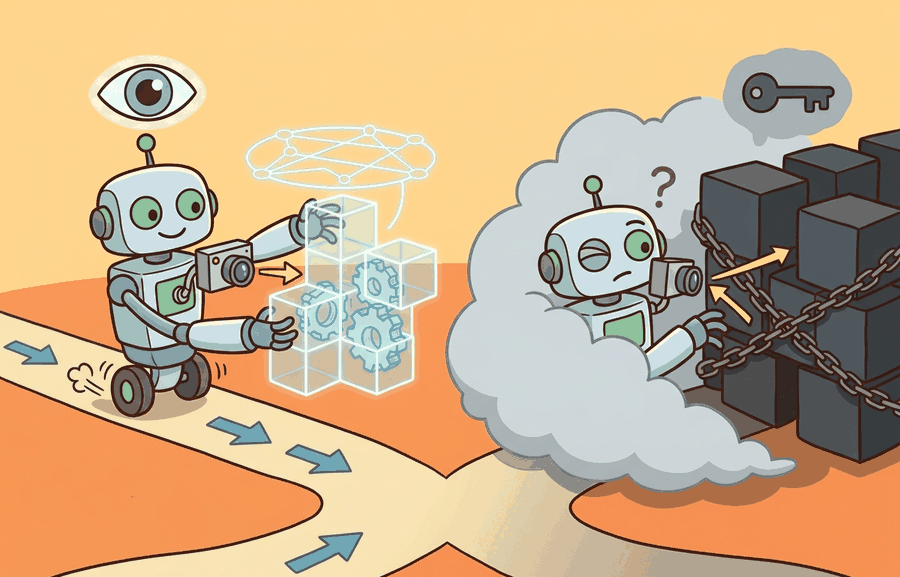
The open-vs-closed model divide gives Frontier and Open Problems a concrete systems role: separate capability, inspectability, licensing, data access, and deployment control. The section keeps asking what the agent observes, what it remembers or updates, which action changes, and what evidence would convince a skeptical reader.
This section develops the technical contract for the open-vs-closed model divide into a usable mental model. First we define the object of study, then we connect it to the agent loop, then we test it with a compact implementation.
The key question in The open-vs-closed model divide is practical: what must the agent know, what can it observe, what action is available, and what evidence shows that the action worked under the stated conditions?
Open and closed model trade-offs should be judged by the action it improves. A section claim is strong when it names the decision, the measurement, and the failure mode before a larger model or simulator is introduced.
Theory
For The open-vs-closed model divide, the practical design rule is to make the interface inspectable before optimization begins: inputs, outputs, units, latency, bounds, and failure labels should all be visible in the saved artifact.
The mechanism in The open-vs-closed model divide is the contract between representation and action. Name what enters the module, what leaves it, which assumptions make that transformation valid, and which log would reveal a bad handoff.
Worked Example
For The open-vs-closed model divide, keep one concrete rollout in view. A sensor reading becomes an estimate, the estimate constrains an action, the action changes the world, and the next observation confirms or contradicts the assumption. The section's idea is useful only if it improves that loop.
For The open-vs-closed model divide, keep the small contract as the inspectable interface, then use OpenVLA, SmolVLA, GR00T, Gemini Robotics, or pi-zero-family tools without changing logging or replay fields.
Practical Recipe
- Write the observation, action, and success metric before choosing a model.
- Build a baseline that is simple enough to debug by inspection.
- Add the library implementation only after the baseline behavior is understood.
- Record failures as structured cases: perception error, state error, planning error, control error, or evaluation error.
- Run at least one perturbation test before trusting the result.
The common mistake in The open-vs-closed model divide is to trust a component score before checking the closed-loop interface. The failure usually appears where state, timing, authority, or evaluation context crosses a module boundary.
A team using The open-vs-closed model divide starts by writing the task panel, not by picking the largest model. They keep a baseline run, a maintained-tool run, and a perturbation run in the same result folder. The comparison is accepted only when the action trace, metric, and failure labels come from one script.
A good embodied system makes the open-vs-closed model divide visible twice: once in the design sketch and once in the replay artifact. The second view keeps the first one honest.
For The open-vs-closed model divide, the open research question is not whether a larger policy can produce a better demo. The sharper question is whether the method improves reliability across new scenes, new embodiments, delayed feedback, and rare failures under an evaluation protocol that another lab can reproduce.
For The open-vs-closed model divide, can you name the observation, action, protected assumption, success metric, and one likely failure case? If any field is vague, rewrite the contract before adding model complexity.
Topic-Native Deepening
Teams building embodied systems constantly face the open-versus-closed decision: do you rely on a vendor API or a local model stack that you can inspect, tune, and reproduce? The answer affects not only cost and convenience, but also debugging depth, benchmark transparency, safety review, and long-term maintenance.
This section frames the divide as a systems governance problem. The right model choice is the one whose assumptions, interfaces, and operational risks match the evidence requirements of your project.
The open-vs-closed model divide becomes teachable once the student can state the operative variables, the decision boundary, and the evidence artifact. The section should therefore be read together with Chapter 34 on open and closed VLA ecosystems and Chapter 55 on deployment architecture, where the same loop is developed from adjacent angles.
Let utility be $U = \alpha\,\text{capability} - \beta\,\text{latency} - \chi\,\text{cost} + \delta\,\text{inspectability} + \eta\,\text{reproducibility}$. Open and closed model choices change all five terms, so the decision cannot be reduced to benchmark accuracy alone.
A closed model often buys stronger default capability and managed infrastructure. An open model buys inspectability, repeatability, and the ability to run ablations. Embodied AI cares about both because hardware debugging rarely succeeds when the decision process is a black box.
- Define the latency, privacy, reproducibility, and fine-tuning requirements of the task.
- Score one open and one closed candidate on the same workload and evidence panel.
- Record which claims depend on provider-side hidden components, such as unknown training data or runtime filtering.
- Choose the smallest model regime that satisfies the deployment contract.
- Keep a migration plan in case the chosen regime becomes unavailable or too expensive.
| Dimension | What To Specify | Why It Matters |
|---|---|---|
| Closed model | High default capability, vendor tooling, managed inference | Opaque failure analysis and weaker reproducibility. |
| Open model | Local inspection, weight access, custom fine-tuning | More infrastructure burden and potentially weaker default performance. |
| Hybrid strategy | Closed planner with open local executor or monitor | Useful when privacy and capability must be balanced. |
| Evidence artifact | Cost, latency, reproducibility, and failure analysis table | Prevents branding from replacing engineering judgment. |
The expected output should reveal why the model choice was made. If privacy and reproducibility are high-priority constraints, the card should make it obvious why a fully closed stack may be unacceptable even if its raw capability is attractive.
After the from-scratch contract is clear, the practical route uses OpenVLA, LeRobot, local VLM stacks, provider APIs, Triton, vLLM, MLflow. The payoff is that standard interfaces, logging, batching, and replay support move from ad hoc glue code into maintained infrastructure, while the evidence schema stays the same.
A good project prototype may begin with a closed planner to move quickly, then migrate to an open VLA or smaller local VLM for the deployed path. Students should explicitly record which artifacts remain reproducible after the migration and which capabilities were lost or gained.
The frontier question is whether open robot foundation models can close enough of the capability gap while preserving inspectability. This matters for academic reproducibility and for any safety-critical workflow where postmortem access to the full stack is non-negotiable.
For The open-vs-closed model divide, the printed artifact should identify the open technical uncertainty, the evidence already available, and the next experiment or design review that would make the frontier claim testable.
- The open-vs-closed model divide matters when it changes an embodied agent's action under a stated observation and metric.
- Separate capability, inspectability, licensing, data access, and deployment control.
- Strong evidence is saved as one artifact containing the baseline, the maintained-tool path, the metric panel, and labeled failures.
Design a method-matched experiment for The open-vs-closed model divide. Specify the environment, observation schema, action interface, metric, and one perturbation that targets the section's core assumption.
Section References
Open X-Embodiment Collaboration. Open X-Embodiment: Robotic Learning Datasets and RT-X Models. arXiv, 2023.
Use for cross-embodiment data scaling, RT-X evaluation, and dataset-standardization claims.
Bardes, A. et al. Revisiting Feature Prediction for Learning Visual Representations from Video. arXiv, 2024.
Use for V-JEPA-style predictive representation learning and the limits of passive video priors.
What's Next?
Next, continue with What is still unsolved (long-horizon reasoning, reliability, real-world RL), where this frontier question is connected to a different research bottleneck.