"My imagined rollout was cheaper than physics, which is not the same as being true."
A World Model Near A Contact Event
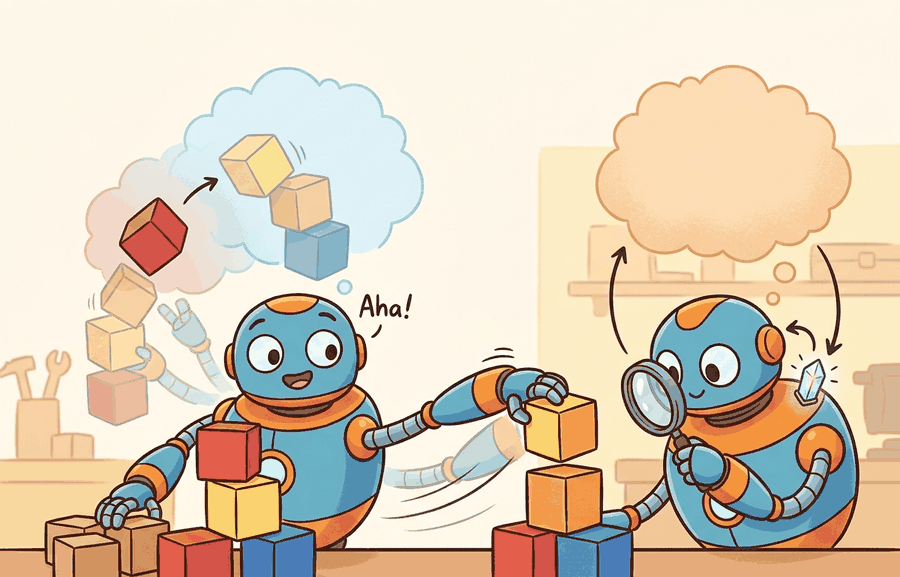
World models in the robot loop gives Frontier and Open Problems a concrete systems role: judge a world model by whether imagined rollouts improve real action selection under a fixed budget. The section keeps asking what the agent observes, what it remembers or updates, which action changes, and what evidence would convince a skeptical reader.
This section develops the technical contract for world models in the robot loop into a usable mental model. First we define the object of study, then we connect it to the agent loop, then we test it with a compact implementation.
The key question in World models in the robot loop is practical: what must the agent know, what can it observe, what action is available, and what evidence shows that the action worked under the stated conditions?
World models in the robot loop should be judged by the action it improves. A section claim is strong when it names the decision, the measurement, and the failure mode before a larger model or simulator is introduced.
Theory
For World models in the robot loop, the practical design rule is to make the interface inspectable before optimization begins: inputs, outputs, units, latency, bounds, and failure labels should all be visible in the saved artifact.
The mechanism in World models in the robot loop is the contract between representation and action. Name what enters the module, what leaves it, which assumptions make that transformation valid, and which log would reveal a bad handoff.
Worked Example
For World models in the robot loop, keep one concrete rollout in view. A sensor reading becomes an estimate, the estimate constrains an action, the action changes the world, and the next observation confirms or contradicts the assumption. The section's idea is useful only if it improves that loop.
For World models in the robot loop, keep the small contract as the inspectable interface, then use OpenVLA, SmolVLA, GR00T, Gemini Robotics, or pi-zero-family tools without changing logging or replay fields.
Practical Recipe
- Write the observation, action, and success metric before choosing a model.
- Build a baseline that is simple enough to debug by inspection.
- Add the library implementation only after the baseline behavior is understood.
- Record failures as structured cases: perception error, state error, planning error, control error, or evaluation error.
- Run at least one perturbation test before trusting the result.
The common mistake in World models in the robot loop is to trust a component score before checking the closed-loop interface. The failure usually appears where state, timing, authority, or evaluation context crosses a module boundary.
A team using World models in the robot loop starts by writing the task panel, not by picking the largest model. They keep a baseline run, a maintained-tool run, and a perturbation run in the same result folder. The comparison is accepted only when the action trace, metric, and failure labels come from one script.
Treat world models in the robot loop like a control-room label. If the label does not tell a future debugger what moved, what sensed, or what failed, it is decoration rather than engineering knowledge.
For World models in the robot loop, the open research question is not whether a larger policy can produce a better demo. The sharper question is whether the method improves reliability across new scenes, new embodiments, delayed feedback, and rare failures under an evaluation protocol that another lab can reproduce.
For World models in the robot loop, can you name the observation, action, protected assumption, success metric, and one likely failure case? If any field is vague, rewrite the contract before adding model complexity.
Topic-Native Deepening
World models promise sample efficiency because the agent can imagine futures before touching hardware. The open problem is that imagination only helps if the latent model stays aligned with the contact dynamics, sensing artifacts, and control delays that matter for the robot's actual decisions.
The section therefore treats a world model as a decision module, not just a predictive loss. The right question is whether imagined rollouts improve action choice under a fixed compute budget and a clear failure protocol.
World models in the robot loop becomes teachable once the student can state the operative variables, the decision boundary, and the evidence artifact. The section should therefore be read together with Chapter 38 on world models and Chapter 37 on model-predictive planning, where the same loop is developed from adjacent angles.
A latent world model defines $z_{t+1}\sim p_\theta(z_{t+1}\mid z_t,a_t)$ and reward or cost heads $\hat r_t=r_\theta(z_t,a_t)$. Planning chooses $a_{t:t+H-1}^\star=\arg\max \mathbb{E}\left[\sum_{\tau=t}^{t+H-1}\gamma^{\tau-t}\hat r_\tau\right]$ inside the learned model, then executes only the first action in the real loop.
The useful intuition is model-predictive control in latent space. The policy is not trusting a fantasy forever; it is repeatedly proposing short-horizon plans, re-observing the world, and correcting the latent state before error compounds too far.
- Encode the current observation into a latent state with uncertainty if available.
- Roll out candidate action sequences inside the latent dynamics for a short horizon.
- Score each sequence with task reward, safety cost, and model-uncertainty penalty.
- Execute the first action only, then re-encode the real observation and replan.
- Log model mismatch whenever real next-state evidence diverges from predicted outcomes.
| Dimension | What To Specify | Why It Matters |
|---|---|---|
| Dynamics mismatch | Contacts, slip, cable interactions, or unmodeled delay | The planner becomes overconfident in impossible futures. |
| Observation aliasing | Two latent states explain the same camera view | Planning commits to the wrong hidden state. |
| Long horizon | Predictions drift after several imagined steps | A short MPC horizon becomes necessary. |
| Evidence artifact | Prediction-vs-reality replay with uncertainty and intervention labels | This reveals whether the planner helps or hallucinates. |
The expected output should read like a planner contract. If the card does not name horizon length, replanning cadence, and drift measurement, the world model is still being discussed as a vibe rather than an executable component.
After the from-scratch contract is clear, the practical route uses DreamerV3, TD-MPC2, mbrl-lib, MuJoCo, Isaac Lab, JAX or PyTorch. The payoff is that standard interfaces, logging, batching, and replay support move from ad hoc glue code into maintained infrastructure, while the evidence schema stays the same.
In a capstone, students can keep the control problem simple, such as pushing an object to a goal, then compare a model-free baseline against a world-model planner under limited interaction budget. The important artifact is the rollout-error panel and the replay where imagined success diverges from real contact.
The frontier is not just better video prediction. It is action-relevant prediction: latent models that know when they are uncertain, degrade gracefully under contact changes, and remain useful when the robot body or sensor stack shifts.
For World models in the robot loop, the printed artifact should identify the open technical uncertainty, the evidence already available, and the next experiment or design review that would make the frontier claim testable.
- World models in the robot loop matters when it changes an embodied agent's action under a stated observation and metric.
- Judge a world model by whether imagined rollouts improve real action selection under a fixed budget.
- Strong evidence is saved as one artifact containing the baseline, the maintained-tool path, the metric panel, and labeled failures.
Design a method-matched experiment for World models in the robot loop. Specify the environment, observation schema, action interface, metric, and one perturbation that targets the section's core assumption.
Section References
Open X-Embodiment Collaboration. Open X-Embodiment: Robotic Learning Datasets and RT-X Models. arXiv, 2023.
Use for cross-embodiment data scaling, RT-X evaluation, and dataset-standardization claims.
Bardes, A. et al. Revisiting Feature Prediction for Learning Visual Representations from Video. arXiv, 2024.
Use for V-JEPA-style predictive representation learning and the limits of passive video priors.
What's Next?
Next, continue with The open-vs-closed model divide, where this frontier question is connected to a different research bottleneck.