"Adaptation starts where the training distribution stops pretending to be the world."
A Rapid Motor Adaptation Whiteboard
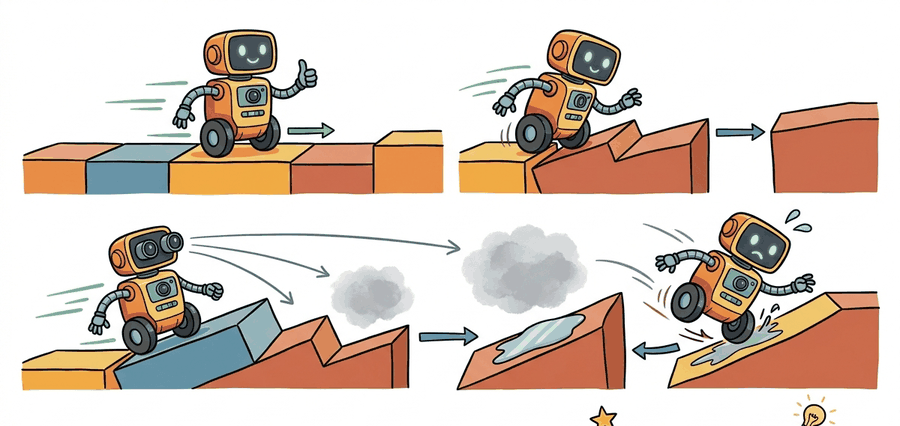
Terrain adaptation is about closing the loop faster than the environment can invalidate the current policy assumptions.
Rapid Motor Adaptation style systems can be summarized as $a_t = \pi(o_t, z_t)$, where $z_t = \phi(h_{t-k:t})$ is a latent variable inferred from recent observation history. The fast policy uses the latent to change foot placement, body posture, and compliance before the environment has to be fully identified in symbolic terms.
For parkour or aggressive terrain tasks, the challenge is not only latent inference. It is contact schedule feasibility under delayed and partial sensing. A policy that adapts too slowly behaves like a good flat-ground walker with a bad memory.
The interesting question is not whether the policy changes after a stumble. It is whether the change tracks a real hidden cause such as friction, step height, payload, or actuator loss.
Theory
Adaptation systems sit between robust control and online system identification. They do not attempt full physical reconstruction of the world at every step. They infer exactly enough hidden structure to change the next action usefully.
This makes evaluation tricky. A policy that adapts may still overfit to training terrain families. The correct test is a held-out disturbance panel with cause labels: softer ground, payload shift, low friction, missing foothold, or delayed contact sensing.
For parkour-like behavior, the controller must also reason about contact sequences. Adaptation is not just a gain change. It can imply a completely different next foothold or body orientation.
- Train or fit a latent encoder on a history window that includes proprioception, contact events, and optional terrain sensing.
- Replay disturbances with a frozen policy and inspect whether the latent shifts in a physically interpretable direction.
- Measure adaptation latency from disturbance onset to policy correction.
- Compare nominal, adapted, and oracle-latent baselines on the same unseen terrain panel.
- Keep at least one failure class that the latent does not explain, to avoid overstating what the adaptation module learned.
Worked Example
A simple latent-distance check can reveal whether the adaptation module reacts differently to friction loss and to payload shift, which is the minimum scientific standard for claiming it learned hidden dynamics rather than noise.
latent_nominal = [0.12, -0.08]
latent_low_friction = [0.44, -0.03]
latent_payload_shift = [0.15, 0.27]

def l1(a, b):
    return round(sum(abs(x - y) for x, y in zip(a, b)), 2)

print({"nominal_to_friction": l1(latent_nominal, latent_low_friction)})
print({"nominal_to_payload": l1(latent_nominal, latent_payload_shift)})Expected output interpretation. Both disturbances move the latent away from nominal, but in different directions. That is the beginning of useful adaptation evidence. The next test is whether those latent shifts actually produce different corrective actions and better recovery.
Isaac Lab terrain curricula, RMA-style adaptation implementations, and ROS 2 replay logs are the practical stack here. The key is to log history windows and latent states alongside the executed control.
Practical Recipe
- Define hidden-variable disturbances explicitly before training: friction, compliance, mass shift, foot-height error, actuator delay.
- Train with randomized terrain and disturbance schedules, but keep held-out test families untouched.
- Log latent trajectories and action trajectories together.
- Measure adaptation latency and post-disturbance recovery, not only episode success.
- Reproduce at least one hardware failure in simulation with the same disturbance label.
A policy that memorizes training terrain classes can look adaptive while doing nothing meaningful on genuinely new surfaces.
A quadruped crossing stepping stones may need a latent that distinguishes underfoot compliance from lateral slip. Both create foot placement error, but the right correction differs.
Adaptation is valuable only when the robot learns what changed before it runs out of safe options.
The frontier combines online adaptation with vision, event-based contact sensing, and hierarchical planners that can change contact schedule as well as gains. The open problem is keeping these systems interpretable enough to debug after a field miss.
What hidden variable would you want your locomotion system to infer online first, and how would you test that the inferred change improved the next action rather than just changed it?
This material is ideal for showing the difference between domain randomization and adaptation. Randomization makes the nominal policy broader. Adaptation tries to identify which world instance the robot is in right now and exploit that fact online.
It is also a place to show how evaluation panels should be labeled by cause, not just by surface appearance. A policy that handles loose gravel may still fail on worn actuators, even if both look like rough motion from the outside.
| Tool or Library | Role in the Topic | Builder Advice |
|---|---|---|
| Isaac Lab terrain curricula | Generate varied disturbance panels | Keep one unseen terrain family for final evaluation. |
| RMA-style adaptation stack | Latent inference plus fast policy | Log latent states and action changes together. |
| ROS 2 replay plus hardware logs | Tie sim adaptation to real failures | Promote real misses into named disturbance classes. |
This section ties into goal and reward design, sim-to-real transfer, and 3D perception.
Create two unseen disturbance families, such as friction loss and payload shift, and audit whether the latent state, action correction, and recovery metric all change in section-specific ways.
When adaptation fails, separate wrong latent inference from too-slow adaptation, infeasible contact schedule, and actuator saturation. Those are different research problems even when the video looks similar.
Section References
Kumar, A. et al. "Rapid Motor Adaptation for Legged Robots." Project page. https://ashish-kmr.github.io/rma-legged-robots/
Primary reference for fast latent adaptation in legged locomotion.
Isaac Lab documentation. https://isaac-sim.github.io/IsaacLab/
Current tooling reference for terrain curricula and transfer workflows.
Margolis, G. et al. "Rapid Locomotion via Reinforcement Learning." Code repository. https://github.com/Improbable-AI/rapid-locomotion-rl
Useful practical reference for agile locomotion control and evaluation.
Good adaptation compresses hidden world changes into actionable corrections before the robot loses recoverability.
Design an adaptation benchmark with three hidden disturbance types and one held-out terrain family. Specify which latent, action, and recovery traces must be logged to justify the claim that the policy adapted rather than got lucky.