"The point of multimodality is to make one channel useful when the other one lies."
A Multimodal Robot Group
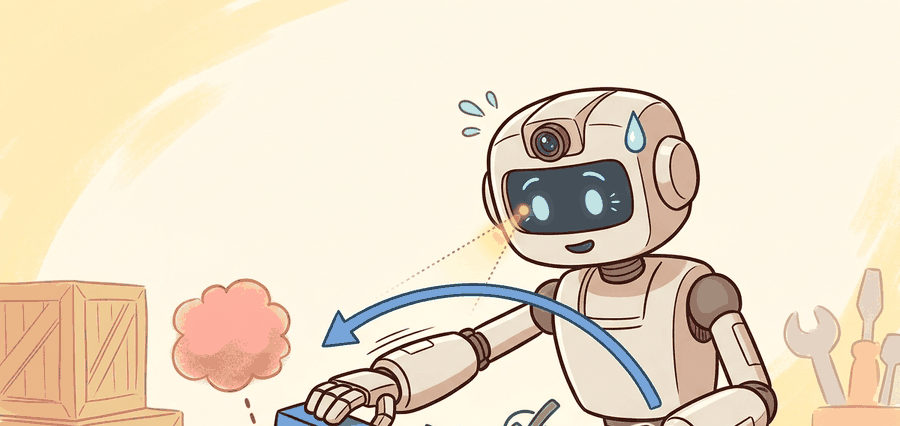
Visuo-tactile pretraining tries to align what the robot sees before contact with what it feels during contact, so a policy can carry uncertainty and object state across that transition more intelligently.
This section explains contrastive and sequence-model approaches to joint visual and tactile representation learning, then ties them to manipulation policies that need to react under occlusion, slip, or contact ambiguity.
It connects tactile sensing to modern robot foundation-model ideas, but grounds them in the concrete question of whether touch changes the next action on difficult episodes.
A visuo-tactile model is only stronger than a visual model if the training process forces it to use the tactile channel on cases where vision is uncertain or misleading.
Theory
The central representation question is whether vision and touch should share a latent space, a predictive state, or only a late fused policy head. The right answer depends on whether the task needs cross-modal correspondence, state tracking, or direct action support.
Many practical systems use a contrastive or predictive loss to align pre-contact visual features with post-contact tactile observations, then fine-tune a policy on top. The failure mode is obvious: if vision alone solves the training distribution, the model learns to ignore touch.
$$ \mathcal{L}_{\text{vt}} = -\log \frac{\exp(\mathrm{sim}(z_v, z_t)/\tau)}{\sum_j \exp(\mathrm{sim}(z_v, z_t^{(j)})/\tau)},\qquad a_t = \pi([z_v, z_t, q_t]) $$
The learner encodes visual and tactile streams, aligns or predicts across them, and then exposes a fused latent state to the manipulation policy. Evaluation must isolate hard cases where the tactile branch should matter.
- Define which task phases are pre-contact visual, contact-rich tactile, or mixed.
- Train a representation that couples those phases through aligned objects, actions, or future outcomes.
- Fine-tune the policy with episodes where tactile information changes the optimal action.
- Audit the fused model against vision-only and touch-only ablations on the same hard cases.
Worked Example
# Compare fused and vision-only performance on hard episodes.
vision_only = {"hard_success": 0.41}
visuo_tactile = {"hard_success": 0.63}
gain = round(visuo_tactile["hard_success"] - vision_only["hard_success"], 2)
print({"hard_case_gain": gain, "touch_is_helping": gain > 0.0})Expected output: The expected output reports a positive gain on hard cases. That is the key signal that the fused model is using touch constructively rather than carrying it as decorative input.
LeRobot, PyTouch, and custom multimodal encoders can accelerate experimentation, but the key artifact remains the hard-case audit that proves touch affects decisions under occlusion or slip.
Practical Recipe
- Define hard cases before pretraining so the evaluation target is clear.
- Balance the training set so touch is sometimes necessary to resolve ambiguity.
- Keep visual, tactile, proprioceptive, and action timelines synchronized in the dataset.
- Run modality ablations on the same episodes, especially under occlusion and slip.
- Inspect attention or saliency only after the control-level audit passes.
If the dataset lets vision solve almost every example, the model will gladly ignore touch while still producing impressive aggregate metrics.
Package opening, compliant insertion, and slippery pick tasks often benefit from visuo-tactile pretraining because the model can use visual context to anticipate contact and tactile feedback to correct it.
Multimodal models are a little like group projects: if one member can do all the work, the others may quietly coast until the hard case arrives.
The frontier includes visuo-tactile transformers, contact-predictive world models, and large multimodal robot corpora. The reliable contribution is still measurable hard-case improvement tied to action quality.
What exact episode type in your benchmark should force the fused model to use touch instead of only vision?
A useful way to teach this topic is through counterfactuals. Ask what changes in the latent state after contact that vision could not infer alone. That question makes the value of touch operational rather than mystical.
This section also introduces an important research discipline: ablate by episode type, not only by dataset average. Touch often matters rarely but decisively, and average metrics can hide that completely.
| Tool or Library | Role in the Topic | Builder Advice |
|---|---|---|
| LeRobot | Multimodal robot data handling | Useful for synchronized robot trajectories and policy training pipelines. |
| PyTouch | Tactile encoding and learning | Good for quickly prototyping tactile feature extractors or encoders. |
| Custom transformer or sequence models | Fusion backbone | Use them only after defining the episode types where fusion should matter. |
Build a fused and a vision-only model on a tiny benchmark with occluded-contact episodes. Compare only on those episodes and explain the difference.
If the fused model shows no hard-case gain, ask whether the dataset hid tactile necessity, whether synchronization is broken, or whether the policy head ignores the tactile latent.
Section References
Open framework for robot datasets and policy training that can host multimodal inputs.
Reference tactile-learning library for multimodal experiments.
Visuo-tactile neural-field project showing multimodal object-state inference in manipulation.
Visuo-tactile pretraining is successful when it creates measurable hard-case gains on episodes where touch should change the action.
Design a hard-case panel for a visuo-tactile policy and specify the ablations you would run to prove the tactile channel is useful.