"Dexterity in simulation becomes interesting only after hardware disagrees."
A Sim-to-Real Transfer Diary
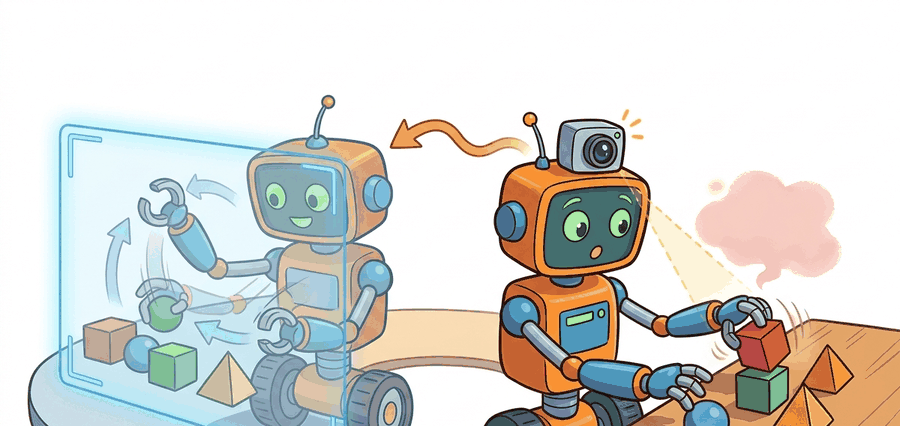
Dexterous sim-to-real transfer is hard because every hidden modeling error in friction, compliance, sensing, delay, and calibration becomes a new contact failure mode.
This section explains why dexterity transfer needs more than randomization. The team must manage actuator delays, fingertip compliance, tactile noise, latency, and contact-model mismatch explicitly.
It ties dexterous learning back to sensing, simulation, and deployment. The result is a transfer ledger that records exactly what simulator assumptions survived hardware contact.
Dexterous sim-to-real does not fail only because the simulator is imperfect. It fails because contact behavior is so sensitive that small mismatches in delay, friction, or compliance can change the entire contact sequence.
Theory
The simulator serves as a proposal generator for contact strategies, not as an oracle. Transfer succeeds when the policy has seen enough variability to survive the small but decisive differences between simulated and real fingertips, objects, and timing.
For dexterity, the important gaps are often not image realism but contact realism: friction coefficients, local compliance, sensor latency, finger backlash, and object inertial mismatch.
$$ \theta^\star = \arg\min_\theta \mathbb{E}_{\phi \sim p(\Phi)}\left[\mathcal{L}_{\text{sim}}(\theta;\phi)\right],\qquad \Delta_{\text{real-sim}} = d(\tau_{\text{real}}, \tau_{\text{sim}}) $$
The team fits or randomizes a family of simulator parameters, trains a dexterous policy across that family, and then compares simulator and hardware traces for the same task panel. The transfer artifact should include the parameter ranges and the first real-world failure signatures.
- Identify or randomize friction, delay, compliance, and sensor-noise ranges before large-scale training.
- Train on parameter families that preserve plausible contact physics instead of randomizing blindly.
- Run hardware pilots with strong safety limits and compare real traces against simulated traces directly.
- Update the simulator family or recovery policy when the first mismatch signatures appear.
Worked Example
# Record one sim-to-real gap summary for a dexterous task.
sim = {"slip_rate": 0.08, "success": 0.81}
real = {"slip_rate": 0.19, "success": 0.62}

gap = {
    "slip_gap": round(real["slip_rate"] - sim["slip_rate"], 2),
    "success_gap": round(sim["success"] - real["success"], 2),
}
print(gap)Expected output: The expected output reveals that real hardware slips more and succeeds less than simulation. That immediately suggests a contact mismatch rather than a purely visual mismatch.
MuJoCo, ManiSkill, and tactile simulators help produce transfer-ready rollouts, but successful dexterous transfer still depends on careful real-trace comparison and guarded hardware deployment.
Practical Recipe
- Measure actuator delay and fingertip compliance on hardware before sim policy training begins.
- Randomize only parameters that could plausibly vary in the real system.
- Compare sim and real on the same task instances and metrics whenever possible.
- Use a hardware safety gate that limits force, speed, and number of consecutive failures.
- Log real-world failures as transfer cases, not as embarrassing exceptions.
Randomization can become a ritual. If the parameter family does not cover the real mismatch that matters, more randomization only hides the blind spot behind extra compute.
Dexterous cube rotation often transfers poorly when fingertip friction or actuator delay is mis-modeled, even if the simulator looks visually convincing and the policy score is high.
A simulator that always agrees with your policy might just be a very supportive fiction writer.
Differentiable tactile simulation, faster visuo-tactile rendering, and richer hand models are improving transfer. The lasting discipline is still to measure the first real mismatch and fold it back into the model family.
Could you name the top three contact parameters whose mismatch would most damage your hardware result?
Sim-to-real for dexterity is a natural place to teach parameter families rather than single best-fit models. Contact behavior lives in ranges, and robust policies must survive those ranges rather than memorize a single simulator setting.
It is also where careful evidence culture pays off. A side-by-side trace of sim and real force, slip, and orientation can explain more than a hundred aggregate benchmark points.
| Tool or Library | Role in the Topic | Builder Advice |
|---|---|---|
| MuJoCo | Dexterous transfer simulation | Use it for fast contact rollouts and parameter sweeps. |
| TACTO or tactile simulators | Touch-channel modeling | Helpful when tactile cues drive contact transitions or slip detection. |
| Hardware transfer ledger | Mismatch auditing | Record slip, timing, and success gaps for each transfer round. |
Train a toy dexterous policy in simulation under three friction settings, then evaluate a held-out friction value and explain how the transfer gap should be recorded.
When transfer fails, first check which trace diverged earliest: pose, force, slip, or timing. The earliest divergence is usually the most actionable one.
Section References
Widely used simulator for dexterous control and transfer studies.
Open-source simulator for high-resolution vision-based tactile sensing.
Open tactile RL environments useful for sim-to-real studies.
Dexterous sim-to-real succeeds by auditing contact mismatches explicitly and training across the parameter ranges that actually matter on hardware.
Write a transfer ledger template for a dexterous task with fields for friction, delay, tactile noise, success, slip, and first divergence time.