"Policies are only interesting when the object disagrees."
A Robot-Learning Lab Book
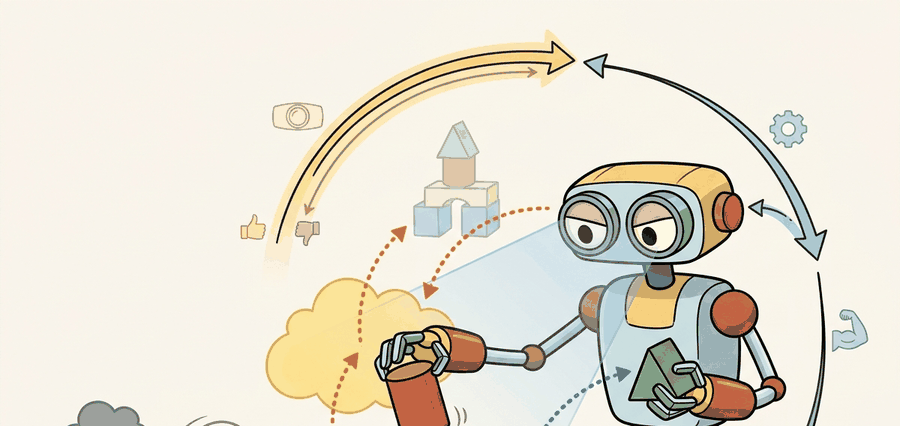
Learning-based manipulation policies sit on top of the same physics and interface contracts as analytic pipelines. Their promise is adaptation and generalization, not exemption from contact, safety, or evaluation.
This section surveys the main policy families for manipulation: behavior cloning and diffusion policies from demonstrations, reinforcement learning with shaped or sparse rewards, and VLA policies conditioned on images and language.
The unifying engineering question is simple: how does the learned policy expose an action contract the robot can monitor, interrupt, and evaluate on the same scenario panel as a classical baseline?
A learned manipulation policy is useful when it generalizes contact decisions and recovery, not when it only imitates clean demonstrations in the easiest parts of the workspace.
Theory
Behavior cloning minimizes prediction error on demonstrated actions, which is efficient but vulnerable to covariate shift. Reinforcement learning optimizes return under interaction, which can discover recovery but is sample hungry. VLA policies use large pretraining and language context, but still need embodiment-specific action interfaces and safety wrappers.
The right comparison is not which family sounds strongest, but which one improves same-panel success, recovery rate, and data efficiency for the manipulation domain you actually care about.
$$ \mathcal{L}_{BC} = -\sum_t \log \pi_\theta(a_t^\star \mid o_t),\qquad J(\theta)=\mathbb{E}_{\pi_\theta}\left[\sum_t r_t\right],\qquad a_t = \pi_{\theta}(o_t, x_t) $$
A learned manipulation stack ingests demonstrations, rollouts, or pretraining corpora, maps observations into an action policy, executes under a bounded interface, and relies on verifiers to decide whether to continue, intervene, or relabel data. That bounded interface is what makes learning compatible with real robots.
- Choose the action interface first: joint deltas, Cartesian waypoints, chunked trajectories, or gripper events.
- Match the learning family to the available signal: demonstrations, reward, language, or mixed supervision.
- Wrap the policy with collision, force, and timeout guards before hardware evaluation.
- Evaluate against analytic or scripted baselines on the same tasks, sensors, and success code.
Worked Example
# Pick a policy family from task signal and recovery needs.
task = {"demos": 500, "reward_dense": False, "language": True, "needs_recovery": True}

if task["demos"] > 300 and task["language"]:
    choice = "vla_or_diffusion_bc"
elif task["reward_dense"] and task["needs_recovery"]:
    choice = "rl"
else:
    choice = "behavior_cloning"

print({"policy_family": choice, "recovery_needed": task["needs_recovery"]})Expected output: The expected result chooses a language-aware imitation route because demonstrations and instruction context are available. In the real system, the next step would be to define the exact action chunk or waypoint interface.
LeRobot, robomimic, ManiSkill, and current OpenVLA-style stacks cover much of the data, policy, and evaluation infrastructure. They help most when the team already knows which action API and recovery signals the learned policy must obey.
Practical Recipe
- Normalize action and observation interfaces across policy families before training.
- Keep a scripted or analytic baseline alive for every task family.
- Evaluate recovery separately from one-shot success by injecting mild perturbations.
- Log policy outputs alongside force, collision, and timeout guards to localize blame.
- Promote hardware policies only after they pass the same-panel simulator and bench tests.
Policy learning is often blamed for failures that actually come from a bad action interface. If the policy emits commands too low-level to be monitored safely, even a good model will look erratic on hardware.
On tabletop pick and place, diffusion policies often shine when the task needs smooth multimodal trajectories, while a simpler BC policy may be enough if the cell is tightly structured and recovery logic is external.
A policy with great losses and terrible object outcomes is just a very committed impersonator.
The frontier is moving toward cross-embodiment VLAs, larger robot datasets, and policy distillation across simulators and hardware. The systems bar remains action-interface clarity, safe execution wrappers, and fair baselines.
Could you explain why your chosen action interface is compatible with intervention, safety filtering, and offline replay?
This chapter section is a good place to stress that policy families and action APIs are different design layers. A diffusion policy over Cartesian chunks and a BC model over joint deltas may fail for reasons that have nothing to do with diffusion or cloning and everything to do with monitorability and embodiment fit.
It is also the right moment to insist on same-panel evidence. Manipulation papers and demos frequently compare policies that ran with different controllers, sensors, or success metrics. Those comparisons sound quantitative while saying very little.
| Tool or Library | Role in the Topic | Builder Advice |
|---|---|---|
| LeRobot | Dataset and policy workflow | Use it for data loaders, policy baselines, and low-cost hardware integration. |
| robomimic | Offline imitation-learning baselines | Use it when you need strong manipulation imitation baselines and reproducible configs. |
| ManiSkill | GPU manipulation training and evaluation | Useful for policy iteration and broad task panels before hardware tests. |
Train a small policy on a toy manipulation dataset and compare it to a scripted baseline on nominal and perturbed episodes. Report success and recovery behavior.
Separate policy mistakes into perception misread, action-interface mismatch, unsafe command, and missing recovery. Those labels keep learning experiments from turning into vague stories about instability.
Section References
Open tooling for robot datasets, imitation policies, and low-cost hardware workflows.
Manipulation imitation-learning benchmark suite and policy library.
Current open-source vision-language-action stack for robot control and fine-tuning.
Learned manipulation policies are most valuable when they improve recovery and generalization while staying inside a clear, monitorable action contract.
Choose one manipulation task and justify whether BC, RL, or a VLA policy is the right first learning baseline. Your answer should mention data, action interface, and recovery supervision explicitly.