Pretraining is only worth the electricity bill if the robot needs fewer collisions to learn the same lesson.
A Patient JEPA Encoder
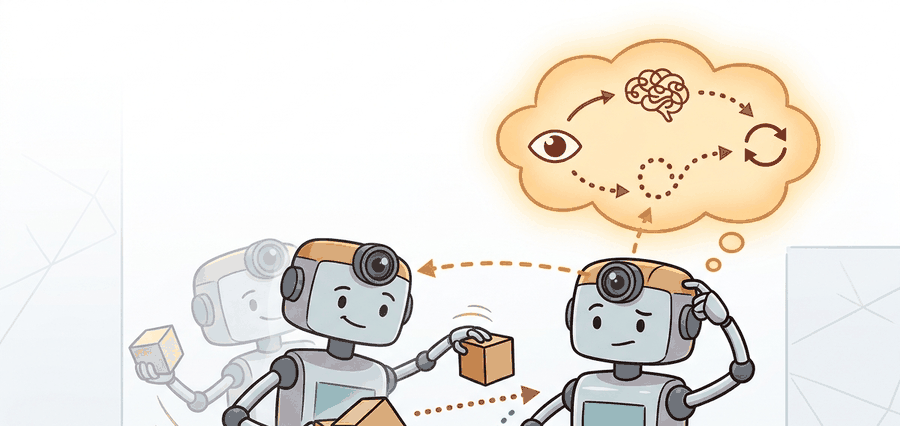
Self-supervised Pretraining For Control matters because embodied intelligence is a closed loop. The agent must sense, represent, predict, decide, act, observe the consequence, and revise its belief before the next action.
Self-supervised pretraining becomes useful for control only when the frozen or lightly adapted encoder exposes the state variables the controller cannot cheaply relearn from sparse robot rewards. In practice, those variables are often object permanence, coarse geometry, temporal continuity, and action-relevant scene changes.
The engineering question is therefore not "should we pretrain?" but "which objective, transfer interface, and adaptation budget give the controller the highest return per hour of robot data?"
A model earns its place only when it improves action. In Self-supervised Pretraining For Control, the reader should keep asking which decision changes, which uncertainty is exposed, and which failure mode becomes easier to diagnose.
Theory
Let $\phi(o_t)$ be a pretrained encoder and $\pi_\theta(a_t \mid \phi(o_t), g_t)$ a downstream controller conditioned on goal $g_t$. The transfer question is whether pretraining improves the data-efficiency or asymptotic quality of the control objective
$$ J(\theta; \phi)=\mathbb{E}\left[\sum_{t=0}^{T-1}\gamma^t r(s_t,a_t)\right]. $$
In practice the encoder can be frozen, partially adapted, or fully fine-tuned. A convenient decomposition is
$$ \phi^\star=\arg\min_\phi \mathcal{L}_{\text{ssl}}(\phi), \qquad \theta^\star=\arg\max_\theta J(\theta;\phi^\star), $$
followed by a decision about whether joint fine-tuning is worth the extra instability. The control win comes from giving the policy an input representation that already respects the structure of the task before expensive interaction begins.
The practical loop is pretrain, freeze or adapt, attach a control head, then compare against a no-pretraining baseline on the same rollout panel. If the representation only improves offline probes but not control data-efficiency, it has not yet earned deployment cost.
Worked Example
The following probe compares two control-learning curves under a simple transfer model. The point is to inspect what a pretraining gain looks like numerically before it gets buried in a larger robot stack.
# Compute a JEPA-style representation prediction loss.
# Compare sample-efficiency with and without a pretrained encoder.
import numpy as np

robot_hours = np.array([1, 2, 4, 8, 16], dtype=np.float32)
scratch_success = np.array([0.18, 0.27, 0.39, 0.51, 0.64], dtype=np.float32)
pretrained_success = np.array([0.31, 0.42, 0.55, 0.66, 0.75], dtype=np.float32)

gain = pretrained_success - scratch_success
best_hour = int(robot_hours[np.argmax(gain)])
print({
    "scratch_final": round(float(scratch_success[-1]), 2),
    "pretrained_final": round(float(pretrained_success[-1]), 2),
    "largest_gain_hour": best_hour,
    "largest_gain": round(float(np.max(gain)), 2),
})
{'scratch_final': 0.64, 'pretrained_final': 0.75, 'largest_gain_hour': 4, 'largest_gain': 0.16}The expected output should show the largest gain at an early or middle interaction budget. If the gain only appears after large amounts of robot data, the encoder may be helping optimization less than a better controller or dataset would.
The hand-built probe only exposes the transfer logic. In a real stack, PyTorch covers the encoder and control head, FAISS is useful for latent retrieval diagnostics, and LeRobot or ROS 2 logs keep the pretrained checkpoint tied to real rollout traces instead of isolated offline plots.
For Self-supervised pretraining for control, evaluate the generated or predicted object through the closed loop that consumes it, because interface failures often dominate component scores.
A warehouse-picking team pretrains on thousands of hours of unlabeled wrist-camera and overhead-camera video, then fine-tunes only a small grasp-ranking head on hard-negative robot episodes. The benefit is not abstract representation quality. The benefit is that the controller starts with features that already separate handle geometry, occlusion boundaries, and object persistence, so the robot spends its scarce interaction budget on contact refinement rather than relearning the scene from scratch.
The frontier question is no longer whether self-supervised pretraining helps at all. It is which objectives produce latents that transfer across embodiments, camera shifts, and task families without hiding the contact-scale details that high-precision control still needs.
This section connects to Chapter 27 for vision for action, Chapter 35 for foundation models, Chapter 41 for generative planning. Follow those links when a planning, perception, or safety assumption needs a refresher before the current method is trusted.
Can you state the observation, state estimate, action, prediction horizon, success metric, and most likely failure mode for Self-supervised pretraining for control? If not, the system boundary is still too vague.
In production, the decisive question is where the representation enters the controller. Frozen latents are attractive because they stabilize training and simplify debugging, adapter-based tuning is often the best compromise when the task differs from pretraining, and full fine-tuning should be reserved for cases where the embodiment mismatch is large enough that a fixed encoder blocks performance.
V-JEPA 2 is a useful anchor because it separates broad passive pretraining from smaller embodiment-specific adaptation. That pattern generalizes beyond JEPA: whenever robot data is expensive, treat pretraining as a way to purchase state abstraction early, then verify the win with matched closed-loop evidence.
- Write the observation, action, state estimate, success metric, and rejection criterion.
- Run a deterministic smoke test on one seed and save the complete configuration.
- Add one perturbation tied to the section topic: delay, noise, horizon length, contact change, distractor object, or generated-scene shift.
- Compare only methods evaluated by the same script, split, seed panel, and metric definition.
- Record a postmortem that assigns failures to perception, representation, dynamics, planning, control, data coverage, timing, or evaluation.
When Self-supervised pretraining for control fails, do not collapse the result into a single method verdict. Assign the failure to the interface that broke, rerun one controlled perturbation, and keep the trace next to the metric. That habit turns a disappointing rollout into a reusable diagnostic asset.
Self-supervised Pretraining For Control is useful when it improves a measured closed-loop decision, exposes its uncertainty, and leaves behind an artifact that another reader can replay.
Design a minimal experiment for Self-supervised pretraining for control. Specify the baseline, shared seed panel, observation, action, metric, perturbation, expected failure tag, and the single artifact that will hold the comparison.
Bibliography & Further Reading
Primary References And Tools
LeCun, Y.. "A Path Towards Autonomous Machine Intelligence." (2022). https://openreview.net/forum?id=BZ5a1r-kVsf
This position paper frames JEPA as a path toward predictive abstract representations. It gives the conceptual motivation for predicting in representation space rather than reconstructing every sensory detail.
Assran, M. et al.. "Self-Supervised Learning from Images with a Joint-Embedding Predictive Architecture." (2023). https://arxiv.org/abs/2301.08243
I-JEPA is the image-based foundation for the joint-embedding predictive idea. It is useful for understanding masking, target encoders, and representation prediction before moving to video.
Bardes, A. et al.. "V-JEPA: Revisiting Feature Prediction for Learning Visual Representations from Video." (2024). https://arxiv.org/abs/2404.08471
V-JEPA extends JEPA-style prediction to video. It grounds the chapter's distinction between predicting latent features and reconstructing pixel-level futures.
Meta AI. "Introducing the V-JEPA 2 World Model and New Benchmarks." (2025). https://ai.meta.com/blog/v-jepa-2-world-model-benchmarks/
The official V-JEPA 2 release discusses video-trained world models, benchmarks, and zero-shot robot-control claims. The chapter treats these as important frontier claims that need task-level verification.
Assran, M. et al.. "V-JEPA 2: Self-Supervised Video Models Enable Understanding, Prediction and Planning." (2025). https://arxiv.org/abs/2506.09985
The V-JEPA 2 paper connects self-supervised video pretraining with action-conditioned latent planning. It is the central technical reference for this chapter's JEPA-to-control bridge.