"Synthetic data is best treated as a targeted experiment, not as a wholesale substitute for real experience."
Synthetic Worlds Need Audit Trails
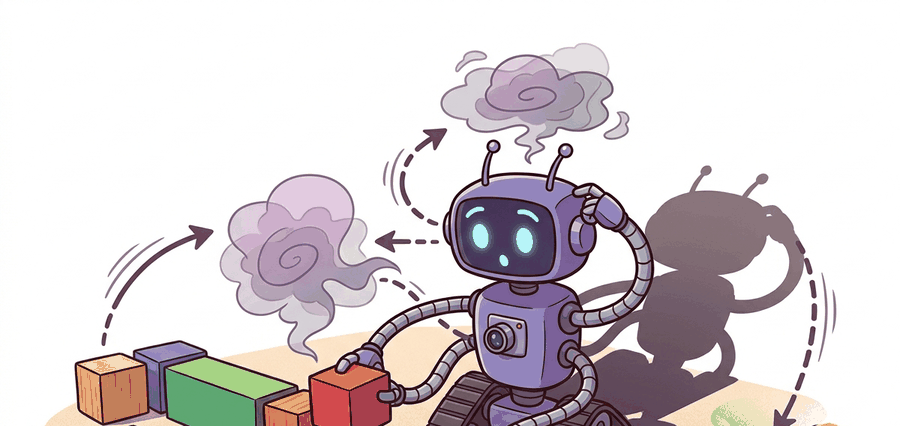
Generative world models become immediately useful when they generate edge cases, rare combinations, or evaluation panels that would be slow or dangerous to collect in the real world. The challenge is keeping those synthetic worlds matched to the task you actually care about.
Follow the pipeline from scenario specification to generation to task evaluation. Every gain in data volume or scenario diversity must be checked against one risk: the synthetic world may shift the policy toward solving artifacts rather than the intended task.
Synthetic data is best treated as a targeted experiment, not as a wholesale substitute for real experience. Coverage helps only when causal structure stays aligned and the training monitor still agrees with real-world success rate.
Problem First
Humanoids, mobile manipulators, and autonomous vehicles all suffer from sparse exposure to rare but important events. Generative world models promise to fill that gap, but they can also inject unrealistic correlations or shortcut cues. This section is about using generated worlds as training or evaluation assets without fooling yourself about transfer.
Core Model
Let $\mathcal{D}_{\text{real}}$ be the observed dataset and $\mathcal{D}_{\text{gen}}$ the generated dataset. A simple mixture view is: $$\mathcal{D}_{\text{mix}} = \alpha \mathcal{D}_{\text{real}} + (1-\alpha) \mathcal{D}_{\text{gen}}.$$ The benefit grows when $\mathcal{D}_{\text{gen}}$ covers rare but task-relevant states; the risk grows when generated states alter the causal structure of the task.
For evaluation, the logic is similar but stricter. A generated panel is useful when it systematically probes failure modes that are hard to capture in the field, such as sudden lighting change, near-collision geometry, or unusual human motion. The panel is misleading when it adds unrealistic shortcuts that inflate performance.
Humanoid pipelines sharpen this tradeoff because balance, contact timing, and recovery dynamics are fragile. A visually plausible synthetic clip may still miss the contact transitions that determine whether the policy falls.
Specify the rare event you want more of, generate the scenario family, run a matched policy evaluation on real and synthetic panels, and accept the synthetic data only if it improves the intended robustness metric without degrading transfer on the untouched real validation set.
Minimal Probe
The probe below computes a simple mixture ledger. The goal is not to maximize synthetic share blindly, but to keep track of how much real supervision anchors the generated edge cases.
# Track how much of a training mix comes from generated worlds.
# The ledger matters because synthetic coverage and synthetic bias rise together.
real_episodes = 320
generated_episodes = 180
synthetic_fraction = generated_episodes / (real_episodes + generated_episodes)
print({"synthetic_fraction": round(synthetic_fraction, 2), "real_anchor_kept": synthetic_fraction < 0.5})
{'synthetic_fraction': 0.36, 'real_anchor_kept': True}
Expected behavior: A moderate synthetic fraction can be healthy because real data still anchors the task. The number itself is not universal, but the ledger forces the team to state how much of the policy's experience came from generated worlds before they interpret transfer results.
The bookkeeping is only a few lines, but the practical shortcut is to pair it with generated-scenario platforms such as Cosmos, Project Genie-style interfaces, or open data stacks such as LeRobot and Open X-Embodiment while keeping the ledger in your own training and evaluation code. Teams often log those runs through PyTorch-based trainers, Isaac or MuJoCo validation scenes, and TensorBoard or Weights & Biases dashboards. The platform generates the worlds; your pipeline must preserve the provenance and the real-versus-generated split explicitly.
Practical Recipe
- Generate synthetic data for named failure modes, not for generic volume.
- Keep real-only, synthetic-only, and mixed evaluations side by side.
- Inspect whether the policy learned cues that exist only in the generated worlds.
- For humanoids and contact-rich robots, prioritize edge cases tied to balance recovery, occlusion, or human interaction over purely cosmetic variation.
Generated worlds can teach the wrong lesson faster than real data can. If a policy improves only on synthetic panels while slipping on untouched real validation, the synthetic coverage is probably injecting a shortcut.
A humanoid locomotion team may synthesize slippery-floor or moving-obstacle scenes that are too risky to over-sample on hardware. The generated data is valuable when it teaches early recovery behavior and preserves contact timing. It is harmful if the synthetic world makes falls too predictable or textures correlate spuriously with safe footholds. In practice, teams often compare those runs in PyTorch trainers against Isaac or MuJoCo validation scenes while watching TensorBoard or Weights & Biases dashboards for real-versus-synthetic drift.
The most promising direction is targeted synthetic coverage: use world models to generate the exact corner cases that real data lacks, then verify those cases with matched real-world probes. The hardest open problem is causal fidelity, especially for contact-rich humanoid and manipulation tasks where small errors can change the whole recovery strategy.
For robot datasets and scaling decisions, see Chapter 24. For sim-to-real transfer protocols, revisit Chapter 20. For deployment monitoring after synthetic pretraining, connect to Chapter 55.
Generated worlds are most valuable when they sharpen coverage rather than replace reality wholesale. That is especially true in humanoid pipelines, where the policy's mistakes are shaped by contact and embodiment details that are easy to blur in a video-centric generator. Teams often pair generated scenarios with real-data anchors from LeRobot, Open X-Embodiment, or task-specific logs for exactly this reason.
The right mental model is not “synthetic data is cheaper real data.” It is “synthetic data is a controllable experimenter.” Use it to target missing cases, but keep real data as the anchor that decides whether those generated cases taught the right lesson.
Can you state one rare event that should be over-sampled with a world model, one artifact that would make that synthetic data dangerous, and one real-world probe that would verify transfer?
Use generative world models to target missing edge cases and structured evaluations, while keeping real data as the anchor that decides whether the synthetic lesson transfers.
Pick one humanoid or robot task and define a synthetic-data policy: what event will you generate, what real validation panel will you keep untouched, and what failure would make you discard the generated data?
Bibliography & Further Reading
Primary References And Tools
NVIDIA. "Physical AI with World Foundation Models." (2026). https://www.nvidia.com/en-us/ai/cosmos/
Cosmos is the clearest current source for synthetic-world pipelines aimed at physical AI.
Google DeepMind. "Genie 3: A New Frontier for World Models." (2025). https://deepmind.google/blog/genie-3-a-new-frontier-for-world-models/
Genie 3 shows how interactive world generation may feed future data-generation and evaluation loops.
Open X-Embodiment Collaboration. "Open X-Embodiment." (2023). https://arxiv.org/abs/2310.08864
This is a useful contrast point because it emphasizes broad real-data aggregation rather than synthetic generation.