"In hardware, the rejection decision is often more important than the nominal prediction."
A Latent State That Must Survive Contact
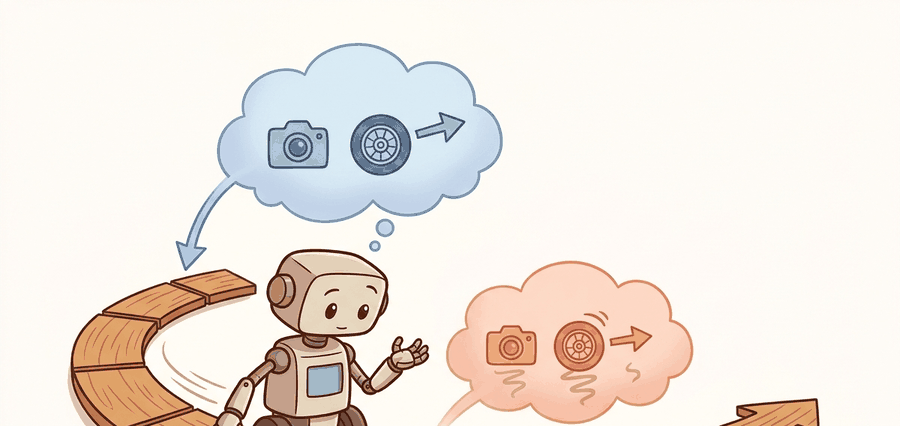
Visual control is where all latent-world-model abstractions are tested at once. The representation must fuse images with proprioception, survive occlusion and contact, and still be fast enough for the control loop that actually moves hardware.
Read this section as a deployment checklist: choose sensors, define which hidden variables matter for the task, decide whether the latent must reconstruct images or only preserve control variables, then instrument the closed-loop failures you expect in the real robot.
In hardware, the rejection decision is often more important than the nominal prediction. A world model needs a fallback story, not only a best-case story.
Problem First
A world model that looks great on benchmark rollouts can still fail the moment vision becomes ambiguous, latency spikes, or the robot makes contact. Visual control is the acid test because the learned state must handle high-dimensional sensing while preserving the low-dimensional geometry and timing that control depends on.
Core Model
A deployed visual-control latent often combines multiple sensing streams: $$z_t = f_\theta\big(\mathrm{enc}_{\text{vision}}(o_t^{1:m}), \mathrm{enc}_{\text{prop}}(q_t, \dot q_t), a_{t-1}, h_{t-1}\big).$$ This matters because vision alone rarely resolves hidden contact state, while proprioception alone rarely resolves scene structure.
The control objective remains the same, but rollout error should now be read through a safety lens: $$a_t = \pi(z_t), \qquad \text{reject if } \Pr(\text{collision or instability} \mid z_t) > \tau.$$ In practice, the world model becomes one module in a larger stack that may include a low-level stabilizer, safety filter, or reflex policy.
Visual control therefore favors representations that are task-sufficient, multimodal, and timing-aware. A perfect decoder is optional. Stable contact prediction, fast inference, and recoverable failure handling are not.
Fuse vision and proprioception before planning, monitor rollout confidence during execution, and hand off to a safer controller or reflex when the latent state becomes unreliable. A world model in hardware is part of a fallback architecture, not the whole architecture.
Minimal Probe
The probe below fuses a visual embedding with proprioception and then checks whether a simple confidence gate would reject an unsafe rollout. The logic is intentionally small, because this is the boundary every hardware stack eventually needs to expose.
# Fuse vision and proprioception, then gate execution by confidence.
# The rejection decision is often more important than the nominal action.
import numpy as np

vision_latent = np.array([0.62, 0.18, 0.51])
proprio_latent = np.array([0.55, 0.24, 0.48])
fused = 0.7 * vision_latent + 0.3 * proprio_latent
uncertainty = np.abs(vision_latent - proprio_latent).mean()
execute = uncertainty < 0.08
print({"fused_state": np.round(fused, 3).tolist(), "uncertainty": round(float(uncertainty), 3), "execute": execute})
{'fused_state': [0.599, 0.198, 0.501], 'uncertainty': 0.053, 'execute': True}
Expected behavior: Execution should proceed only when the sensing streams agree closely enough for the controller to trust the fused state. If uncertainty stays high during contact or occlusion, the stack needs a fallback mode rather than a stronger decoder.
The from-scratch fusion check is about 10 lines. In practice, teams pair world-model code with maintained robotics stacks such as LeRobot, Isaac Lab, or MuJoCo-based controllers. Those stacks handle sensor synchronization, rollout logging, and hardware interfaces so the world-model engineer can concentrate on state quality and failure gating.
Practical Recipe
- Log vision-only, proprio-only, and fused-state diagnostics separately.
- Define a rejection policy for latent uncertainty before the first hardware test.
- Stress the model with lighting change, occlusion, calibration drift, and mild contact mismatch.
- Measure wall-clock latency alongside task success; a stronger latent that arrives too late is still a failure.
If visual and proprioceptive streams disagree, executing the nominal action can be less safe than doing nothing or handing off to a fallback controller. Hardware world models must be calibrated for abstention.
A humanoid stepping over clutter needs foot-contact timing, scene geometry, and body-state estimates in one loop. If the camera overexposes or the proprioception drifts, the latent may still look numerically plausible while the next foot placement becomes unsafe. Good visual-control pipelines therefore log disagreement, trigger fallback controllers, and treat world-model confidence as an operational signal.
The frontier is moving toward multimodal world models that unify camera streams, proprioception, force, and language goals while still meeting deployment latency. The unresolved issue is how to calibrate rollout confidence well enough that a real robot knows when to trust its predicted future and when to back off.
For visual sensing failure modes, revisit Chapter 27. For contact dynamics and friction that latent rollouts often struggle with, see Chapter 6. For deployment audits and safety metrics, connect to Chapter 53.
Visual control is where world models stop being abstract. The useful representation must carry geometry, embodiment, and timing in one state. That often means a multimodal latent, a shorter imagination horizon than benchmark videos suggest, and an explicit contract for when to reject the model's advice.
There is also a design decision about decoding. Some teams keep an image decoder because reconstructions expose what the latent forgot. Others remove it and devote capacity to reward, value, or contact heads. The better choice depends on what failures the builder needs to diagnose and how much inference budget the controller has.
If a world model controls hardware from vision, can you name the fallback policy, the uncertainty signal that triggers it, and the first real-world perturbation you would run before trusting the rollout horizon?
For visual control, a world model is only as good as its multimodal state quality, latency budget, and fallback behavior under uncertainty.
Design a rejection policy for a camera plus proprioception world model on a mobile manipulator. Which signal would trigger the fallback controller, and how would you test that threshold before deployment?
Bibliography & Further Reading
Primary References And Tools
Hafner, D. et al.. "Mastering Diverse Domains through World Models." (2023). https://arxiv.org/abs/2301.04104
DreamerV3 remains the main reference for vision-based latent control at scale.
Hansen, N., Su, H., and Wang, X.. "TD-MPC2: Scalable, Robust World Models for Continuous Control." (2023). https://openreview.net/forum?id=Oxh5CstDJU
TD-MPC2 highlights the latency-sensitive, decoder-free end of the design spectrum.
Hugging Face. "LeRobot." (2024). https://github.com/huggingface/lerobot
LeRobot is a practical reference for the logging, dataset, and policy infrastructure that visual-control teams actually use.