"The world model does not need to be right about everything; it needs to be right about what the policy will try next."
An Agent That Dreams On Purpose
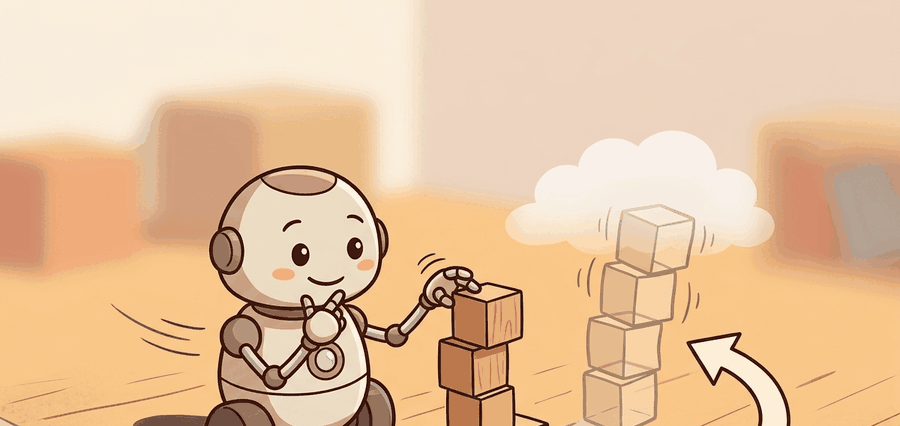
Dreamer turns the world model into a training ground. Instead of using latent dynamics only for planning, it imagines trajectories inside the model and trains the actor and critic on those futures.
Track the data flow in two phases: posterior rollouts from real replay for model learning, then prior rollouts in imagination for behavior learning. The key question is what makes imagined updates useful rather than self-delusion.
Dreamer gains sample efficiency by spending model compute instead of environment interaction, but that bargain works only while imagined rollouts stay trustworthy enough for policy improvement.
Problem First
Once the world model exists, the next design choice is whether to use it only for local planning or also as a synthetic experience generator for policy learning. Dreamer matters because real robot interaction is expensive, so if the model can generate sufficiently faithful imagined futures, the actor can improve with many more gradient steps than hardware time would ever permit.
Core Model
Dreamer keeps the RSSM backbone but adds latent actor-critic learning. Starting from posterior states inferred from replay, the algorithm imagines trajectories using the model prior and optimizes the actor against predicted returns: $$\hat z_{t+1}, \hat h_{t+1} \sim p_\theta(\cdot \mid \hat h_t, \hat z_t, a_t), \qquad a_t \sim \pi_\psi(\cdot \mid \hat h_t, \hat z_t).$$ The critic estimates value in latent space, and the actor is trained on a bootstrapped return: $$V_\nu(\hat s_t) \approx \mathbb{E}\Big[\sum_{k=0}^{H-1} \gamma^k \hat r_{t+k} + \gamma^H V_\nu(\hat s_{t+H})\Big].$$
The subtle point is distribution shift. Imagined states are not real replay states, so the world model must stay accurate on the states the evolving actor actually visits. DreamerV3's contribution is not a brand-new objective so much as a robustness package: normalization, target balancing, and stable parameterizations that let the same recipe work across Atari, DeepMind Control, Crafter, and Minecraft.
Dreamer therefore sits between pure model-free RL and explicit online MPC. It learns a policy like a model-free agent, but the experience it learns from is partly synthesized by the world model.
Infer posterior states from real replay, sample short imagined rollouts from those anchor states, estimate latent rewards and continuation, compute bootstrapped returns, then update actor and critic entirely in latent space. The world model learns from reality; the behavior learner trains in dreams.
Minimal Probe
The code below computes a short lambda-style return over imagined rewards and values. This is the quantity that lets Dreamer update behavior without waiting for fresh environment interaction after every step.
# Compute a short imagined return from latent rewards and critic values.
# The backward scan shows how bootstrapping extends horizon cheaply.
import numpy as np

rewards = np.array([0.7, 0.5, 0.4])
values = np.array([1.2, 1.0, 0.8, 0.6])
gamma = 0.99
lam = 0.95
returns = np.zeros_like(rewards)
target = values[-1]
for t in range(len(rewards) - 1, -1, -1):
    target = rewards[t] + gamma * ((1 - lam) * values[t + 1] + lam * target)
    returns[t] = target
print(np.round(returns, 3).tolist())
[2.319, 1.729, 0.994]
Expected behavior: The first imagined step has the largest target because it inherits both immediate reward and the bootstrapped tail. If these returns become systematically overoptimistic relative to real rollouts, the imagination horizon is too long or the model reward head is drifting.
The manual return computation is about 12 lines. In practice, the same target becomes roughly 3 lines with utilities such as rlax.lambda_returns in JAX or the return-estimation helpers inside the official DreamerV3 implementation. Those libraries absorb scan logic, shape handling, and truncation bookkeeping so the engineer can focus on horizon diagnostics.
Practical Recipe
- Anchor imagination rollouts from posterior states inferred from real data, not from arbitrary latent samples.
- Keep imagined horizon short at first; longer dreams increase update efficiency but also amplify model bias.
- Track disagreement between imagined and real reward or continuation on matched states.
- Inspect whether policy improvement survives when you shorten the imagination horizon by half.
A policy can learn to exploit world-model errors instead of task structure. If shortening the imagination horizon sharply changes the learned behavior, the actor is probably feeding on model bias.
A legged robot team may collect only a few minutes of hardware data per day. Dreamer-style imagination lets them turn each real rollout into hundreds of latent training targets. The bargain only works if imagined failures resemble real ones; otherwise the actor learns to exploit simulator artifacts hidden inside the world model.
The main frontier question is how far imagination can scale before model bias dominates the update. Recent work explores better representation objectives, uncertainty-aware imagination, and hybrid schemes that combine Dreamer-style latent actor learning with explicit planning or offline datasets.
For actor-critic objectives and bootstrapping, revisit Chapter 15. For offline datasets that can seed world-model learning, connect to Chapter 25. For explicit receding-horizon planning instead of latent actor learning, compare with Section 38.5.
Dreamer is best thought of as a compute allocation strategy. Real interaction produces anchor states; imagination expands those anchors into many more value targets and policy gradients. The win is sample efficiency. The risk is that model error becomes the training distribution, especially when the actor discovers states the current model has never seen.
DreamerV3 is important historically because it showed that a single robust recipe can span very different domains. That result shifted the discussion from “can world models work at all?” to “what representation and objective choices make them dependable across tasks with wildly different observation and reward scales?”
Can you explain why Dreamer trains the world model on real replay but trains the actor on imagined rollouts, and what empirical sign would tell you that the dreams became too long or too optimistic?
Dreamer succeeds when imagined rollouts are cheap enough to multiply learning signal and accurate enough that the policy still improves in the real environment.
Write a deployment checklist for deciding the maximum imagination horizon in a robot task. Which three curves or replay comparisons would you inspect before extending the horizon?
Bibliography & Further Reading
Primary References And Tools
Hafner, D. et al.. "Dream to Control: Learning Behaviors by Latent Imagination." (2020). https://arxiv.org/abs/1912.01603
The original Dreamer paper explains the imagined actor-critic loop cleanly.
Hafner, D. et al.. "Mastering Diverse Domains through World Models." (2023). https://arxiv.org/abs/2301.04104
DreamerV3 is the current reference for robust, broadly configured latent imagination.
Danijar Hafner. "DreamerV3 Project Page." (2023). https://danijar.com/project/dreamerv3/
The project page is useful for code, ablations, and task coverage after the theory is clear.