A planner without a model is blind. A planner with one wrong model is confidently blind.
A Budget-Conscious MPC Loop
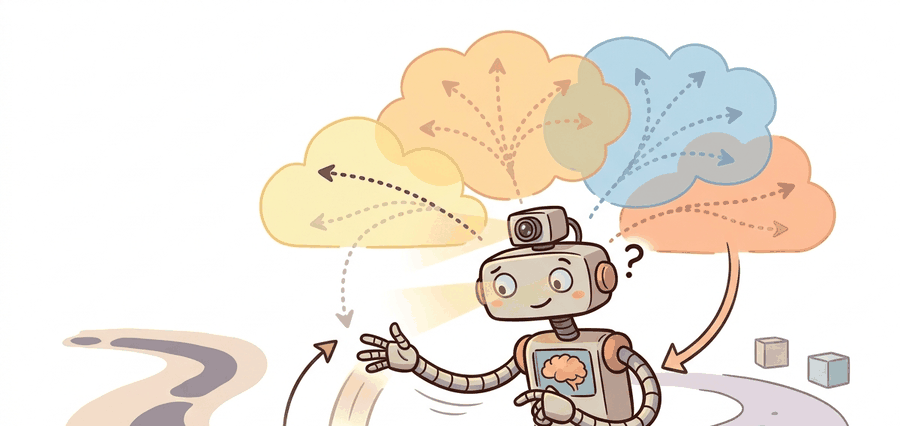
Learning the dynamics model is where model-based RL either becomes data-efficient engineering or collapses into self-deception. The planner depends on the model's local accuracy, support coverage, and uncertainty calibration, not on benchmark mythology.
A learned model becomes useful when it exposes both what it expects to happen and where that expectation stops being reliable for control.
Ensembles And Predictive Distributions
A standard robotics model predicts state deltas rather than absolute next state:
$$ \Delta \hat s_t = f_\theta(s_t, a_t), \qquad \hat s_{t+1} = s_t + \Delta \hat s_t. $$
Training deltas often improves conditioning. Ensembles then estimate epistemic uncertainty by disagreement across several bootstrap models. PETS is the canonical reference for combining such ensembles with trajectory sampling in planning.
The mechanism is worth stating clearly. Delta prediction reduces the dynamic range the learner must model, especially when positions or joint angles evolve smoothly from one step to the next. Bootstrapped ensembles then expose how sensitive that prediction is to dataset variation. When those two design choices are paired with horizon-conditioned evaluation, the planner gets a better signal about both local fit and out-of-support risk.
Ensembles do not make the model correct. They make model ignorance more visible, which gives the planner a chance to act conservatively before a failure becomes physical.
Where Dynamics Learners Break
Two failure modes are especially common. The first is representation collapse: the model input omits a latent variable that actually drives the transition, such as slip state, cable tension, or tool wear. In that case every ensemble member can be consistent and wrong. The second is train-test mismatch in rollout usage. The model is trained one step at a time, then asked to support five-step or ten-step ranking during planning, which means small local biases are multiplied before the controller can correct them.
Good failure analysis therefore pairs one-step metrics with rolled-out overlays on a fixed panel. Tools such as PyTorch Lightning, Weights & Biases, or plain structured JSON logs are fine, but the artifact should always show where the predicted state first leaves the physically plausible band. That is the point where the planner should have shortened horizon, switched to a fallback controller, or asked for more data.
Worked Probe
The next probe predicts a one-step velocity delta from four ensemble members and logs both the mean transition and the disagreement the planner should read.
# Aggregate one-step delta predictions from a tiny ensemble.
members = [0.09, 0.10, 0.11, 0.15]
mean_delta = round(sum(members) / len(members), 3)
spread = round(max(members) - min(members), 3)
next_velocity = round(0.6 + mean_delta, 3)
print(
    {
        "delta_members": members,
        "mean_delta": mean_delta,
        "spread": spread,
        "predicted_next_velocity": next_velocity,
    }
)
{'delta_members': [0.09, 0.1, 0.11, 0.15], 'mean_delta': 0.113, 'spread': 0.06, 'predicted_next_velocity': 0.713}
Read the spread alongside the mean: the mean delta gives the planner its best estimate of the next velocity, but the spread of 0.06 across members is the signal that matters for trust. When one member drifts notably from the others, the planner should treat the rollout as less reliable, not simply average over the disagreement and proceed as if nothing is unusual.
Use PyTorch or JAX for the ensemble, log held-out rollout metrics by horizon, and keep raw transition buffers versioned. mbrl-lib remains a useful reference implementation for PETS-style experiments, while TD-MPC2 codebases show how the learned model gets coupled tightly to the planner. Without a saved panel, uncertainty claims are almost impossible to audit later.
Predict deltas, train several bootstrap members on slightly different resampled datasets, evaluate one-step and multi-step held-out error, then save both the mean and disagreement signals that the planner will consume.
Disagreement is not the same as calibrated uncertainty. Ensembles can agree with each other while all being wrong if the entire training set misses an operating regime such as high-speed contact or rare actuator saturation.
For an autonomous vehicle, ensembles can flag rare road states or unusual friction conditions before the planner trusts an aggressive maneuver. For a robot arm near a singular or contact-rich posture, they can expose that the model is less certain exactly where precise control matters most.
This section extends the predictive-uncertainty story in Section 36.4 and prepares the ground for CEM, MPPI, and latent MPC in Section 37.3.
Current model-based RL increasingly merges ensembles with latent planning and value learning. Some systems reduce explicit uncertainty heads and rely on learned latent consistency signals, but the engineering question remains the same: what indicator tells the planner to trust or distrust the rollout?
What statistic from your dynamics learner would you feed into a safety gate: mean error, ensemble spread, held-out coverage, or all three? Why?
An ensemble is a committee. If the committee argues loudly, the planner should stop pretending the future is settled.
A useful dynamics learner predicts transitions and exposes where those transitions are trustworthy. Without that second part, planning can become faster but less safe.
Specify a bootstrap-ensemble training protocol for a robot task. What would you resample, what delta would you predict, and how would the planner use disagreement?
Bibliography & Further Reading
Primary References And Tools
Chua, K. et al.. "Deep Reinforcement Learning in a Handful of Trials using Probabilistic Dynamics Models." (2018). https://arxiv.org/abs/1805.12114
PETS is the core uncertainty-aware ensemble reference.
Deisenroth, M., and Rasmussen, C.. "PILCO: A Model-Based and Data-Efficient Approach to Policy Search." (2011). https://dl.acm.org/doi/10.5555/3104482.3104583
Classical uncertainty-aware model-based control with strong sample-efficiency intuition.
DeepMind. "MuJoCo Documentation." (accessed 2026). https://mujoco.readthedocs.io/
Useful when model-learning experiments need clean state traces and contact-rich dynamics.