"Action representation is where a language model becomes a robot controller or fails to become one."
A Grounded AI Agent
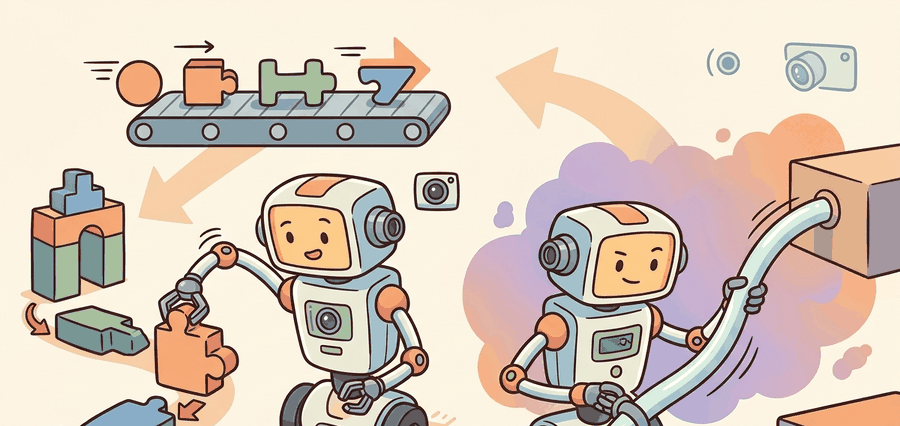
A large robot-data mixture can improve average performance while weakening a specific robot or task family. Report per-embodiment and per-task slices, not only aggregate success.
Cross-embodiment learning works only when the dataset records what changed: robot body, camera view, action convention, control rate, task language, and success definition.
The main question here is how to compress one second of robot motion without destroying the very details that make the motion executable. FAST matters because it makes the discrete route competitive again on smooth, high-rate action traces.
The Action Representation Problem
A VLA can only learn actions through the representation it is given. If the representation loses timing, smoothness, gripper convention, or coordinate meaning, no amount of language understanding repairs it. This is why action tokenization, action chunking, diffusion heads, and flow heads belong in the same design conversation.
Naive tokenization bins each action dimension at each timestep. It is easy to implement, but it can produce long token sequences and visible quantization error. Action chunking predicts several future actions at once, which improves temporal consistency. Diffusion and flow heads generate continuous chunks directly. FAST keeps the token route but compresses action sequences in frequency space before tokenization.
Code Fragment 1 below shows a tiny version of per-dimension action tokenization. The example is intentionally small so the quantization error is visible.
# Discretize continuous end-effector deltas into fixed bins.
# This teaches the source of tokenization error before FAST compresses full action sequences.
import numpy as np

values = np.array([-0.041, -0.012, 0.006, 0.019, 0.044])
bins = np.linspace(-0.05, 0.05, 9)
token_ids = np.digitize(values, bins) - 1
centers = (bins[:-1] + bins[1:]) / 2
reconstructed = centers[np.clip(token_ids, 0, len(centers) - 1)]
print(token_ids.tolist())
print(np.round(reconstructed - values, 4).tolist())
[0, 3, 4, 5, 7] [-0.0028, 0.0058, 0.0002, -0.0002, -0.0002]
token_ids vector shows how continuous action deltas become discrete symbols. The reconstruction error line explains why naive binning can damage fine motor behavior at high control rates.FAST In Plain Language
FAST stands for Frequency-space Action Sequence Tokenization. Instead of tokenizing every raw action dimension at every timestep, it transforms an action sequence into frequency coefficients, then tokenizes the compressed representation. The intuition is familiar from signal processing: many smooth robot motions can be described with fewer low-frequency components than raw samples.
Robot actions often change smoothly over short horizons. Frequency-space compression captures that smooth structure before the sequence reaches the language-model-style tokenizer. The model predicts fewer symbols, and those symbols decode back into a continuous action chunk.
The manual binning above is 13 lines and omits control-rate metadata, compression, inverse transforms, and dataset normalization. A FAST+ tokenizer in an open VLA stack handles those details as a reusable component, letting the policy train on compressed action tokens while preserving a continuous decoded trajectory.
# Pseudocode for a FAST-style tokenizer interface.
# Use the current openpi or FAST implementation rather than reimplementing DCT+BPE.
tokenizer = load_action_tokenizer("fast_plus")
tokens = tokenizer.encode(action_chunk, robot_metadata=metadata)
restored_chunk = tokenizer.decode(tokens, robot_metadata=metadata)

if isinstance(restored_chunk, list):
    print({"rows": len(restored_chunk), "first": restored_chunk[0] if restored_chunk else None})
elif isinstance(restored_chunk, dict):
    print({"fields": sorted(restored_chunk), "audit_ready": all(value not in (None, "") for value in restored_chunk.values())})
else:
print({"value": restored_chunk})tokenizer.encode and tokenizer.decode calls show the production interface that replaces manual binning. A maintained tokenizer handles compression, symbol mapping, and robot-specific metadata conventions.Figure 34.5 should be read as an action-interface comparison: discrete tokens, continuous heads, chunked actions, rate limits, and inverse transforms must be audited together.
Build And Evaluation Checklist
Curriculum, depth, and self-containment. FAST shows that tokenized actions can remain competitive when the tokenizer compresses smooth trajectories before symbols are predicted. For Action tokenization vs. continuous heads; the FAST tokenizer, the practical reading is to pin down the interface, assumptions, concrete example, and failure mode before comparing methods.
Production and evaluation contract. Tokenization quality is a control problem, not a vocabulary trick. For Action tokenization vs. continuous heads; the FAST tokenizer, treat the diagram, code, table, exercise, warning, and references as one evidence packet: boundary, artifact, tool choice, transfer check, failure mode, and source grounding.
Before accepting a Action tokenization vs. continuous heads; the FAST tokenizer result, name the loop variable that changed, the tool that makes it reproducible, the failure that would fool the metric, and the source that backs the claim.
Write an evidence row for one action representation: token or vector format, quantization scale, controller frequency, saturation rule, success metric, and the failure caused by representation mismatch.
Decision Guide
| Representation | Use When | Main Risk |
|---|---|---|
| Single-step actions | Fast reactive control with strong low-level controller | Jitter and myopic behavior |
| Action chunks | Manipulation needs short-horizon consistency | Chunk reuse can hide mid-course errors |
| Naive tokens | Simple experiments or low-frequency actions | Quantization error and long sequences |
| FAST tokens | Autoregressive VLA with smooth high-rate actions | Tokenizer mismatch across robots |
| Diffusion or flow | Continuous multi-modal trajectories | Sampling cost and latency |
Choose the action representation by plotting three things from your demonstrations: action smoothness, control frequency, and number of plausible trajectories for the same observation. Smooth high-rate data points toward FAST, diffusion, or flow. Sparse low-frequency commands can tolerate simpler tokens.
Expected output: Action tokenization vs. continuous heads; the FAST tokenizer should leave a reproducible VLA evidence trace with checkpoint, action representation, robot interface, metric, and failure label.
The best check on an action tokenizer is to decode it back into motion and ask whether the robot still moves the way the demonstration intended.
What information is lost when you bin each action dimension independently? Name one motor task where that loss would matter.
The field has not converged on one action representation. The most likely durable pattern is an interface layer that lets policies swap tokenized, diffusion, and flow heads while keeping the same observation and dataset schema.
Action representation is the hidden curriculum of VLA training. It determines what motor behaviors the model can express before learning even begins.
Take a short sequence of end-effector deltas from any robot task. Compute the quantization error from 8, 16, and 256 bins, then explain which errors would be visible on hardware.
What's Next?
Section 34.6 studies co-training, the method that tries to combine web semantics with embodied data.
FAST uses frequency-space compression to tokenize continuous action sequences for autoregressive VLAs. It is the key source for the chapter distinction between naive per-dimension binning and compressed action-sequence tokenization.
pi-zero uses a flow-matching action head on top of a pretrained vision-language backbone. The paper is central for understanding why continuous action generation became a serious alternative to discretized action tokens.
Pi-zero point five extends pi-zero through heterogeneous co-training for broader open-world generalization. It is useful for readers studying the frontier between task-specific robot policies and household-scale generalist behavior.
RT-2 made the action-as-language move explicit by fine-tuning VLM backbones to emit robot actions as tokens. Researchers should read it for the co-training setup, while practitioners should read it for the limits of transferring web semantics into motor control.
Chi et al. (2023). "Diffusion Policy: Visuomotor Policy Learning via Action Diffusion." arXiv.
Diffusion Policy established denoising over action sequences as a strong imitation-learning recipe. It gives the mathematical and practical background for diffusion heads in later VLA systems.
Hugging Face. "LeRobot." GitHub.
LeRobot is the practical open-source toolkit used here for datasets, policy training, evaluation, and low-cost robot workflows. Engineers should start here before writing custom data loaders or training loops.