A Careful Control Loop
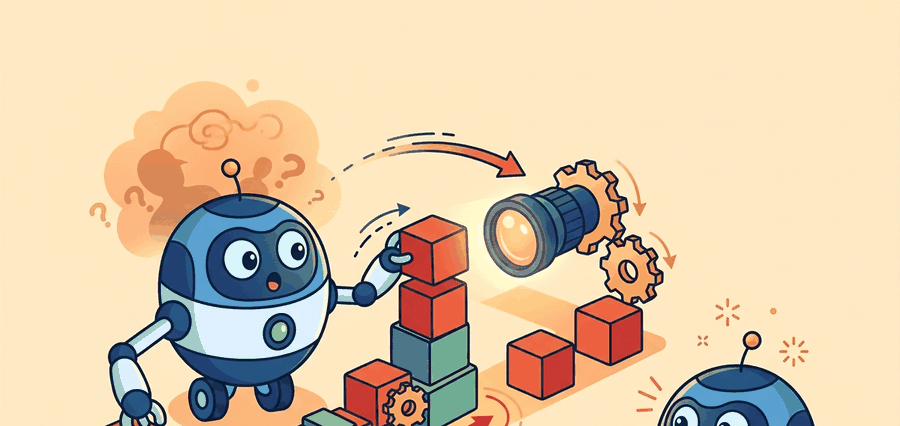
Read the figure as a grounding pipeline: image and language tokens are not yet robot state until the section explains how they become time-stamped facts, affordances, uncertainty, and a logged control decision.
Build And Evaluation Checklist
Curriculum, depth, and self-containment. Image-text pretraining gives embodied agents broad semantic priors, but action requires geometry, timing, and state. The section separates recognition from control. For From image-text models to embodied perception, the practical reading is to pin down the interface, assumptions, concrete example, and failure mode before comparing methods.
Production and evaluation contract. A VLM feature is useful for embodiment only when it improves the next observation, state estimate, or action choice. For From image-text models to embodied perception, treat the diagram, code, table, exercise, warning, and references as one evidence packet: boundary, artifact, tool choice, transfer check, failure mode, and source grounding.
Before accepting a From image-text models to embodied perception result, name the loop variable that changed, the tool that makes it reproducible, the failure that would fool the metric, and the source that backs the claim.
Write one evidence row that separates image-text accuracy from embodied usefulness: camera frame, language query, produced scene fact, action candidate, latency, uncertainty, and the controller decision that changed.
Image-text pretraining gives semantics, not control. A CLIP-style model can tell the robot that a mug is a mug, but the embodied stack still has to answer where the mug is, whether it is reachable, how stale the frame is, and what action should follow from that evidence.
From Similarity Scores to Actionable State
The core problem is that static image-text models are trained to score compatibility between an image and a phrase, while an embodied agent needs a state estimate that supports action. The state must include geometry, uncertainty, timing, and task context. A high image-text score alone does not tell the controller where to move or whether the observation is already stale.
This is why Chapter 27 on visual perception for action and Chapter 29 on localization matter here. VLM semantics usually enter the robot loop as one factor in a larger estimator, not as the estimator itself.
A visual representation earns its keep only if it changes a downstream decision: which object to grasp, which drawer to open, which region to reobserve, or which plan to reject as unsafe. Caption quality is useful evidence, but control quality is the criterion that matters.
A Minimal Formal Contract
Let $I_t$ denote the current image, $q_t$ the language query for the task, and $s_t$ the latent scene state the robot actually needs. A pretrained image-text encoder gives embeddings $f_I(I_t)$ and $f_T(q_t)$ and a compatibility score
$$ \sigma_t = \frac{f_I(I_t)^\top f_T(q_t)}{\|f_I(I_t)\| \, \|f_T(q_t)\|}. $$The score $\sigma_t$ is useful because it says whether the observation contains evidence for the queried concept. It is not yet enough for control. The embodied estimator still has to infer a belief over state,
$$ b_t(s) = p(s_t = s \mid I_{1:t}, a_{1:t-1}, q_t), $$where the belief depends on image history, previous actions, and task language. This link to belief state is what turns a static VLM into embodied perception rather than visual search.
The cosine score tells us whether an image and phrase align in representation space. The belief $b_t(s)$ tells us whether the robot should move left, wait for another view, or abort because the target is uncertain. The first quantity is semantic evidence; the second is control state.
Worked Numeric Example
Code Fragment 1 turns a few region-language similarities into a calibrated object-selection distribution. This mirrors the simplest embodied use case: the robot must choose which region deserves the next action or reobservation.
# Convert region-language similarities into a calibrated target distribution.
# The temperature term controls how aggressively the robot commits to one region.
# A low confidence gap should trigger another camera view instead of a grasp.
import numpy as np

region_names = np.array(["red_mug", "blue_bowl", "metal_sink"])
similarities = np.array([0.84, 0.79, 0.31], dtype=float)
temperature = 0.10

logits = similarities / temperature
probs = np.exp(logits - logits.max())
probs /= probs.sum()

best = int(np.argmax(probs))
margin = float(probs[best] - np.partition(probs, -2)[-2])

print({"target": region_names[best], "probabilities": probs.round(3).tolist(), "margin": round(margin, 3)})The expected output is a normalized probability vector whose top class is red_mug and whose confidence margin stays explicitly visible. A builder should read this trace as "semantic evidence exists, but the gap is not yet huge," which is why the margin is stored as a control signal for reobservation rather than hidden inside a single winning label.
The probability gap is a small but important embodied quantity. If the top two regions are nearly tied, a cautious robot should gather another view or ask for a disambiguating instruction instead of treating the current winner as ground truth. This is the same uncertainty-sensitive design principle that appeared in state estimation and sensor fusion.
The numeric example above teaches the mechanism in 13 lines. In practice, the same scoring path takes about 6 lines with Hugging Face transformers and a CLIP checkpoint. The library handles preprocessing, batching, normalization, and model loading internally, so you can focus on region proposals and decision logic.
Code Fragment 2 shows that shortcut with the maintained CLIP interface.
# Use a maintained CLIP checkpoint to score one image against task phrases.
# pip install transformers pillow torch
# The processor handles resize, normalization, and tensor packing.
from PIL import Image
from transformers import CLIPModel, CLIPProcessor

model_id = "openai/clip-vit-base-patch32"
processor = CLIPProcessor.from_pretrained(model_id)
model = CLIPModel.from_pretrained(model_id)

image = Image.open("tabletop_scene.png")
prompts = ["the red mug", "the blue bowl", "the metal sink"]
batch = processor(text=prompts, images=image, return_tensors="pt", padding=True)
logits = model(**batch).logits_per_image.softmax(dim=-1)
print(logits[0].tolist())The expected output is one short probability list over the three task phrases, with the first phrase dominating but the second still nontrivial. In practice that means CLIP has semantic evidence for the mug, not a mathematically settled proof; if the top two numbers were nearly tied, the right next step would be a crop refinement, second view, or geometry check instead of immediate actuation.
Practical Embodiment Recipe
- Write the task query in action language, for example "pick the red mug nearest the sink," not only class language such as "detect mugs."
- Split perception into semantic evidence, geometry, and temporal freshness. Do not let a single score stand in for all three.
- Use the VLM to rank candidate regions or hypotheses, then fuse that ranking with depth, pose, and reachability checks from camera and body frames.
- Store the evidence artifact: image id, prompt, top regions, latency, confidence margin, final action, and failure label.
- Evaluate on closed-loop success, recovery rate, and false-positive action rate, not only retrieval accuracy.
A robot often fails when a high semantic score hides missing geometry. The model may correctly identify "mug" while the grasp planner reaches behind a glass wall, chooses the wrong depth layer, or acts on an image captured before the object moved.
On a mobile manipulator, a useful image-text model can route the next perception step: "look at the left shelf again because the confidence margin is too small" or "switch to wrist camera because the target is partly occluded." That kind of reobservation policy is often more valuable than a single-shot zero-shot label.
A VLM is like a very articulate witness. It may describe the mug beautifully, but the robot still needs a floor plan, a clock, and a rule for when the witness is no longer current.
Recent robot foundation models such as RT-2 and OpenVLA do not stop at image-text scoring. They couple semantic pretraining with robot trajectories so language-conditioned perception can flow directly into action tokens. The active research question is how much of the resulting robustness comes from semantic breadth, how much from robot data diversity, and how much from the control interface itself.
Can you say which part of your state estimate comes from semantics, which part comes from geometry, and which part comes from temporal evidence? If not, the robot still has a captioning system, not embodied perception.
There are three progressively stronger uses of image-text models in robotics. The weakest use is captioning a frame and hoping a planner can infer everything else. The middle use is hypothesis ranking, where the VLM scores candidate regions, trajectories, or task interpretations that other modules generated. The strongest use is to make the score one observable term inside a structured state estimator whose outputs are explicitly consumed by planning and control.
The middle design is usually the best starting point for a real system because it respects modular boundaries. The detector or tracker proposes candidates, the VLM injects semantics, the geometry stack checks reachability, and the controller executes only when the evidence contract is satisfied. This also makes failure analysis cleaner: you can ask whether the error came from candidate generation, semantic ranking, calibration, or control timing.
| Tool | What It Gives You | When To Reach For It |
|---|---|---|
transformers | Maintained CLIP and VLM checkpoints, processors, and batching | Use it for reproducible embedding extraction and prompt scoring. |
| OpenCV | Rectification, region crops, projection, and image diagnostics | Use it to make the visual evidence physically interpretable before model calls. |
| ROS 2 image transport | Timestamps, frame ids, and synchronized camera topics | Use it when stale observations could create unsafe actions. |
| LeRobot | Dataset and policy recipes with vision observations attached | Use it when the same perception fields must survive into training and evaluation. |
When an image-text model appears to help, inspect one artifact that contains the scene image, prompts, region scores, confidence gap, depth estimate, chosen action, and episode result. Compare that artifact against a baseline policy on the same episodes. If the VLM raises retrieval scores but not task success, the missing variable is usually geometry, calibration, or latency rather than semantics.
Embodied perception starts when image-text similarity becomes one audited term inside a belief-and-action loop. Static semantics are the beginning of the pipeline, not the end of the control problem.
Take a tabletop task and define the smallest artifact that would let you test whether CLIP-style semantics improves behavior. Include the prompt, candidate regions, confidence margin, depth check, chosen action, and success label.
Radford et al. (2021). "Learning Transferable Visual Models From Natural Language Supervision."
The foundational CLIP paper. Its image-text contrastive objective is the cleanest starting point for understanding why semantic similarity helps but does not by itself solve action selection.
A direct bridge from web-scale vision-language pretraining to robot control. Use it to study how semantic pretraining can be injected into action-token prediction.
Kim et al. (2024). "OpenVLA: An Open-Source Vision-Language-Action Model."
A practical current reference for open VLA systems. The paper is especially useful because it exposes the fusion of SigLIP and DINOv2 features inside a robot policy stack.
The data-side complement to this section. It shows why semantic models only become embodied when paired with broad robot interaction data and consistent evaluation protocols.