"Motion cues matter when they change what the robot should do before the next frame arrives."
A Patient Embodied AI Agent
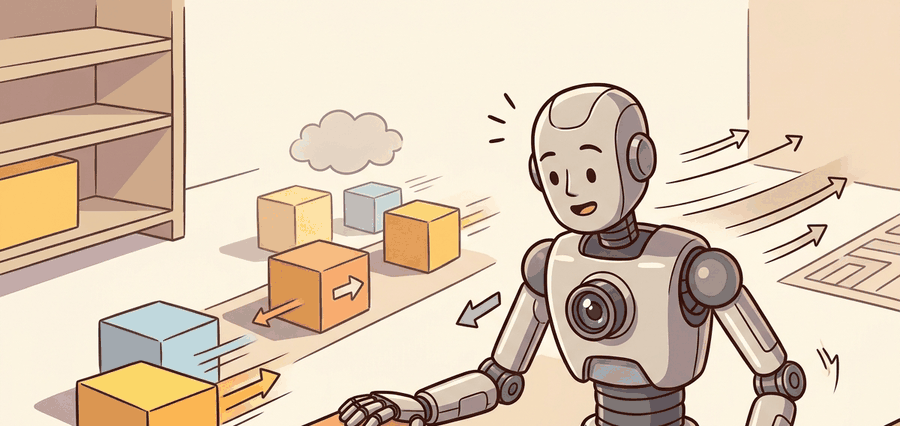
Optical flow and motion cues captures how image evidence moves between frames. For embodied agents, flow is a cue for ego-motion, moving obstacles, time-to-contact, tracking failures, and when a controller should slow down.
Problem First: Why This Representation Exists
Optical flow is not just a visualization of motion. In embodied systems it is a short-horizon warning signal whose value depends on frame timing, ego-motion compensation, and action latency.
The contract here maps frame pairs to action timing: flow field, camera motion estimate, dynamic-object hypothesis, uncertainty, update rate, and the reactive controller that consumes it.
Flow becomes embodied knowledge when it changes braking, pursuit, gaze, manipulation timing, or collision avoidance before a slower semantic pipeline can respond.
Figure 27.4.1 should be read as a motion-cue contract: flow field, ego-motion compensation, object motion hypothesis, latency, and controller consumer determine whether motion changes the next command.
Mathematical Core
Classical optical flow starts with brightness constancy and a small-motion approximation.
$I_x u + I_y v + I_t = 0,\quad \tau \approx \frac{\theta}{\dot\theta}$
The first equation says that image intensity should stay constant as a point moves. The time-to-contact approximation uses visual expansion: when an object's angular size grows quickly, the robot may need to brake even before full 3D reconstruction is available.
- Estimate sparse or dense flow between consecutive frames.
- Subtract expected ego-motion flow when camera motion is known.
- Cluster residual flow into moving object hypotheses.
- Convert expansion, bearing change, or residual speed into a controller-level slow, stop, or replan signal.
| Design Choice | Use When | Control Risk |
|---|---|---|
| Sparse feature flow | Visual odometry and low-compute tracking | Fails on textureless surfaces and repetitive patterns. |
| Dense learned flow | Scene motion and manipulation video | Can be expensive and may hallucinate in occlusion. |
| Residual flow | Moving obstacle detection | Bad ego-motion compensation can create false obstacles. |
Worked Miniature
Code Fragment 27.4.1 uses bounding-box size over time to estimate a simple time-to-contact cue. It is not a replacement for full flow, but it teaches the control signal hidden inside motion.
# Estimate time-to-contact from visual expansion.
# A smaller tau means the controller should slow or stop sooner.
import numpy as np

box_width_px = np.array([42.0, 48.0, 56.0, 67.0])
dt_s = 0.10
growth_rate = (box_width_px[-1] - box_width_px[-2]) / dt_s
tau_s = box_width_px[-1] / growth_rate
command = "slow" if tau_s < 1.0 else "continue"
print(round(float(tau_s), 2))
print(command)OpenCV provides Lucas-Kanade and Farneback flow, while modern PyTorch models provide learned dense flow. Those tools reduce implementation work, but the robot still needs ego-motion compensation, latency checks, and a controller policy for residual motion.
Do not treat every flow vector as object motion. A turning camera creates global flow, so the system must subtract expected ego-motion before labeling a pedestrian, arm, or drone as moving.
An indoor delivery robot can use residual flow to slow for a person stepping from behind a shelf. The action policy should log whether the stop came from obstacle geometry, optical expansion, or a conservative fallback.
For Optical flow and motion cues, the perception result must answer what action changed, what uncertainty changed, and what log would reproduce the decision. Otherwise the output is still visualization, not embodied evidence.
Debugging And Evaluation
Evaluate motion cues with time-aligned logs: record frame pair, optical flow summary, ego-motion correction, predicted moving obstacle, chosen action, latency, and near-miss label.
Perturb frame rate, motion blur, rolling shutter, camera shake, and independently moving objects, then check whether the action changes because of motion rather than texture.
Recent video foundation models make long-range tracking easier, but closed-loop robotics still needs low-latency motion cues with calibrated failure labels. The frontier is combining learned flow, geometric ego-motion, and uncertainty-aware control.
Section 27.5 extends motion-driven avoidance into intentional contact: once the robot knows what is moving and where, affordances let it decide which regions it can actually grasp, push, or step on.
Section References
OpenCV. Optical flow tutorials. https://docs.opencv.org/4.x/d4/dee/tutorial_optical_flow.html
Documents classical sparse and dense optical-flow tools used in practical robotics prototypes.
NVIDIA. Isaac ROS Visual SLAM documentation. https://nvidia-isaac-ros.github.io/repositories_and_packages/isaac_ros_visual_slam/index.html
Shows real-time visual motion estimation in a ROS 2 robotics stack.
Can you name the representation, the consuming action, the uncertainty or freshness field, and the failure label for Optical flow and motion cues? If any one is missing, the section is not yet ready for a robot replay log.
Optical flow is not just pretty arrows; it is a low-latency motion signal that must be separated into ego-motion, object motion, and control response.
Design a residual-flow test for a mobile robot turning in place while a person walks across the scene. What flow should be subtracted, and what residual should trigger slowing?