A Careful Control Loop
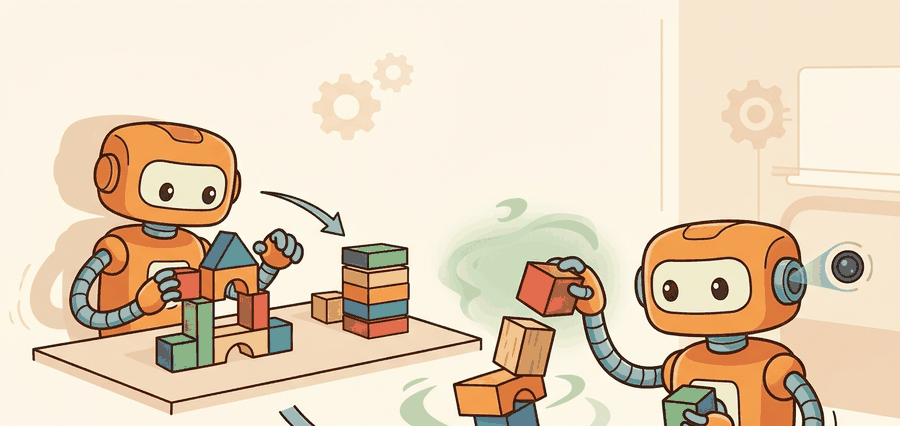
Offline-to-online fine-tuning asks a hard robot-learning question: how can a policy improve from a fixed dataset without touching the robot during training? The answer is not "train harder." The answer is to respect the support of the data, make pessimism explicit, and evaluate with artifacts that expose when the learned policy leaves the behavior distribution.
Why Offline RL Is Different
For Offline-to-online fine-tuning, offline RL starts from a static dataset and must make the behavior policy, support envelope, reward labels, and candidate-policy update explicit before any robot rollout is trusted.
Offline-to-online fine-tuning starts from a conservative offline policy, then spends a limited interaction budget to adapt on hardware or in a trusted simulator. The critical design choice is the safety gate: online learning may update the policy only after interventions, constraint violations, and support drift are monitored.
For Offline-to-online fine-tuning, the policy is allowed to improve only inside measured dataset support; outside that support, the value estimate should be treated as a risk signal.
Formal Contract
For Offline-to-online fine-tuning, the baseline objective is useful only after the data distribution and robot action scale are fixed; otherwise expected return can reward unsupported commands.
$$J(\pi) = \mathbb{E}_{\tau \sim \pi}\left[\sum_{t=0}^{T} \gamma^t r(s_t,a_t)\right].$$
For Offline-to-online fine-tuning, the practical objective needs a pessimism or support term because training cannot ask the real robot whether a novel action is safe.
$$\pi_0 \leftarrow \mathrm{OfflineRL}(D), \quad D_{k+1}=D_k\cup\tau_k, \quad \pi_{k+1}\leftarrow \mathrm{Update}(\pi_k,D_{k+1})\;\mathrm{subject\ to}\; c(\tau_k)\leq C.$$
For Offline-to-online fine-tuning, the pessimism term should expose unsupported gripper poses, contact modes, saturation regions, missing viewpoints, or reset states rather than hiding them in one value estimate.
Worked Numeric Trace
Code Fragment 1 for Offline-to-online fine-tuning compares candidate actions with dataset support and applies pessimism only after the support metric and robot action scale are explicit.
# Track whether online fine-tuning is staying inside a safety budget.
# Each rollout contributes success, intervention, and support-drift evidence.
rollouts = [
    {"success": 0, "interventions": 2, "support_drift": 0.18},
    {"success": 1, "interventions": 1, "support_drift": 0.12},
    {"success": 1, "interventions": 0, "support_drift": 0.09},
]
max_interventions = 3
max_drift = 0.20
total_interventions = sum(r["interventions"] for r in rollouts)
worst_drift = max(r["support_drift"] for r in rollouts)
allowed = total_interventions <= max_interventions and worst_drift <= max_drift
print(f"successes={sum(r['success'] for r in rollouts)}/3")
print(f"interventions={total_interventions} worst_support_drift={worst_drift:.2f}")
print(f"continue_online_updates={allowed}")interventions=3 worst_support_drift=0.18
continue_online_updates=True
- Fit a behavior model or nearest-neighbor support estimator on logged state-action pairs.
- Train a critic on Bellman targets from the fixed dataset.
- For each candidate action, subtract a penalty when the action is unlikely under the dataset.
- Update the policy toward high pessimistic value, not raw critic value.
- Evaluate behavior cloning, offline RL, and any fine-tuned policy on one saved task panel.
Practical Recipe
- Start with behavior cloning and report it. If BC solves the task, offline RL must justify its extra complexity.
- Write the dataset manifest: robot body, sensors, action units, operator source, split rule, reset distribution, episode horizon, reward source, and license.
- Audit action support before training. Plot nearest-neighbor distances or behavior log probabilities for every proposed policy action.
- Train CQL, IQL, or behavior-regularized actor-critic only after the support audit exists.
- Report same-config evaluation: one task panel, one split, one seed policy, one artifact, and one failure taxonomy.
For Offline-to-online fine-tuning, use d3rlpy, robomimic, or LeRobot after the support audit is defined; the library may replace replay-buffer plumbing but must preserve dataset split, action scale, and evaluation artifact.
For Offline-to-online fine-tuning, a warehouse manipulation audit should align expert picks, recoveries, failures, behavior-cloning baseline, support distance, and offline-RL policy output in one table before reporting improvement.
For Offline-to-online fine-tuning, compare behavior cloning and offline RL under the same split: BC is strongest with narrow expert demonstrations, while offline RL needs meaningful rewards, recoveries, and a visible support audit.
For Offline-to-online fine-tuning, current robot-data work should be read through dataset quality, conservative objectives, diffusion or transformer policies, and offline-to-online safety gates.
For Offline-to-online fine-tuning, trust requires naming the behavior policy, support estimator, pessimism mechanism, BC baseline, and exact evaluation artifact.
Offline-to-online fine-tuning is useful when it makes the perception-action loop more reliable, not when it merely adds a more impressive model name.
Design a method-matched experiment for Offline-to-online fine-tuning. Specify the environment, observation schema, action interface, metric, and one perturbation that targets the section's core assumption.
What's Next
This section grounded offline-to-online fine-tuning in an explicit robot-data contract: observations, actions, demonstrations, evaluation splits, and failure labels. The next reading step is Section 25.5, where the same contract is carried into the next technique or chapter.
CQL addresses overestimation from distribution shift by learning conservative value estimates. It is essential for understanding why offline RL must avoid unsupported actions.
IQL avoids direct evaluation of unseen actions and extracts policies through advantage-weighted behavioral cloning. It is a practical complement to CQL when teaching conservative improvement from static data.
D4RL: Datasets for Deep Data-Driven Reinforcement Learning.
D4RL popularized standardized offline RL datasets and benchmark tasks. Readers should use it as a cautionary baseline source, since robot deployment needs extra support checks beyond benchmark scores.
d3rlpy: Offline Deep Reinforcement Learning Library.
d3rlpy implements many offline RL algorithms behind a consistent Python API. It is useful for library-shortcut experiments after the reader understands support mismatch and conservative objectives.
robomimic Study: What Matters in Learning from Offline Human Demonstrations for Robot Manipulation.
The robomimic study compares offline learning algorithms across simulated and real manipulation tasks. It connects the chapter's offline RL theory to robot-specific data quality and evaluation concerns.