A Careful Control Loop
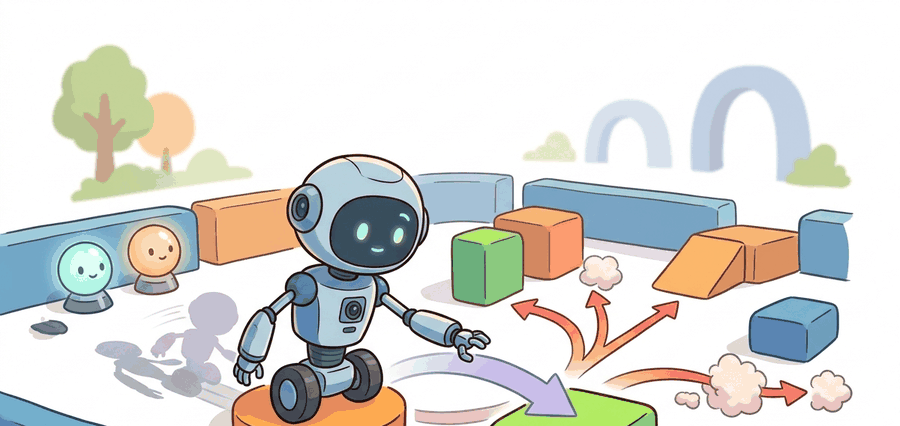
Safe exploration asks the agent to gather information without spending safety margin irresponsibly. In embodied systems, a bad exploratory action can damage hardware, enter an unrecoverable state, violate a human-space constraint, or teach the policy that risky behavior is an acceptable shortcut.
It builds on reward specification in Chapter 18: Reward Design and Goal Specification, reuses partial observability from Chapter 2: The Agent-Environment Interface, and prepares transfer testing in Chapter 20: Sim-to-Real Transfer.
This section develops the technical contract for exploration under constraints. The object of study is not only the reward-seeking policy, but the safety envelope that decides which exploratory actions are admissible.
The key question is practical: what constraint must never be violated, which near-violation should trigger intervention, and how does the evaluation report reward and cost together?
A safety mechanism earns its place when it changes the action before damage occurs. In safe exploration, the reader should keep asking which action is vetoed, clipped, slowed, redirected, or converted into a recovery maneuver.
Theory
We can view the agent at time $t$ as receiving an observation $o_t$, maintaining an internal state estimate $\hat s_t$, proposing an action $a_t$, and passing that action through a constraint check before execution. A constrained objective tracks both reward $R$ and cost $C$, then requires a condition such as $E[C] \le d$ for a chosen limit $d$.
The practical design rule is to make the safety channel explicit. Inputs, outputs, assumptions, timing, and failure modes should include distance to boundary, intervention count, recovery success, and whether the constraint is hard, statistical, or learned from data.
The mechanism is a sequence of transformations: observe, estimate risk, propose action, filter or shield action, execute, monitor, and recover. Each transformation should have a measurable contract, otherwise "safe" becomes a label rather than a testable property.
Worked Example
Code Fragment 19.3.1 implements a tiny action shield. The policy proposes exploratory actions, but the shield vetoes any action whose clearance is below the limit or whose recovery flag is false.
# Filter exploratory actions through a simple safety shield.
# The chosen action must be informative and still recoverable.
candidates = [
    {"action": "inspect shelf gap", "value": 0.70, "clearance": 0.22, "recoverable": True},
    {"action": "squeeze behind shelf", "value": 0.95, "clearance": 0.07, "recoverable": False},
    {"action": "rotate camera", "value": 0.50, "clearance": 0.40, "recoverable": True},
]

safe = []
for item in candidates:
    allowed = item["clearance"] >= 0.15 and item["recoverable"]
    print(item["action"], "allowed" if allowed else "vetoed")
    if allowed:
        safe.append(item)

print("selected", max(safe, key=lambda item: item["value"])["action"])Expected output: the printed trace should show both allowed and vetoed actions. If the run reports only reward, it cannot prove that exploration respected the constraint.
The from-scratch fragment is for understanding. In a practical system, use Gymnasium wrappers for quick constraint checks, MuJoCo for contact and actuator limits, ROS 2 for hardware intervention traces, and Safety Gymnasium-style benchmark tasks when cost signals need to be logged beside reward. The shortcut removes boilerplate so the engineering attention goes to constraint design and recovery evidence.
Practical Recipe
- Write the reward metric and cost metric before choosing a model.
- State the hard constraint, soft constraint, intervention rule, and recovery condition separately.
- Build a shielded baseline that is simple enough to debug by inspection.
- Record failures as structured cases: constraint miss, false veto, delayed intervention, unsafe recovery, or evaluation mismatch.
- Run at least one perturbation test that pushes the policy near the safety boundary.
The common mistake is to average reward over successful episodes and discard the near misses. Safe exploration needs the near misses, false vetoes, intervention timing, and recovery failures because those are the measurements that reveal whether the safety layer works.
A warehouse robot team should log final success, cost return, minimum clearance, human intervention, emergency stop, recovery action, and whether the same policy checkpoint was used for every comparison. The logs reveal whether the agent is learning safer exploration or merely receiving unreported help.
Safe exploration is the only place where "nothing happened" can be a result, as long as the log proves that the right risky thing did not happen.
A core research frontier is learning safety envelopes that remain useful under distribution shift. The hard part is preserving exploration pressure while keeping constraint violations, false vetoes, and recovery failures visible in the same evidence artifact.
Can you name the constraint, cost metric, intervention trigger, recovery rule, and most likely false sense of safety? If not, the safety boundary is still too vague.
The idea in this section becomes useful when it is tied to a closed-loop safety contract. In this chapter on Exploration in Embodied Worlds, the contract names the observation stream, the state estimate, the action representation, the cost signal, the intervention mechanism, and the evaluation artifact. Without that contract, a model can look capable in a notebook while violating a constraint that nobody logged.
The graduate-level habit is to separate four claims. The reward claim explains what the policy tries to accomplish. The cost claim explains what must stay bounded. The shield claim explains which actions are modified before execution. The evidence claim records which measurements would convince a skeptical builder that safety held during exploration.
| Tool or Library | Role in the Topic | Builder Advice |
|---|---|---|
| Gymnasium | Constraint wrapper smoke tests | Use it to verify that reward, cost, termination, and truncation are logged separately. |
| Safety Gymnasium | Cost-aware benchmark tasks | Use it when safe RL baselines need explicit cost signals rather than post hoc labels. |
| ROS 2 | Intervention and emergency traces | Use it to record vetoes, stops, controller status, and recovery actions on hardware. |
| MuJoCo | Contact and actuator constraints | Use it when clearance, joint limits, and recovery from near-contact are part of the safety envelope. |
| LeRobot | Safe demonstration replay | Use it to compare learned exploration against demonstrations that include cautious recovery behavior. |
A robust implementation starts with a tiny, inspectable safety wrapper and only then moves to a maintained learner. The baseline should log reward, cost, proposed action, executed action, veto reason, intervention timing, and recovery outcome. The library version should produce the same artifact schema, so the comparison is a same-task comparison rather than a story assembled from separate experiments.
- Write a one-paragraph safety contract with reward, cost, constraint, intervention, recovery, and failure fields.
- Start with the smallest simulator or wrapper that exposes the constraint faithfully.
- Run one deterministic smoke test and one near-boundary perturbation before scaling.
- Save a single result artifact containing configuration, seed, reward, cost, interventions, traces, and failure labels.
- Compare methods only when one script evaluates reward and cost on the same task panel.
When safe exploration fails, avoid labeling the whole method as weak. First assign the failure to hazard sensing, constraint definition, false veto, late intervention, unsafe recovery, controller saturation, or evaluation. Then rerun one controlled perturbation that isolates the suspected cause.
For safe exploration, compare only construct-matched metrics that are co-computed in one pass on one configuration: same environment panel, same policy checkpoint, same seed set, same constraint threshold, same perturbation suite, and the same success definition. Save reward, cost, interventions, vetoes, recovery outcomes, traces, and failure labels in one artifact so every number in a later table is backed by the same run.
Safe exploration succeeds when reward improves inside the constraint envelope, with violations, vetoes, and recoveries reported beside success.
Design a safe-exploration experiment in simulation. Specify the reward metric, cost metric, constraint threshold, intervention rule, recovery behavior, and one perturbation that moves the policy near the boundary.
What's Next?
This section turned safe exploration into a testable constraint contract: define reward, define cost, save one comparable artifact, and diagnose failures by the safety channel. Next, continue with Section 19.4, where partial observability makes the same safety and exploration questions harder.
Achiam, J. et al. (2017). Constrained Policy Optimization. ICML.
This paper is the natural anchor for reward maximization under expected cost constraints. Use it here to separate the reward claim from the safety-budget claim.
Bellemare, M. G. et al. (2016). Unifying count-based exploration and intrinsic motivation. NeurIPS.
The paper connects pseudo-counts to intrinsic rewards in high-dimensional spaces. In safe exploration, this source is useful for asking how novelty bonuses should be limited when visits consume risk budget.
Pathak, D. et al. (2017). Curiosity-driven Exploration by Self-supervised Prediction. ICML.
Intrinsic Curiosity Module rewards prediction progress in learned feature space. Use it here as a reminder that curiosity needs a shield when prediction error would send the robot toward unsafe transitions.
Burda, Y. et al. (2018). Exploration by Random Network Distillation. arXiv.
RND is a practical intrinsic reward method based on prediction error. In constrained settings, the same prediction-error trace should be logged with cost, vetoes, and interventions.
DD-PPO connects exploration to distributed simulation and navigation evaluation. It is useful here because scale can improve coverage while still requiring constraint-matched evaluation.
Habitat-Lab provides embodied navigation and interaction environments. Use it to log collisions, path clearance, recovery behavior, and intervention events beside navigation success.