A Careful Control Loop
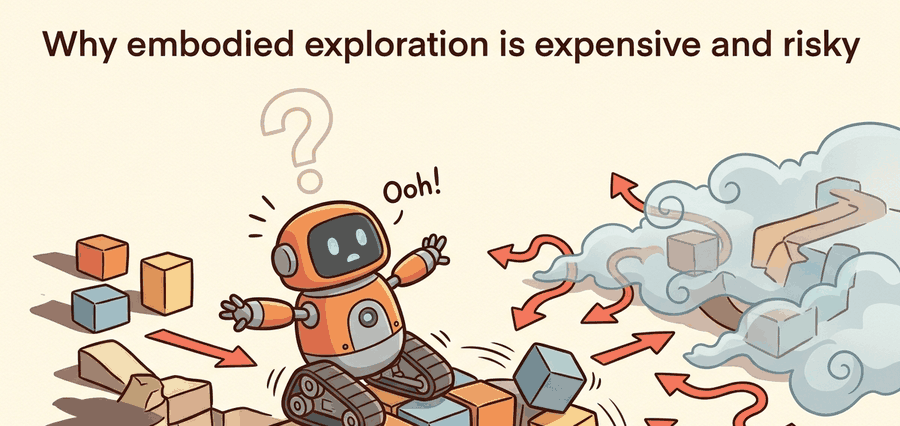
Embodied exploration is expensive and risky because the agent pays for information with motion. A web crawler can retry a link; a robot that opens the wrong cabinet may move an object, drain a battery, enter an unrecoverable corner, or create a reset that changes the next trial.
It builds on reward specification in Chapter 18: Reward Design and Goal Specification, reuses partial observability from Chapter 2: The Agent-Environment Interface, and prepares transfer testing in Chapter 20: Sim-to-Real Transfer.
This section turns exploration cost into a concrete design variable. The central object is a probe: an action chosen mainly to reduce uncertainty rather than to complete the task immediately.
The key question is practical: what uncertainty does the probe reduce, what does it cost to execute, what does it cost to reset, and what evidence shows that the probe was worth taking?
An exploration strategy earns its place when it changes the next physical action, not merely the dashboard score. A useful policy can say "look again," "touch lightly," "return to a checkpoint," or "stop because the reset budget is nearly gone."
Theory
We can view the agent at time $t$ as receiving an observation $o_t$, maintaining an internal state estimate $\hat s_t$, choosing an action $a_t$, and observing a consequence $o_{t+1}$. Exploration adds a second accounting stream: $i(a_t)$ for expected information, $c(a_t)$ for motion and time, $r(a_t)$ for reset burden, and $h(a_t)$ for hazard risk.
A useful embodied exploration objective is therefore not "maximize novelty." It is closer to choosing probes with high information per unit of recoverable cost, while refusing probes whose hazard or irreversibility exceeds the current safety envelope.
The mechanism is a loop of propose, price, execute, and audit. The agent proposes an information-gathering action, prices its energy, time, reset, and hazard costs, executes only if the action is recoverable, then records whether uncertainty actually fell.
Worked Example
Code Fragment 19.1.1 scores three candidate probes by information gain, reset burden, and hazard risk. The numbers are small enough to inspect by hand, which is the point: before training a policy, a builder should know what the system treats as expensive.
# Price exploration probes by information gained and physical cost.
# This makes reset burden and hazard risk visible before training.
probes = [
    {"action": "open drawer", "info": 0.80, "reset": 0.70, "hazard": 0.20},
    {"action": "tap handle", "info": 0.45, "reset": 0.10, "hazard": 0.05},
    {"action": "drive behind shelf", "info": 0.90, "reset": 0.95, "hazard": 0.35},
]

for probe in probes:
    score = probe["info"] - 0.5 * probe["reset"] - 1.5 * probe["hazard"]
print(probe["action"], round(score, 3))Expected output: the printed trace should show which probe the cost model prefers and why. If the most informative action always wins, the diagnostic is missing the embodied part of embodied exploration.
The from-scratch fragment is for understanding. In a practical system, use Gymnasium for fast environment probes, Habitat-Lab for navigation episodes, MuJoCo for contact-rich dynamics, ROS 2 for robot execution traces, and LeRobot-style datasets for replayable demonstrations. The shortcut removes interface boilerplate so the engineering attention goes to reset design, safety margins, and failure recovery.
Practical Recipe
- Write the observation, action, reset procedure, and success metric before choosing a model.
- Attach a cost to every probe: time, energy, wear, human reset effort, and safety margin consumed.
- Separate reversible probes from irreversible or hard-to-reset probes.
- Record failures as structured cases: perception error, state error, contact error, timing error, reset error, or evaluation error.
- Run at least one perturbation test that changes reset difficulty before trusting the result.
The common mistake is to count visits while ignoring what the visits do to the world. A policy that "explores" by knocking objects into new poses can inflate novelty while making later episodes harder, less comparable, and less safe.
A mobile manipulation team should log not only final success, but the reset count, human interventions, battery draw, contact events, controller saturation, and unrecoverable scene changes. Those fields reveal whether exploration discovered useful affordances or only spent hidden physical budget.
In a simulator, exploration is free. The robot falls, resets instantly, and tries again. On real hardware, each fall costs time, wear, and occasionally a human standing by with a power cut. The budget for curiosity is real, and it runs out before the policy does.
A core research frontier is reset-aware exploration: agents that choose informative probes while accounting for the cost of returning to a comparable state. This matters for home robots, dexterous manipulation, and field robotics, where the hardest part of an experiment is often restoring the world, not computing the next action.
Can you name the observation, state estimate, action, success metric, reset procedure, and most likely irreversible failure for this exploration setup? If not, the system boundary is still too vague.
The idea in this section becomes useful when it is tied to a closed-loop cost contract. In this chapter on Exploration in Embodied Worlds, the contract names the observation stream, the state estimate, the action representation, the timing budget, the reset budget, and the evaluation artifact. Without that contract, a model can look capable in a notebook while failing the first time a sensor drops a frame, a controller saturates, or an object cannot be restored.
The graduate-level habit is to separate four claims. The conceptual claim explains why a probe should reduce uncertainty. The systems claim explains which interface it changes. The safety claim states which states must remain reachable. The evidence claim records which measurement would convince a skeptical builder.
| Tool or Library | Role in the Topic | Builder Advice |
|---|---|---|
| Gymnasium | Cheap probe accounting | Use it for fast smoke tests where reset cost can be simulated and logged deterministically. |
| Habitat-Lab | Navigation reset studies | Use it when map coverage, collision traces, and episode resets are part of the exploration question. |
| ROS 2 | Hardware trace capture | Use it to record action timing, controller status, battery state, and intervention events on a robot. |
| MuJoCo | Contact and wear proxies | Use it when exploratory contacts, actuator limits, and recoverability are central to the task. |
| LeRobot | Replayable demonstrations | Use it to compare learned probes against human or scripted exploration traces with the same artifact schema. |
A robust implementation starts with a tiny, inspectable reset ledger and only then moves to a maintained simulator or robot stack. The baseline should log inputs, outputs, units, timestamps, termination conditions, reset effort, and hazard flags. The library version should produce the same artifact schema, so the comparison is a same-task comparison rather than a story assembled from separate experiments.
- Write a one-paragraph task contract with observation, action, success, reset, and failure fields.
- Start with the smallest simulator, dataset, or wrapper that exposes reset burden faithfully.
- Run one deterministic smoke test and one perturbation test that changes recoverability.
- Save a single result artifact containing configuration, seed, metrics, reset counts, traces, and failure labels.
- Compare methods only when one script evaluates them on the same task panel and reset budget.
When exploration fails, avoid labeling the whole method as weak. First assign the failure to perception, state estimation, planning, control, timing, reset, irreversibility, or evaluation. Then rerun one controlled perturbation that isolates the suspected cause.
For embodied exploration cost, compare only construct-matched metrics that are co-computed in one pass on one configuration: same environment panel, same policy checkpoint, same seed set, same reset budget, same perturbation suite, and the same success definition. Save the result as one artifact with traces, summary statistics, reset counts, videos or state logs, and failure labels so every number in a later table is backed by the same run.
Embodied exploration improves a system when it buys information without hiding the bill: reset effort, hazard exposure, time, energy, and irreversible state changes.
Design a reset-aware exploration experiment in simulation. Specify the environment, observations, actions, success metric, reset budget, irreversible failure condition, and one perturbation that makes reset harder.
What's Next?
This section turned embodied exploration cost into a testable contract: define the loop, price the probe, save one comparable artifact, and diagnose failure by interface. Next, continue with Section 19.2, where intrinsic rewards try to make sparse-reward exploration more deliberate.
This work grounds optimism and uncertainty-driven exploration in tabular MDPs. Use it here to separate a principled confidence bonus from a physical probe that may consume reset budget.
Bellemare, M. G. et al. (2016). Unifying count-based exploration and intrinsic motivation. NeurIPS.
The paper connects pseudo-counts to intrinsic rewards in high-dimensional spaces. It helps explain why novelty bonuses need an embodied cost term when visits are not free.
Pathak, D. et al. (2017). Curiosity-driven Exploration by Self-supervised Prediction. ICML.
Intrinsic Curiosity Module rewards prediction progress in learned feature space. In embodied tasks, that progress signal should be audited against contact events, reset effort, and unrecoverable scene changes.
Burda, Y. et al. (2018). Exploration by Random Network Distillation. arXiv.
RND is a practical intrinsic reward method based on prediction error. The section uses it as a caution that prediction error can reward physically expensive novelty unless the evaluation records cost.
DD-PPO connects exploration to distributed simulation and navigation evaluation. It is useful here because large-scale simulator throughput can hide the reset and coverage assumptions that hardware exposes.
Habitat-Lab provides embodied navigation and interaction environments. Use it to log coverage, collisions, episode resets, and comparable navigation traces rather than only final success.