A Careful Control Loop
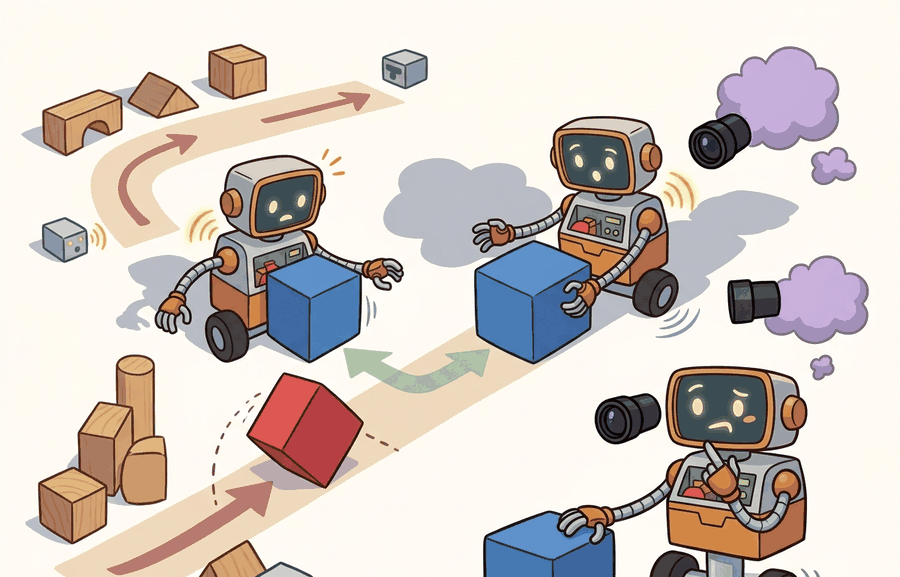
Sample efficiency and off-policy failure modes is one lens on value-based and off-policy methods. We study it because an embodied agent needs decisions that survive contact with noisy sensors, delayed effects, and changing environments.
For Sample efficiency and off-policy failure modes, off-policy learning depends on replay semantics, environment API, target computation, and GPU-scale batching being fixed before comparison with policy-gradient methods.
Sample efficiency is the promise of off-policy RL: learn more from each transition by reusing data. The danger is that reused data may come from a different policy, a different simulator condition, or a different phase of the robot's learning history.
This section develops the failure map. We distinguish useful reuse from distribution mismatch, show why off-policy correction can become high variance, and name the embodied cases where bootstrapping turns missing coverage into confident value errors.
A transition is useful only for the decisions the current policy must make. A million replay entries can still be thin evidence if they miss the object poses, contacts, recovery actions, or sensor failures that deployment will expose.
Theory
Off-policy learning trains a target policy using data collected by a behavior policy. If the behavior policy $\mu$ and target policy $\pi$ differ, an importance ratio can correct expectations in the simplest setting:
$$\rho_t = \frac{\pi(a_t|s_t)}{\mu(a_t|s_t)}$$
Large ratios mean the target policy strongly prefers an action that the behavior policy rarely took. That can reduce bias, but it increases variance. In long-horizon embodied tasks, multiplying many ratios can make estimates unusably noisy, so practical systems clip, truncate, or avoid explicit correction by using value-based bootstrapping.
Bootstrapping has its own failure mode. The critic can assign high value to state-action pairs that are out of distribution, because no transition in replay contradicts the estimate. This is extrapolation error: the model sounds certain exactly where the data is thin.
Off-policy methods trade fresh interaction for data reuse. The trade works when replay covers the target policy's decisions and fails when the current policy asks the critic about actions the behavior data barely visited.
Worked Example
Code Fragment 1 computes importance ratios for three logged actions. The third transition is dangerous because the target policy assigns high probability to an action that the behavior policy rarely selected.
# Compute off-policy correction ratios for logged actions.
# Large ratios identify target-policy decisions with weak behavior-policy support.
logged = [
    {"action": "slow_push", "pi": 0.40, "mu": 0.50},
    {"action": "lift", "pi": 0.20, "mu": 0.25},
    {"action": "fast_recovery", "pi": 0.30, "mu": 0.03},
]

for row in logged:
    ratio = row["pi"] / row["mu"]
    clipped = min(ratio, 2.0)
print(row["action"], f"rho={ratio:.1f}", f"clipped={clipped:.1f}")The expected output shows mild correction for the first two logged actions and an extreme mismatch for fast_recovery. A ratio of 10.0 means the target policy wants that action far more often than the behavior policy ever demonstrated it, so clipping to 2.0 is a variance-control patch, not proof of support.
fast_recovery has an importance ratio of 10.0 because pi is much larger than mu. Clipping the ratio reduces variance, but it also records that the replay data gives weak evidence for the action the target policy now wants.In an embodied dataset, that weak evidence is not an abstract statistical problem. It may mean the robot almost never attempted the emergency recovery motion during collection, yet the learned policy now depends on it during deployment.
Libraries can handle replay, batching, and algorithm updates, but they cannot decide whether the data covers the current policy's decisions. For off-policy experiments, add coverage reports, behavior-policy tags, and condition labels to the artifact even when the trainer is fully managed by Stable-Baselines3, Tianshou, or CleanRL.
Practical Recipe
- Define sample efficiency as return or success per environment interaction, not per gradient step.
- Tag replay by behavior policy, task condition, and collection time.
- Measure policy-data mismatch with action coverage, importance ratios, or nearest-neighbor support.
- Track critic uncertainty or critic disagreement on target-policy actions.
- Report failure modes by distribution shift: observation, action, dynamics, reward, or termination.
The common mistake is to report fewer environment steps without reporting coverage. A method can look sample efficient because it reuses data aggressively, while the learned critic is extrapolating over actions and states the robot never actually visited.
A fleet-learning project may reuse thousands of delivery-robot logs. That is valuable only if the logs cover the new policy's turns, speeds, obstacle types, lighting conditions, and recovery maneuvers. Otherwise off-policy learning becomes confident imitation of yesterday's easy routes plus speculation about today's hard ones.
A good embodied system makes sample efficiency and off-policy failure modes visible twice: once in the design sketch and once in the replay artifact. The second view keeps the first one honest.
Research on offline RL, conservative critics, uncertainty-aware value learning, and dataset curation all targets the same embodied problem: how to learn from fixed or mixed-policy data without trusting unsupported actions. The central open question is how to turn coverage diagnostics into reliable deployment decisions.
Can you state the behavior policy, target policy, replay coverage, correction rule, and critic diagnostic for a sample-efficiency claim? If not, the claim is missing the evidence needed to interpret it.
Sample efficiency has to be construct-matched. If method A uses 10,000 real robot steps and method B uses 10,000 simulator steps plus a million logged transitions, the comparison is not a single sample-efficiency number. It is a data-regime comparison that must report every source of experience.
Off-policy failure analysis starts by asking which distribution changed. Observation shift changes what the encoder sees. Action shift changes which controls the critic must evaluate. Dynamics shift changes the consequence of the same action. Reward shift changes which behavior the value function calls good. Termination shift changes which failures are hidden by early episode endings.
| Tool or Library | Role in the Topic | Builder Advice |
|---|---|---|
| Offline logs | Behavior-policy evidence | Use them only with policy tags, condition labels, and action-support summaries. |
| CleanRL | Inspectable training loop | Use it to verify which environment steps, replay samples, and gradient steps are counted. |
| Tianshou | Collector and replay controls | Use it to keep collection policy, replay sampling, and evaluation policy explicit. |
| MuJoCo | Controlled shift panel | Use it to generate matched dynamics perturbations for coverage and failure analysis. |
| ROS 2 bags | Real deployment traces | Use them to audit whether real observations and actions match the simulator-trained distribution. |
A robust off-policy implementation records data provenance, not only return. Code Fragment 2 builds one artifact row that ties a sample-efficiency claim to the exact interaction and replay counts behind it.
- Count real environment steps, simulator steps, replayed transitions, and gradient updates separately.
- Store behavior-policy tags for every replay source.
- Report action-support warnings for target-policy actions with weak coverage.
- Evaluate the current policy on a fixed perturbation panel, not on replay alone.
- Keep negative diagnostics in the registry even when only significant wins enter the paper tables.
# Build one sample-efficiency audit record.
# Separating data sources prevents invalid apples-to-oranges comparisons.
from dataclasses import dataclass, asdict

@dataclass
class SampleEfficiencyAudit:
    algorithm: str
    real_steps: int
    sim_steps: int
    replay_samples: int
    gradient_updates: int
    weak_action_support: str
    evaluation_panel: str

    def as_row(self) -> dict[str, object]:
        return asdict(self)

record = SampleEfficiencyAudit(
    algorithm="TD3",
    real_steps=0,
    sim_steps=50000,
    replay_samples=1000000,
    gradient_updates=200000,
    weak_action_support="fast_recovery torque range",
    evaluation_panel="mass_friction_delay_v1",
)
print(record.as_row())The expected output should be read as an accounting record, not a performance claim. It says this result used only simulator interaction, extremely heavy replay reuse, and still has a named weak-support region, so any sample-efficiency comparison must keep those data sources and support warnings attached to the score.
SampleEfficiencyAudit separates real steps, simulator steps, replay samples, and gradient updates. The weak_action_support field records where off-policy reuse is most likely to produce extrapolation error.When an off-policy method fails, do not start by blaming the algorithm name. First identify whether the bad value came from behavior-policy mismatch, missing action support, stale dynamics, reward mislabeling, termination bias, or critic extrapolation. Then rerun one matched perturbation panel with coverage diagnostics enabled.
For sample-efficiency claims, compare only metrics co-computed in one pass on one data accounting scheme: same environment panel, same policy checkpoint, same seed set, same perturbation suite, and the same definitions of real steps, simulator steps, replay samples, and gradient updates. Save the coverage diagnostics with the result table.
Off-policy learning is valuable because it reuses expensive embodied experience. It is trustworthy only when data provenance, coverage, correction, and bootstrapping diagnostics explain why reuse applies to the current policy.
Design a sample-efficiency table for two off-policy methods. Include real steps, simulator steps, replay samples, gradient updates, success, one safety metric, and one coverage warning that would block a strong claim.
What's Next?
This section turned sample efficiency and off-policy failure modes into a testable embodied-learning contract: define the loop, choose the tool, save one comparable artifact, and diagnose failure by interface. Next, continue with Chapter 16, where the same evaluation habit carries into the next reinforcement-learning decision.
Watkins, C. J. C. H., and Dayan, P. (1992). Q-learning. Machine Learning.
The canonical derivation of tabular Q-learning and its convergence proof. Read to understand the off-policy update rule and why the max over next-state actions makes Q-learning off-policy by construction; this distinction carries through to DQN and all its successors.
Mnih, V. et al. (2015). Human-level control through deep reinforcement learning. Nature.
Demonstrates that replay buffers and target networks together stabilize Q-learning with neural function approximators. Read Section 2 for the DQN algorithm and the supplementary for network architecture; replay and target-network ideas appear in every subsequent off-policy deep RL method including DDPG, TD3, and SAC.
Lillicrap, T. P. et al. (2015). Continuous control with deep reinforcement learning. arXiv.
Adapts DQN to continuous action spaces by combining a deterministic policy gradient actor with a Q-function critic and using replay and target networks from DQN. Read Algorithm 1 for the full update loop; DDPG is the direct predecessor to TD3 and understanding its overestimation problem motivates TD3's twin-critic design.
Identifies and fixes the Q-value overestimation problem in DDPG through three mechanisms: clipped double critics, delayed policy updates, and target-policy smoothing. Read Section 4 for each fix and the ablation in Section 5; these three tricks are now standard practice for off-policy continuous-control and appear directly in SAC variants.
Haarnoja, T. et al. (2018). Soft Actor-Critic. ICML.
Combines off-policy learning with a maximum-entropy objective, adding an automatic temperature parameter that balances exploration and exploitation without manual tuning. Read Section 4 for the soft Bellman equation and the entropy temperature update; SAC is the most widely used off-policy baseline for continuous robot control tasks.
A modular PyTorch RL library with clean separation between collector, trainer, and policy components. Use it to prototype off-policy algorithms without reimplementing replay buffers and target-network logic; the policy abstraction makes it straightforward to compare DQN, DDPG, TD3, and SAC in a common framework.