A Careful Control Loop
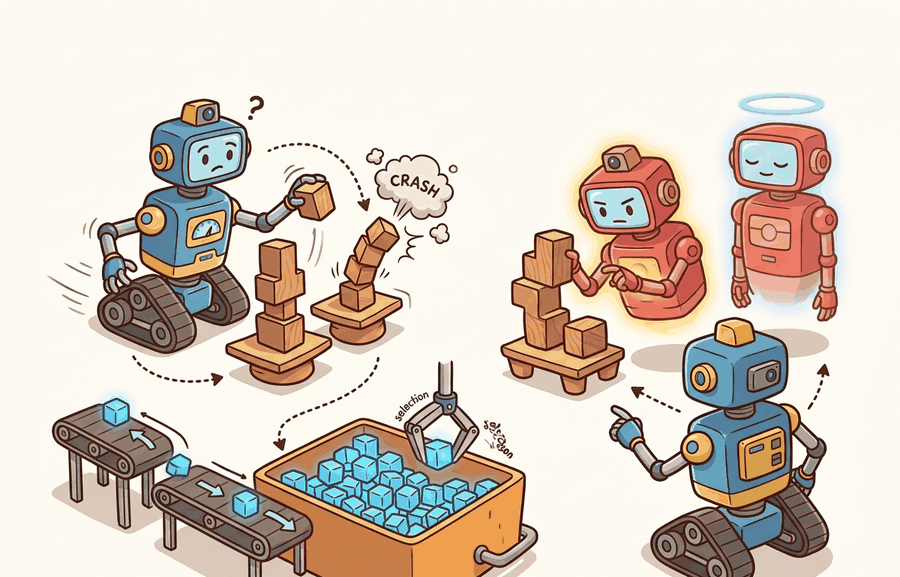
Replay buffers and target networks is one lens on value-based and off-policy methods. We study it because an embodied agent needs decisions that survive contact with noisy sensors, delayed effects, and changing environments.
For Replay buffers and target networks, off-policy learning depends on replay semantics, environment API, target computation, and GPU-scale batching being fixed before comparison with policy-gradient methods.
Replay buffers and target networks solve two different instability problems in deep Q-learning. Replay buffers slow down the data stream by training on stored transitions rather than only the newest correlated frames. Target networks slow down the learning target by using older parameters to compute the bootstrap value.
The key question is practical: is the agent learning from a representative memory of interaction, or from a recent slice of behavior that overrepresents one hallway, one object pose, one lighting condition, or one failure mode?
A replay buffer is not passive storage. Its capacity, sampling rule, freshness, and episode mix define the training distribution that the Q network sees, so buffer design is part of the learning algorithm.
Theory
Without replay, consecutive updates come from consecutive frames. In a robot task, that means many nearly identical observations while the arm approaches the same object. Gradient descent then overfits the most recent local experience and forgets rare but important transitions.
A replay buffer stores tuples $(o_t, a_t, r_t, o_{t+1}, d_t)$ and samples mini-batches from that store. Uniform replay reduces short-range correlation. Prioritized replay samples high-error transitions more often, which can speed learning but needs correction weights because the sampled distribution no longer matches the buffer distribution.
A target network addresses a different problem. The DQN loss uses a target of the form $r + \gamma \max_{a'}Q_{\theta^-}(o',a')$. If $\theta^-$ equals the online network after every update, the model changes both sides of its own target at once. Copying online weights into $\theta^-$ every fixed interval, or slowly averaging them with Polyak updates, makes the target move on a slower time scale.
Replay controls which transitions train the critic. The target network controls which critic computes the next-state value. Separating these roles helps debug whether instability came from biased data, stale targets, or overconfident bootstrap values.
Worked Example
Code Fragment 1 shows the two clocks in a small replay example: the online estimate changes every update, while the target estimate is copied only at a synchronization step.
# Simulate replay sampling and a target-network synchronization clock.
# The target estimate stays fixed until the sync interval is reached.
replay_rewards = [-0.2, 0.0, 1.0, -0.1]
online_q = 0.30
target_q = 0.50
gamma = 0.90
alpha = 0.20
sync_interval = 3

for update, reward in enumerate(replay_rewards, start=1):
    td_target = reward + gamma * target_q
    online_q += alpha * (td_target - online_q)
    if update % sync_interval == 0:
        target_q = online_q
print(update, f"online={online_q:.3f}", f"target={target_q:.3f}")The expected output should be read as a lagged-target trace. The target value stays frozen through updates 1 and 2, synchronizes at update 3, and then remains fixed again while the online critic continues to move, which is the stabilizing behavior target networks are designed to create.
online_q and target_q expose the separation between learning and target construction. The third update copies the online estimate into the target estimate, which changes the bootstrap value used by later replay samples.The point is not that update 3 is special, it is that the synchronization schedule is an experimental condition. In an embodied run, a target update that is too frequent can chase noise, while a target update that is too slow can train against stale dynamics after a curriculum or domain shift.
CleanRL is useful for inspecting replay and target-network details in a compact script. Stable-Baselines3 and Tianshou are useful when you need maintained replay buffers, vectorized collectors, checkpointing, and logging. Keep the buffer statistics visible even when a library owns the implementation.
Practical Recipe
- Choose buffer capacity by task diversity, not only by memory budget.
- Log the age distribution of sampled transitions.
- Track which environment conditions appear in replay batches.
- Record the target-network sync interval or Polyak coefficient with every run.
- Recompute metrics after perturbations using the same replay and target settings.
Replay can make old behavior look more important than it is. A buffer full of early random exploration may keep training the critic on collisions that the current policy no longer produces, while a buffer full of recent easy successes may erase rare recovery cases.
For a warehouse robot, replay should preserve rare transitions such as wheel slip, blocked aisles, and near-collision recovery. If uniform replay almost never samples those events, the value function can look stable during average episodes and still fail under the exact conditions that matter operationally.
When replay buffers and target networks feel abstract, ask what would be different in the next frame of video, the next robot state, or the next safety margin.
Replay research for embodied agents increasingly studies data curation, offline-to-online replay, and coverage-aware sampling. The frontier question is how to reuse large logs without letting stale, biased, or unsafe behavior dominate the critic.
Can you report the replay capacity, sampling rule, transition age distribution, target update rule, and the environment conditions represented in sampled batches? If not, the critic's training distribution is underspecified.
Replay buffers turn interaction history into a training dataset, so they inherit every dataset problem: imbalance, stale labels, missing coverage, and selection bias. Target networks turn a moving regression target into a slower one, so they inherit a control problem: how quickly should the target follow the online critic?
The embodied version of this tradeoff is concrete. A quadruped trained on replay from flat terrain may learn stable values for flat steps, then extrapolate poorly on rubble. A target network synced during a terrain curriculum may also lag behind the current dynamics. Logging buffer composition and target lag makes these failure modes visible.
| Tool or Library | Role in the Topic | Builder Advice |
|---|---|---|
| CleanRL | Readable replay implementation | Use it to inspect buffer insertion, random sampling, target sync, and loss computation in one script. |
| Stable-Baselines3 | Maintained DQN replay stack | Use it for baselines where checkpointing, vectorized collection, and logging matter. |
| Tianshou | Collector and buffer variants | Use it to compare replay policies while keeping data collection code consistent. |
| MuJoCo | Controlled perturbation source | Use it to label replay by friction, mass, contact, and terrain condition. |
| ROS 2 bags | Real interaction logs | Use them cautiously, with explicit coverage labels before mixing hardware logs into replay. |
A robust implementation treats replay metadata as first-class evidence. Code Fragment 2 creates a compact buffer audit row that records not only what was sampled, but when it was collected and which condition it came from.
- Assign each transition an episode id, collection step, environment condition, and behavior policy tag.
- Compute batch summaries for transition age, reward mix, terminal fraction, and condition coverage.
- Store the target-network update rule in the same artifact as the training metrics.
- Plot TD error by condition, not only by global step.
- Reject comparisons where methods saw different replay condition mixes.
# Build one replay audit row for an off-policy update.
# The metadata makes stale or imbalanced sampled transitions visible.
from dataclasses import dataclass, asdict

@dataclass
class ReplayAuditRecord:
    transition_id: str
    age_steps: int
    condition: str
    behavior_policy: str
    action: str
    reward: float
    target_sync_step: int

    def as_row(self) -> dict[str, object]:
        return asdict(self)

record = ReplayAuditRecord(
    transition_id="episode_041_step_018",
    age_steps=12400,
    condition="low_light_wheel_slip",
    behavior_policy="epsilon_greedy_0.20",
    action="turn_left",
    reward=-1.0,
    target_sync_step=12000,
)
print(record.as_row())The expected output is one replay audit row whose interpretation depends on provenance, not only reward. Here the transition is already 12,400 steps old and was collected before the latest target sync, so a reader should treat it as potentially stale evidence from a shifted condition rather than as a fresh sample from the current policy regime.
ReplayAuditRecord connects one sampled transition to its age, condition, behavior policy, and target sync step. Those fields reveal whether a batch is training the critic on current task evidence or on stale off-policy leftovers.When replay-based learning fails, separate buffer failure from target failure. Buffer failure means the sampled data lacks the condition or action coverage needed by the policy. Target failure means the bootstrap value is too stale, too noisy, or too optimistic. The fix depends on which clock broke.
For replay-buffer experiments, compare methods only when sampled batches are audited from the same stored transition panel or from collectors with the same condition schedule. Report return together with replay age, terminal fraction, condition coverage, and target-update rule so the performance number has a data-distribution explanation.
Replay buffers stabilize DQN by changing the training distribution, and target networks stabilize DQN by slowing the bootstrap target. Both are algorithmic choices that must be logged, audited, and stress-tested under embodied distribution shift.
Design a replay audit for a robot navigation task. Specify buffer capacity, sampling rule, target update rule, transition metadata, and one replay imbalance that could make evaluation look better than deployment.
What's Next?
This section turned replay buffers and target networks into a testable embodied-learning contract: define the loop, choose the tool, save one comparable artifact, and diagnose failure by interface. Next, continue with Section 16.3, where the same evaluation habit carries into the next reinforcement-learning decision.
Watkins, C. J. C. H., and Dayan, P. (1992). Q-learning. Machine Learning.
The canonical derivation of tabular Q-learning and its convergence proof. Read to understand the off-policy update rule and why the max over next-state actions makes Q-learning off-policy by construction; this distinction carries through to DQN and all its successors.
Mnih, V. et al. (2015). Human-level control through deep reinforcement learning. Nature.
Demonstrates that replay buffers and target networks together stabilize Q-learning with neural function approximators. Read Section 2 for the DQN algorithm and the supplementary for network architecture; replay and target-network ideas appear in every subsequent off-policy deep RL method including DDPG, TD3, and SAC.
Lillicrap, T. P. et al. (2015). Continuous control with deep reinforcement learning. arXiv.
Adapts DQN to continuous action spaces by combining a deterministic policy gradient actor with a Q-function critic and using replay and target networks from DQN. Read Algorithm 1 for the full update loop; DDPG is the direct predecessor to TD3 and understanding its overestimation problem motivates TD3's twin-critic design.
Identifies and fixes the Q-value overestimation problem in DDPG through three mechanisms: clipped double critics, delayed policy updates, and target-policy smoothing. Read Section 4 for each fix and the ablation in Section 5; these three tricks are now standard practice for off-policy continuous-control and appear directly in SAC variants.
Haarnoja, T. et al. (2018). Soft Actor-Critic. ICML.
Combines off-policy learning with a maximum-entropy objective, adding an automatic temperature parameter that balances exploration and exploitation without manual tuning. Read Section 4 for the soft Bellman equation and the entropy temperature update; SAC is the most widely used off-policy baseline for continuous robot control tasks.
A modular PyTorch RL library with clean separation between collector, trainer, and policy components. Use it to prototype off-policy algorithms without reimplementing replay buffers and target-network logic; the policy abstraction makes it straightforward to compare DQN, DDPG, TD3, and SAC in a common framework.