A Careful Control Loop
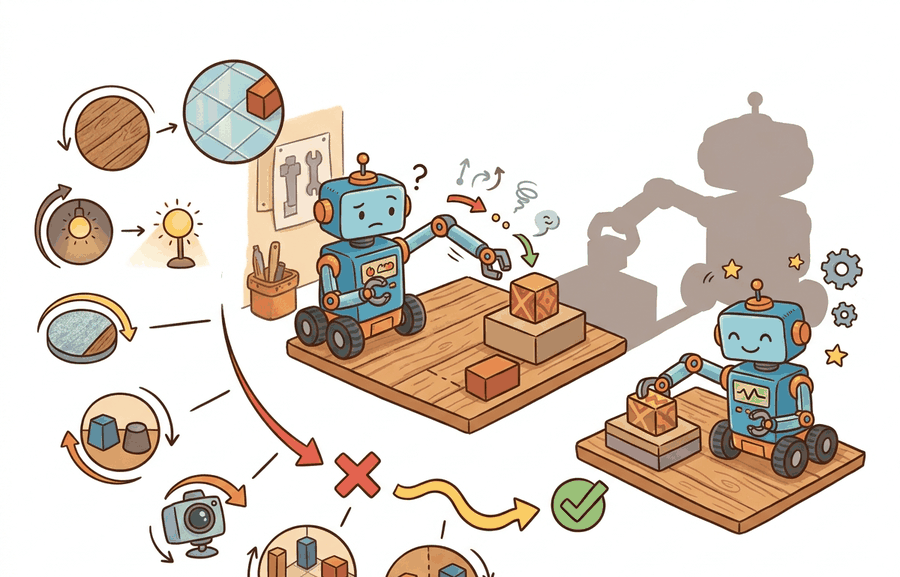
Why synthetic variation matters treats every rendered frame and randomized rollout as a hypothesis about real deployment. A useful synthetic variation plan says which nuisance factors might change, which task variables must stay causal, and which held-out real conditions will decide whether the extra variation helped.
For Why synthetic variation matters, the transfer argument should name which simulator gap is randomized, which real variable it approximates, and which evaluation panel checks whether transfer improved.
What This Section Builds
This section makes synthetic variation operational. It separates task variables such as object pose and goal location from nuisance variables such as lighting, material, camera noise, friction, and actuator lag.
The goal is a reproducible habit: write the randomization distribution before training, name the coverage target, keep a real holdout panel untouched, and compare methods on the same seeds, scenes, and metrics.
Synthetic data is not automatically evidence. It becomes evidence when the randomization plan covers a plausible deployment support, avoids leaking validation scenes into training, and shows that a specific real-world failure mode improves.
Theory
Let $\theta$ collect nuisance parameters such as texture, illumination, camera pose, mass, friction, and sensor noise. Domain randomization trains on $\theta \sim p_{\text{train}}(\theta)$ while deployment samples from an unknown real distribution $p_{\text{real}}(\theta)$. The first question is coverage: does the training support include the real conditions that matter for the task?
Coverage is not the same as chaos. If a drawer-opening policy trains on impossible friction, impossible handle geometry, and impossible camera exposure, it may learn artifacts that never occur on the robot. The practical design rule is to randomize factors that can vary in deployment, keep task semantics stable, and evaluate on held-out real measurements or realistic proxy panels that were not used to tune the ranges.
The mechanism is support overlap. Randomization expands the set of conditions where the learned model has seen equivalent task evidence, while held-out real tests reveal whether the expansion covered useful cases or only generated visual noise.
Worked Example
Consider a tabletop grasping policy trained in simulation. The following snippet turns the randomization plan into an auditable manifest, so the reader can see which factors are meant to cover reality and which ones remain fixed.
# Audit a synthetic variation manifest before training starts.
# Each factor records a distribution and a real-world failure it should cover.
from dataclasses import dataclass

@dataclass
class RandomizedFactor:
    name: str
    distribution: str
    real_failure: str

    def as_row(self) -> dict[str, object]:
        return asdict(self)

factors = [
    RandomizedFactor("lighting_lux", "uniform(250, 900)", "camera glare"),
    RandomizedFactor("table_friction", "uniform(0.35, 0.75)", "block slip"),
    RandomizedFactor("camera_yaw_deg", "uniform(-6, 6)", "calibration drift"),
]

for factor in factors:
print(f"{factor.name}: {factor.distribution} covers {factor.real_failure}")RandomizedFactor records connect each distribution to a real failure mode before training begins. This keeps synthetic variation tied to coverage rather than raw data volume.The manifest is the design surface. In a practical system, MuJoCo, MJX, Isaac Lab, Genesis, Newton, Drake, ROS 2, modern Gazebo, Omniverse Replicator, and BlenderProc can sample those factors, render observations, log seeds, and attach labels. The tool is useful when it preserves the manifest and produces a replayable artifact.
Practical Recipe
- List deployment factors that can change: appearance, geometry, contact, sensor, timing, and task layout.
- Assign each factor a range, distribution, unit, and reason tied to a real failure mode.
- Keep a held-out real panel or calibrated proxy panel that never informs the training ranges.
- Run the baseline and randomized method through one evaluation script on the same scenes, seeds, and metrics.
- Save the manifest, sampled seeds, videos or traces, aggregate metrics, and failure labels as one artifact.
A randomization plan is evidence only when it names the randomized factors, ranges, sampling distribution, held-out real measurements, and failure labels. Synthetic data should improve a measured transfer bottleneck, not merely increase the number of rendered images.
The common mistake is to widen every distribution until the simulator looks diverse. Over-wide randomization can teach invariances that conflict with the task, while under-wide randomization leaves the policy brittle at deployment.
A robotics team training a bin-picking detector might randomize lighting, part color, camera pose, and mild occlusion, but keep object identity and graspable geometry label-consistent. The real holdout panel should include unseen parts, unseen trays, and logged failure labels, so the team can say which transfer bottleneck improved.
A random seed is not a receipt unless the manifest tells you what the seed was allowed to change.
Research on domain randomization now studies when broad synthetic coverage helps and when targeted, adaptive coverage is more sample-efficient. The open problem is evidence selection: identifying the smallest randomized family that covers real deployment variation without teaching the policy to ignore task-critical cues.
Can you name three randomized factors, their units, their distributions, their real-world failure labels, and the held-out panel that will test them? If not, the experiment boundary is still too vague.
Synthetic variation becomes useful when it is tied to a closed-loop contract. The contract names the observation stream, action representation, timing budget, randomized parameter vector, and evaluation artifact. Without that contract, a model can look capable in a notebook while failing the first time a sensor drops a frame or a controller saturates.
The graduate-level habit is to separate three claims. The coverage claim says the sampled factors overlap deployment. The invariance claim says the policy should ignore those factors while preserving task cues. The evidence claim records a construct-matched transfer measurement on one panel and one configuration.
| Tool or Library | Role in the Topic | Builder Advice |
|---|---|---|
| Omniverse Replicator | Visual factor sampling and synthetic labels | Use it when rendered perception data must keep camera, material, light, and annotation metadata together. |
| BlenderProc | Procedural scene generation | Use it when object placement, occlusion, camera pose, and labels need scripted coverage. |
| MuJoCo or MJX | Dynamics parameter sampling | Use it when mass, damping, actuator, and contact ranges must be replayable. |
| Isaac Lab | Parallel randomized rollouts | Use it when the policy needs many randomized environments with logged seeds and task metrics. |
| LeRobot | Real episode comparison | Use it when synthetic policies need to be compared against real robot traces and dataset metadata. |
A robust implementation starts with a tiny, inspectable baseline and only then moves to a high-throughput simulator or renderer. The baseline and the scaled run should produce the same artifact schema, so the comparison is a same-task comparison rather than a story assembled from separate experiments. Code Fragment 2 shows the minimum evidence record for that schema.
- Write a one-paragraph task contract with observation, action, success, and failure fields.
- Start with the smallest simulator, dataset, or wrapper that exposes the task contract faithfully.
- Run one deterministic smoke test and one perturbation test before scaling.
- Save a single result artifact containing configuration, seed, metrics, videos or traces, and failure labels.
- Compare methods only when one script evaluates them on the same task panel.
Expected output: the printed trace should expose the method configuration, randomized factor list, held-out panel, construct-matched metric, and leakage check. If one of those fields is missing, the example is not yet an evaluation artifact.
When a synthetic variation experiment fails, avoid labeling the whole method as weak. First assign the failure to coverage miss, unrealistic factor combination, label leakage, perception error, contact mismatch, timing drift, or metric mismatch. Then rerun one controlled perturbation that isolates the suspected cause and save the trace beside the aggregate score.
Synthetic variation is useful when it makes a policy or perception model more robust under measured transfer stress, with distributions, held-out conditions, and failure labels recorded in one artifact.
Design a randomization manifest for one embodied task. Specify three factors with units and distributions, one real failure each factor should cover, one held-out real or proxy panel, and one train/test leakage check.
Section 13.2 → separates that manifest into visual, physics, sensor, and task factors so each transfer failure has a specific place to land.
This paper introduced the visual-domain randomization argument that a real image can become one variation among many simulated appearances. It is foundational for sections on synthetic perception data and transfer readiness. Readers should connect this source to why synthetic variation matters when deciding what is reusable, what is benchmark-specific, and what must be remeasured.
This paper studies randomized dynamics for robotic control transfer. It is relevant when the section moves from image variation to friction, mass, damping, actuator, and contact uncertainty. Readers should connect this source to why synthetic variation matters when deciding what is reusable, what is benchmark-specific, and what must be remeasured.
This work gives a theoretical view of domain randomization as transfer across a family of parameterized MDPs. Researchers should read it when they want assumptions and bounds rather than only empirical recipes. Readers should connect this source to why synthetic variation matters when deciding what is reusable, what is benchmark-specific, and what must be remeasured.
NVIDIA. "Omniverse Replicator Documentation."
Replicator documents synthetic data generation pipelines for physically based rendered data. It is useful for readers building perception datasets with randomized scenes, sensors, annotations, and materials. Readers should connect this source to why synthetic variation matters when deciding what is reusable, what is benchmark-specific, and what must be remeasured.
DLR-RM. "BlenderProc Documentation and Examples."
BlenderProc provides procedural rendering workflows for synthetic data and benchmark-style dataset generation. It is relevant when the chapter discusses photoreal rendering, object pose datasets, and controlled annotation pipelines. Readers should connect this source to why synthetic variation matters when deciding what is reusable, what is benchmark-specific, and what must be remeasured.