"A new simulator is a research claim until your task says it is an engineering dependency."
A Skeptical Physical AI Agent
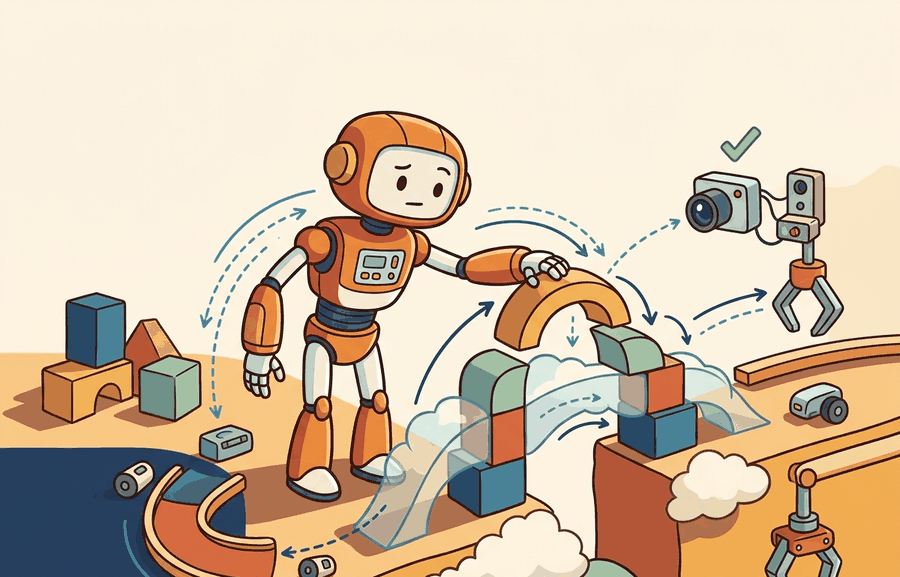
Newton is an open-source GPU-accelerated physics engine developed by NVIDIA, Google DeepMind, and Disney Research, with Linux Foundation governance. It is built on NVIDIA Warp and OpenUSD, and it is positioned as a flexible engine for robot learning. Because it is newer than MuJoCo and Isaac Lab, this section treats it as a frontier tool: important to understand, but not something to adopt blindly.
When observations are images, the renderer becomes part of the learning system. Lighting, camera placement, textures, and sensor noise all shape what the policy learns to trust.
This section treats simulation as infrastructure: dynamics math constrains the physics layer, while OpenUSD constrains asset composition, reproducibility, and interchange with robotics and graphics tools.
Why Newton Exists
Robot learning needs a combination that older simulator stacks rarely provide all at once: GPU-scale stepping, differentiable or compiler-friendly computation, rich scene interchange, extensible solvers, and open governance. Newton aims at that intersection. Its public materials emphasize Warp, OpenUSD, multiple solvers, and robot-learning use cases such as contact-rich locomotion and manipulation.
The useful mental model is that Newton is not merely "another faster simulator." It is an attempt to put GPU kernels, scene interchange, differentiability, and open robot-learning infrastructure under one roof. That makes it scientifically interesting, but it also raises the validation bar: check solver behavior, contact stability, backend maturity, and example coverage on your task before treating the engine as infrastructure.
Newton is a frontier engine, so the adoption rule is simple: enthusiasm can start the prototype, but the baseline comparison decides whether it becomes infrastructure.
As of 2026, Newton is a high-priority tool to watch because it connects three important threads: MuJoCo Warp, OpenUSD scene workflows, and open governance through the Linux Foundation. Treat performance and fidelity claims as task-specific until you reproduce them on your own robot, scene, and metric.
OpenUSD As More Than A File Format
OpenUSD matters because embodied AI scenes are becoming larger and more compositional. A household robot scene may include rooms, articulated objects, materials, lights, cameras, semantic labels, robot assets, and task-specific randomization. A scene graph makes those components reusable. The simulator still needs physics, but the research workflow also needs interchange.
Scene interchange is not the same as physical validity. A USD asset can preserve hierarchy, materials, and semantics while still leaving collision geometry, inertial properties, joint limits, or contact parameters under-specified for learning. Treat OpenUSD as the scene backbone, then audit which simulator-specific assumptions get attached before the policy sees the world.
| Question | Why it matters | Adoption signal |
|---|---|---|
| Do you need OpenUSD scenes? | Scene interchange may matter more than a compact model file | Use Newton or Isaac paths if USD is central |
| Do you need custom GPU physics? | Warp can make custom kernels part of the workflow | Newton is worth prototyping |
| Do you need mature benchmark parity today? | New tools may lack old benchmark coverage | Keep MuJoCo, Isaac Lab, or SAPIEN as baselines |
| Do you need open governance? | Research infrastructure benefits from non-proprietary stewardship | Newton's Linux Foundation path is relevant |
A Recency-Aware Adoption Score
Code Fragment 1 implements a tiny adoption checklist. It does not decide for you. It forces a team to separate frontier value from project risk before adding a new engine to a research dependency chain.
The scorecard is a few lines of governance-aware project planning. In practice, a Newton prototype should use the official Newton repository and examples rather than a hand-built wrapper. The maintained tooling handles Warp integration and scene conventions, while your audit handles whether the tool belongs in the project.
When To Use Newton
Use Newton when you are exploring the frontier of GPU physics, OpenUSD-based robot scenes, custom solver work, or Newton-specific integration with Isaac Lab. Avoid making it the only simulator in a high-stakes study until you have a baseline comparison against a mature engine and a reproducible task artifact.
A lab building a new humanoid locomotion benchmark might prototype Newton because terrain contact, GPU throughput, and OpenUSD scenes matter. The same lab should still run a MuJoCo or Isaac Lab baseline so reviewers can separate benchmark novelty from simulator novelty.
Expected output: A Newton adoption note should include the exact repository or release, Warp and OpenUSD versions, the contact-rich task, the mature baseline, the metric, the solver settings, and the reason Newton changes the experiment rather than only the novelty of the stack.
Are you adopting Newton because it uniquely supports your scene, solver, or GPU workflow, or because it is new? A frontier tool needs a task-specific reason.
Change the weights in Code Fragment 1 for a production robot team instead of a research prototype. Which weights increase, which weights decrease, and why?
Choose Newton and OpenUSD-centered workflows when asset interchange, scene composition, and scalable simulation pipelines dominate the requirement. The contract should pin USD layers, physics schemas, contact parameters, and tool versions.
If a paper or internal report uses a new simulator, include a mature-simulator comparison unless the point of the work is explicitly simulator development. Otherwise, readers cannot tell whether the result comes from the robot method or the simulator stack.
Newton is important because it connects open governance, Warp, OpenUSD, and robot-learning physics. Use it deliberately, with baselines, solver checks, and a written adoption audit.
Section 11.6 turns to Genesis, another emerging simulator family focused on Pythonic multi-physics, rendering, and generative workflows.
NVIDIA. "Newton Physics Engine."
The official Newton page describes the engine's Warp and OpenUSD foundation and its collaboration among NVIDIA, Google DeepMind, and Disney Research. It is the best starting point for current positioning and links.
Newton Physics. "Newton GitHub Repository."
The repository gives the current source, examples, and release activity for Newton. Use it to verify APIs and maturity before treating Newton as a project dependency.
Linux Foundation. (2025). "Linux Foundation Announces Contribution of Newton."
This announcement explains Newton's governance context and stated goals for open robot learning. Readers should use it for institutional context, not as a substitute for task-level benchmarking.
Warp is the GPU programming foundation that makes Newton and MuJoCo Warp relevant to accelerator-native simulation. Readers interested in custom physics kernels should study its programming model.
Alliance for OpenUSD. "OpenUSD Documentation."
OpenUSD is the scene description technology Newton uses for rich simulator scenes. It matters for readers whose tasks require composed assets, semantic scene data, and tool interoperability.