"One robot teaches you a behavior. Ten thousand robots teach you the distribution."
A Batch-First Embodied AI Agent
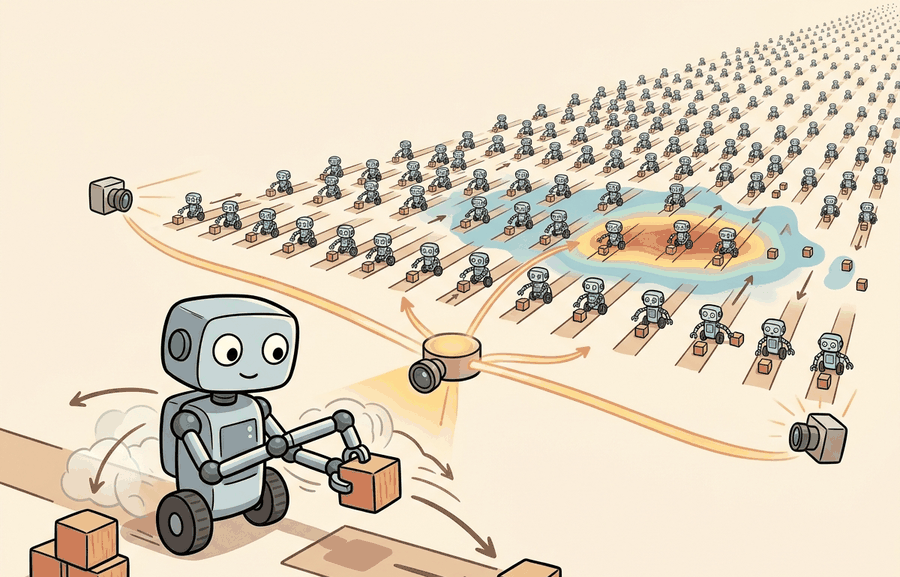
MJX and MuJoCo Warp keep the MuJoCo modeling mindset but move execution toward accelerator-native workloads. MJX exposes MuJoCo-style simulation through JAX, which makes vectorization and differentiable computation natural. MuJoCo Warp implements MuJoCo in NVIDIA Warp for high-throughput GPU simulation and is now part of the broader Newton story.
This section links simulator math to accelerator execution: vectorized dynamics is useful only when contact behavior, gradients or finite differences, and reset logic remain comparable to the reference simulator.
The Problem: One Environment Is Not Enough
Modern robot learning often needs thousands of rollouts, not one beautiful rollout. Reinforcement learning needs many episodes to estimate gradients. Domain randomization needs many variations to expose brittle policies. System identification needs parameter sweeps. This changes the simulator question from "Can I step this robot?" to "Can I step a population of worlds while keeping the data on the accelerator?"
Vectorized simulation is not only a speed trick. It changes which experiments become feasible: sweep friction, randomize masses, run many seeds, estimate uncertainty, and train policies against a distribution rather than a single convenient world.
MJX: MuJoCo Through JAX
MJX is useful when the rest of the learning stack is written in JAX or when you want jit, vmap, and accelerator execution to organize simulation at scale. The mental model is simple: keep the model structure close to MuJoCo, but represent batched simulation state as arrays that JAX can transform.
The sharp edge is that MJX earns its keep on large batches of similar worlds. It is not automatically the best route for a single interactive scene, a debugging session, or a model feature that is not supported by the accelerator backend. Keep a small CPU MuJoCo case nearby, then use MJX when the experiment really needs thousands of parallel states, domain-randomized parameters, or JAX-native policy updates.
Code Fragment 1 does not require MJX. It teaches the vectorization pattern MJX makes valuable: one equation runs across many worlds with different parameters.
# Vectorized rollout: one update rule runs across many worlds.
# NumPy stands in for JAX here so the batching idea is easy to inspect.
# Each column represents a different gravity setting.
import numpy as np

heights = np.full(4, 0.25)
velocities = np.zeros(4)
gravities = np.array([-9.60, -9.70, -9.81, -10.00])
dt = 0.02

for _ in range(10):
    velocities = velocities + gravities * dt
    heights = np.maximum(0.0, heights + velocities * dt)

print(np.round(heights, 4))
[0.0388 0.0366 0.0342 0.03 ]
MuJoCo Warp: MuJoCo On NVIDIA Warp
MuJoCo Warp, often written MJWarp, targets NVIDIA hardware through Warp. Its role is different from MJX: instead of making simulation feel like JAX, it brings MuJoCo-style physics into a GPU programming model designed for parallel kernels. This matters when the bottleneck is raw simulation throughput on NVIDIA hardware and when the broader stack may connect to Newton.
| Question | MJX | MuJoCo Warp |
|---|---|---|
| Main ecosystem | JAX | NVIDIA Warp |
| Best fit | JAX RL, differentiable experiments, batched array workflows | NVIDIA GPU simulation throughput and Newton-linked workflows |
| Developer mental model | Transform functions with jit, vmap, and gradients | Use GPU kernels and Warp-native data paths |
| Validation habit | Compare against CPU MuJoCo on a small seed panel before scaling | Compare against MJX or CPU MuJoCo on the same model and contact task |
| Risk | Feature parity and compilation constraints need checking | Fast-moving ecosystem, so API currency matters |
The manual vectorized NumPy fragment is 15 lines that teach batching. In practice, MJX gives the same idea through JAX primitives, while MuJoCo Warp moves simulation into Warp kernels for NVIDIA GPUs. The libraries absorb data layout, stepping, and accelerator execution, leaving you to define task distributions and evaluation metrics.
Differentiability Is Powerful, But Not Magic
Differentiable simulation asks for gradients of future behavior with respect to states, actions, or parameters. That can help with system identification, trajectory optimization, and model-based learning. Contact makes this hard because impacts and friction can introduce discontinuities. Treat simulator gradients as useful signals, not as proof that the physical world is smooth.
A robust workflow tests gradients the same way it tests speed. Compare automatic gradients against finite differences on a tiny scene, perturb contact parameters, and replay closed-loop rollouts after any backend change. If the gradient improves a loss but breaks the rollout under a small friction change, the optimization found a simulator artifact rather than a control insight.
Choose MJX or Warp when the same physics contract must run across many parallel rollouts. The evaluation should record solver parity, batch size, accelerator, determinism, and any divergence from CPU MuJoCo.
A gradient through a simulator is a property of the simulator's approximation. For contact-rich tasks, validate gradient-based conclusions with finite differences, randomized parameters, and closed-loop rollouts.
Practical Recipe
- Choose MJX when the rest of your learner is JAX-first and batching is central.
- Choose MuJoCo Warp when NVIDIA GPU throughput and Warp or Newton integration matter.
- Keep a CPU MuJoCo sanity case for small examples and debugging.
- Run the same seed, model, and metric across backends before comparing speed.
- Report throughput and behavior, not throughput alone.
A locomotion researcher can use MJX to train thousands of randomized walkers inside a JAX RL pipeline, then compare selected policies against CPU MuJoCo for sanity. A GPU systems researcher may use MuJoCo Warp when the question is how far NVIDIA acceleration can push contact-rich rollout throughput.
Expected output: An accelerator-backend comparison should report model identity, backend versions, batch size, seeds, device, throughput, rollout metric, and a small CPU MuJoCo sanity trace. Speed without behavior matching is not enough evidence.
MJX and MuJoCo Warp are not automatic speed labels. They are promises about where the arrays live, how many worlds move together, and which backend owns the contact calculation.
Are you choosing MJX or Warp because your experiment needs many worlds, differentiability, or GPU residency? If the answer is only "it is faster," define the specific bottleneck first.
Extend Code Fragment 1 to randomize both gravity and restitution. Run 100 worlds, compute the mean final height, and explain what simulator parameter uncertainty means for policy evaluation.
The frontier is converging on accelerator-native simulators that can handle contact, gradients, randomized scenes, and learning loops without repeated CPU transfers. MJX-JAX, MuJoCo Warp, and Newton-style workflows show the same pressure from different ecosystems. The open research question is how to preserve fidelity and debuggability while simulation becomes more parallel and more compiler-driven.
MJX and MuJoCo Warp are not generic upgrades over MuJoCo. They are choices for specific accelerator-native experiments where parallelism, data locality, and sometimes gradients are load-bearing.
Section 11.4 moves from MuJoCo-style accelerator backends to Isaac Sim and Isaac Lab, where simulation is tied to USD scenes, sensors, and large robot-learning workflows.
Google DeepMind. "MuJoCo XLA (MJX) Documentation."
The MJX documentation is the authoritative source for the JAX API and its relationship to MuJoCo. Readers using JAX RL or differentiable experiments should start here before writing production code.
Google DeepMind. "MuJoCo Warp (MJWarp) Documentation."
This documentation explains MuJoCo Warp as a Warp implementation optimized for NVIDIA hardware and parallel simulation. It is relevant for readers evaluating the NVIDIA GPU path from MuJoCo-style models.
Google DeepMind and NVIDIA. "MuJoCo Warp Repository."
The repository gives the current source and examples for MuJoCo Warp. Use it to verify installation details and API status because this part of the stack is developing quickly.
JAX Authors. "JAX Documentation."
JAX documentation explains jit, vmap, automatic differentiation, and accelerator execution. These concepts are necessary for understanding why MJX is more than a different MuJoCo wrapper.
Warp is the Python framework behind MuJoCo Warp and Newton-style GPU kernels. Readers interested in simulator internals and custom GPU physics should use it to understand the programming model.