A Careful Control Loop
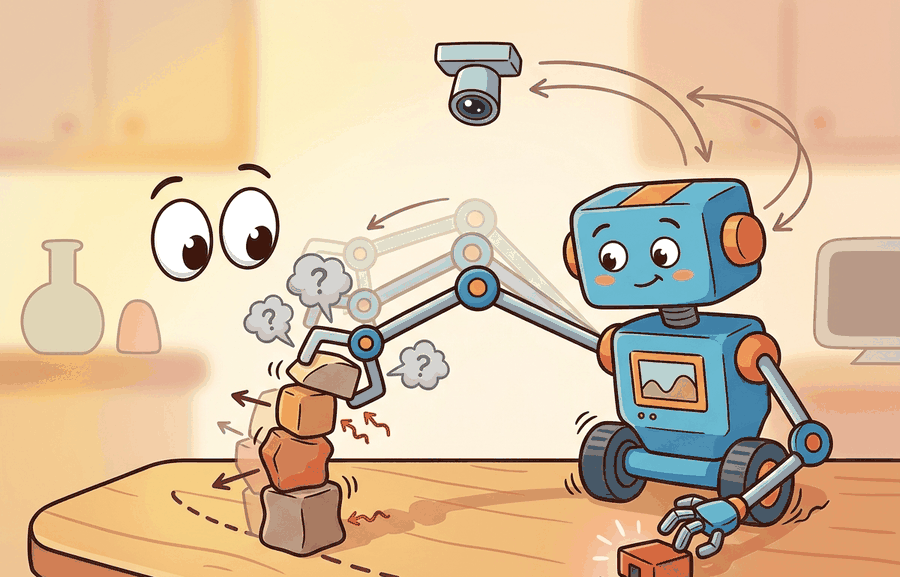
Rigid-body dynamics; the manipulator equation is one lens on dynamics and simulation math. We study it because an embodied agent needs decisions that survive contact with noisy sensors, delayed effects, and changing environments.
This section develops the technical contract for Rigid-body dynamics; the manipulator equation into a usable mental model. First we define the object of study, then we connect it to the agent loop, then we test it with a compact implementation.
The key question in Rigid-body dynamics; the manipulator equation is practical: what must the agent know, what can it observe, what action is available, and what evidence shows that the action worked under the stated conditions?
A representation earns its place when it changes the measurable action interface. In Rigid-body dynamics; the manipulator equation, the reader should keep asking which decision becomes easier, safer, or more reliable.
Theory
For Rigid-body dynamics; the manipulator equation, the practical design rule is to make the interface inspectable before optimization begins: inputs, outputs, units, latency, bounds, and failure labels should all be visible in the saved artifact.
The mechanism in Rigid-body dynamics; the manipulator equation is the contract between representation and action. Name what enters the module, what leaves it, which assumptions make that transformation valid, and which log would reveal a bad handoff.
The Manipulator Equation
Every rigid robot arm with $n$ independent joints obeys one compact second-order law. It is the single most important equation in this chapter, and almost every controller, simulator, and learning method in later chapters is built on top of it:
$$M(q)\ddot{q} + C(q,\dot{q})\dot{q} + g(q) = \tau$$
The terms are:
- $q \in \mathbb{R}^n$: the joint configuration (angles for revolute joints, displacements for prismatic joints), with $\dot{q}$ and $\ddot{q}$ the joint velocities and accelerations.
- $M(q) \in \mathbb{R}^{n \times n}$: the inertia matrix (also called the mass matrix). It is symmetric and positive definite for every reachable configuration. It maps joint acceleration to the inertial part of the required torque.
- $C(q,\dot{q}) \in \mathbb{R}^{n \times n}$: the Coriolis and centrifugal matrix. The product $C(q,\dot{q})\dot{q}$ collects the velocity-dependent coupling forces that appear when several joints move at once.
- $g(q) \in \mathbb{R}^n$: the gravity vector, the torque each joint must supply to hold the arm against gravity at configuration $q$.
- $\tau \in \mathbb{R}^n$: the vector of joint torques (or forces) commanded by the actuators.
(1) $M(q)$ is symmetric positive definite. This guarantees $M(q)^{-1}$ exists, so forward dynamics $\ddot{q} = M^{-1}(\tau - C\dot{q} - g)$ always has a unique solution, and the kinetic energy $\tfrac{1}{2}\dot{q}^\top M(q)\dot{q}$ is strictly positive for any nonzero motion.
(2) $\dot{M}(q) - 2C(q,\dot{q})$ is skew-symmetric under the standard Christoffel-symbol choice for $C$. This passivity property is what makes energy-based and Lyapunov controllers provably stable: the Coriolis term does no net work, $\dot{q}^\top(\dot{M} - 2C)\dot{q} = 0$.
(3) At rest, $\tau = g(q)$. When $\dot{q} = 0$ and $\ddot{q} = 0$ the equation collapses to gravity compensation: the torque needed simply to hold a pose is exactly $g(q)$. This is the first term any real arm controller computes.
The worked example below builds $M$, $C$, and $g$ in closed form for a 2-DOF planar arm (two revolute joints in the vertical plane, masses concentrated at the link tips), then verifies all three structural properties numerically with NumPy.
import numpy as np

# 2-DOF planar arm in a vertical plane, point masses at link tips.
m1, m2 = 1.5, 1.0       # link masses (kg)
l1, l2 = 0.5, 0.4       # link lengths (m)
g_acc  = 9.81           # gravity (m/s^2)

def manipulator_matrices(q, dq):
    """Return M(q), C(q,dq), g(q) for the 2-link planar arm."""
    q1, q2 = q
    dq1, dq2 = dq
    c2, s2 = np.cos(q2), np.sin(q2)

    # --- Inertia matrix M(q) (symmetric, configuration dependent) ---
    a = m1 * l1**2 + m2 * (l1**2 + l2**2 + 2 * l1 * l2 * c2)
    b = m2 * (l2**2 + l1 * l2 * c2)
    d = m2 * l2**2
    M = np.array([[a, b],
                  [b, d]])

    # --- Coriolis / centrifugal matrix C(q,dq) (Christoffel form) ---
    h = -m2 * l1 * l2 * s2
    C = np.array([[h * dq2, h * (dq1 + dq2)],
                  [-h * dq1, 0.0]])

    # --- Gravity vector g(q) ---
    c1   = np.cos(q1)
    c12  = np.cos(q1 + q2)
    g1 = (m1 + m2) * g_acc * l1 * c1 + m2 * g_acc * l2 * c12
    g2 = m2 * g_acc * l2 * c12
    g = np.array([g1, g2])
    return M, C, g

# Pick an arbitrary configuration and velocity.
q  = np.array([0.4, -0.7])
dq = np.array([1.2,  0.9])
M, C, g = manipulator_matrices(q, dq)

# Property 1: M is symmetric positive definite.
print("M symmetric :", np.allclose(M, M.T))
print("M eigvals   :", np.linalg.eigvals(M))   # all strictly > 0

# Property 3: torque to simply hold this pose equals g(q).
tau_hold = g
print("gravity hold torque tau = g(q):", tau_hold)

# Forward dynamics: given a torque, solve for joint acceleration.
tau   = np.array([2.0, 0.5])
ddq   = np.linalg.solve(M, tau - C @ dq - g)
print("forward-dynamics ddq        :", ddq)

# Inverse dynamics round-trip recovers the same torque.
tau_back = M @ ddq + C @ dq + g
print("inverse-dynamics tau        :", tau_back, "(matches input)")

# Property 2: dM/dt - 2C is skew-symmetric.
# dM/dt = (dM/dq2) * dq2 here, since M depends only on q2.
dMdq2 = np.array([[-2 * m2 * l1 * l2 * np.sin(q[1]),
                   -m2 * l1 * l2 * np.sin(q[1])],
                  [-m2 * l1 * l2 * np.sin(q[1]), 0.0]])
Mdot  = dMdq2 * dq[1]
S = Mdot - 2 * C
print("skew-symmetric (S = -S^T)  :", np.allclose(S, -S.T))
print("passivity dq^T S dq ~ 0    :", float(dq @ S @ dq))
Running this prints that $M$ is symmetric with positive eigenvalues, the hold torque equals $g(q)$, the inverse-dynamics round-trip recovers the commanded torque, and $\dot{M} - 2C$ is skew-symmetric so $\dot{q}^\top(\dot{M}-2C)\dot{q}$ is numerically zero. Those four checks are the minimum acceptance test before trusting any dynamics code, hand-built or from a library.
In production, build the same arm in Pinocchio and call pinocchio.crba for $M$, pinocchio.computeCoriolisMatrix for $C$, and pinocchio.computeGeneralizedGravity for $g$, or read them from MuJoCo's mjData.qM and bias terms. The hand-built closed form above is the oracle you compare those library outputs against on the same $(q,\dot{q})$ before you trust a 7-DOF model you cannot verify by hand.
For Rigid-body dynamics; the manipulator equation, the hand-built fragment exposes the physical assumption before maintained tools take over. MuJoCo, MJX, Drake, Pinocchio, and Isaac Lab are useful only when the same mass, contact, actuator, and timestep contract is preserved.
Practical Recipe
- Write the observation, action, and success metric before choosing a model.
- Build a baseline that is simple enough to debug by inspection.
- Add the library implementation only after the baseline behavior is understood.
- Record failures as structured cases: perception error, state error, planning error, control error, or evaluation error.
- Run at least one perturbation test before trusting the result.
The common mistake in Rigid-body dynamics; the manipulator equation is to celebrate the component score before checking the closed-loop handoff. The failure usually appears at the boundary: stale state, wrong frame, delayed action, saturated actuator, or metric that ignores the real task cost.
A robotics team using Rigid-body dynamics; the manipulator equation should log not only final success, but intermediate observations, chosen actions, controller status, and recovery events. The logs reveal whether the method is solving the task or merely passing the easiest episodes.
When rigid-body dynamics; the manipulator equation feels abstract, ask what would be different in the next frame of video, the next robot state, or the next safety margin.
For Rigid-body dynamics; the manipulator equation, treat frontier claims as hypotheses until they expose enough detail to reproduce the result: data boundary, embodiment, controller interface, evaluation panel, and failure cases.
Can you name the observation, state estimate, action, success metric, and most likely failure mode for Rigid-body dynamics; the manipulator equation? If not, the system boundary is still too vague.
Production Pattern
Rigid-body dynamics; the manipulator equation sits inside the Part II robotics contract: geometry defines where things are, kinematics defines what motion is possible, dynamics defines what motion costs, control defines how errors are corrected, and sensing defines what the agent can know on time.
Use the manipulator equation as an accounting identity for inertia, Coriolis terms, gravity, and actuation. This makes the section useful to students, builders, and researchers at the same time: the idea has an intuitive role, a formal interface, a runnable check, and a failure mode that can be reproduced.
The manipulator equation is valuable because it separates the sources of joint torque instead of hiding them inside a simulator step. A controller can then ask a precise question: how much torque accelerates the mechanism, how much cancels gravity, how much counters velocity coupling, and how much is consumed by contact or friction?
The mass matrix is not a list of link masses. It is a configuration-dependent map from joint acceleration to generalized force. When the arm stretches out, the same elbow acceleration can require more shoulder torque because moving one joint also moves mass carried by other joints.
For Rigid-body dynamics; the manipulator equation, dynamics adds causes of motion: forces, torques, inertia, contact impulses, and integration. Keep units, solver step, contact parameters, and energy behavior visible.
| Tool or Library | What It Handles | Verification Check |
|---|---|---|
| MuJoCo | runs articulated dynamics and contact simulation for robot learning experiments | Verify timestep, solver parameters, contact settings, and reset semantics. |
| MJX | runs articulated dynamics and contact simulation for robot learning experiments | Verify timestep, solver parameters, contact settings, and reset semantics. |
| Drake | models dynamical systems, multibody plants, optimization, and controllers | Verify scalar type, plant finalization, frame convention, and solver status. |
| Pinocchio | computes articulated-body kinematics, dynamics, and derivatives | Verify model frames, joint ordering, and derivative convention against the URDF. |
| Isaac Lab | scales robot-learning simulation with GPU workflows and sensor-rich scenes | Verify environment parity, reset distribution, and logged seeds before training. |
Use this recipe when turning Rigid-body dynamics; the manipulator equation into code, a simulator experiment, or a robot diagnostic. The point is not to use every library. The point is to keep the hand-built baseline and the maintained-tool path comparable.
- Specify mass, inertia, actuator limits, contact model, timestep, and solver tolerance before running a rollout.
- Run one free-motion test and one contact test with logged energy, constraint violation, and penetration depth.
- Compare the hand calculation with MuJoCo, Drake, Pinocchio, or MJX on the same model and timestep.
- Store solver settings, random seed, initial state, trajectory, and failure labels in one artifact.
- Scale to Isaac Lab or GPU-parallel simulation only after a small model passes deterministic checks.
For Rigid-body dynamics; the manipulator equation, compare methods only through one saved artifact that preserves the inputs, outputs, units, timestamps, latency budget, configuration, seed, metric definition, and failure labels relevant to this section. The comparison is meaningful only when the same script evaluates the same panel.
Extend the section exercise by adding one perturbation specific to Rigid-body dynamics; the manipulator equation and one latency or uncertainty check. Save the result in the EvidenceRecord schema, then explain which library output you trust and why.
For Rigid-body dynamics; the manipulator equation, distrust smooth simulation until the section-specific physical assumption has been stress-tested: timestep, contact stiffness, damping, friction, actuation, and energy behavior should each have a small diagnostic.
Technical Core
Rigid-body dynamics; the manipulator equation needs a topic-native core: variables, equations or system contracts, an algorithmic procedure, an expected output, and a failure diagnosis. Figure 6.2.T summarizes the chain this section must preserve when moving from a teaching example to a real embodied system.
The standard rigid-body form is $M(q)\ddot q + C(q,\dot q)\dot q + g(q) + \tau_f = \tau + J(q)^\top\lambda$. Here $M(q)$ is symmetric and positive definite for independent coordinates, $C(q,\dot q)\dot q$ is the velocity-coupling vector often called Coriolis and centrifugal effort, $g(q)$ is gravity, $\tau_f$ models damping or friction, and $J^\top\lambda$ maps contact or constraint forces into joint space. The matrix $C$ itself is convention-dependent, so compare the product $C\dot q$ or the full bias term rather than isolated entries.
- For inverse dynamics, start from measured or planned $(q,\dot q,\ddot q)$ and compute $\tau_\text{req}=M\ddot q+C\dot q+g+\tau_f-J^\top\lambda$.
- For forward dynamics, start from $(q,\dot q,\tau)$ and solve $\ddot q=M^{-1}(\tau+J^\top\lambda-C\dot q-g-\tau_f)$.
- Verify $M(q)$ is symmetric, positive definite, and ordered by the same joint list as the URDF or model file.
- Run a gravity-only pose test and a zero-velocity acceleration test before adding contacts or controllers.
| Contract Field | What To Specify | Why It Matters |
|---|---|---|
| State and observation | Variables, units, timestamps, frames, and uncertainty. | Prevents a model score from being mistaken for robot capability. |
| Action interface | Command type, limits, update rate, and safety fallback. | Makes the learned or planned output executable. |
| Evidence artifact | Trace, metric, configuration, seed, and failure label. | Allows baseline and library path to be compared in one pass. |
| Tool path | MuJoCo, Drake, Isaac Sim, Gazebo, PyBullet, SAPIEN, NumPy | Shows the practical library route after the mechanism is understood. |
For Rigid-body dynamics; the manipulator equation, expected output is a state trace with the relevant physical invariant: bounded energy error for free motion, bounded penetration for contact, and a solver-status field that explains divergence.
Rigid-body dynamics; the manipulator equation is validated by conserved quantities where they should hold, stable contact where contact is expected, and reproducible divergence under a named parameter perturbation.
Section References
Core references for Rigid-body dynamics; the manipulator equation: Modern Robotics; Murray, Li, and Sastry; Siciliano et al.; LaValle; and the official documentation for Drake, MuJoCo, Pinocchio, CasADi, python-control, GTSAM, ROS 2, and OpenCV as applicable.
Use these references to check notation, frame conventions, solver assumptions, and library behavior before comparing hand-built and maintained-tool implementations.
Rigid-body dynamics; the manipulator equation is useful when it makes the perception-action loop more reliable, not when it merely adds a more impressive model name.
Design a method-matched experiment for Rigid-body dynamics; the manipulator equation. Specify the environment, observations, actions, metric, one perturbation, and the library output you would compare against the hand-built baseline.