"A robot without frames has many coordinates and no agreement."
A Meticulous Mapping Agent
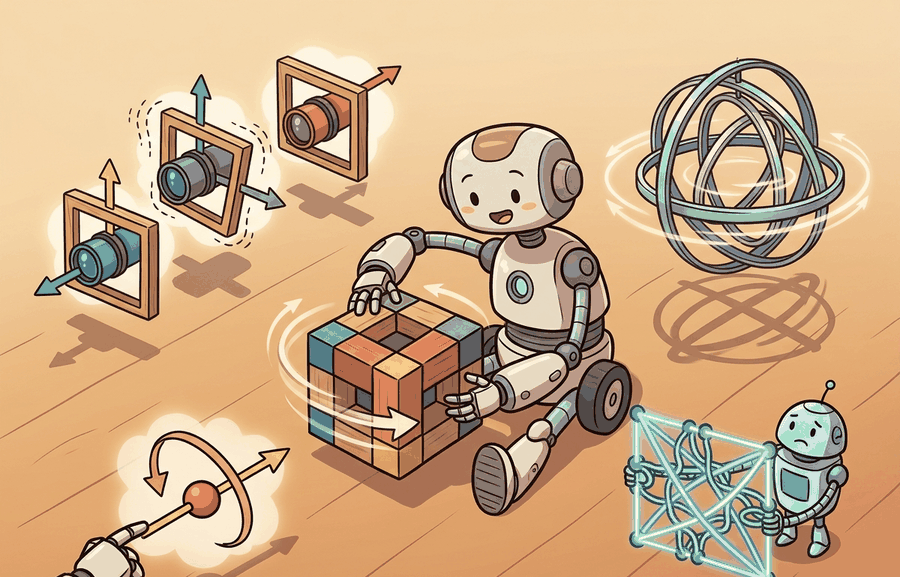
Rotations describe orientation without changing size or shape. Matrices, Euler angles, axis-angle vectors, and quaternions are all useful, but each representation carries a different set of numerical and convention traps.
Embodied systems move cameras, wrists, wheels, feet, and object frames through orientation space. A rotation can be logged as yaw-pitch-roll for a human, stored as a quaternion for interpolation, optimized as a rotation vector, and applied as a matrix to points and vectors.
The builder skill is not memorizing one representation. It is choosing the representation that fits the operation, then checking invariants so a convention mistake does not reach hardware.
A valid rotation matrix satisfies $R^TR=I$ and $\det(R)=1$. A valid quaternion has unit norm. These checks are cheap, and they catch many failures before a gripper points the wrong way.
Theory
Rotation matrices are direct operators on vectors and compose by multiplication. Every valid rotation $R \in SO(3)$ satisfies two invariants that double as runtime checks:
$$R^\top R = I, \qquad \det(R) = +1.$$
The first says the columns are orthonormal; the second rules out reflections (a determinant of $-1$ is a left-handed mirror, not a rotation). Euler angles build a rotation from three elementary rotations about the coordinate axes. Under the ZYX convention with yaw $\psi$, pitch $\theta$, and roll $\phi$,
$$R = R_z(\psi)\,R_y(\theta)\,R_x(\phi).$$
This factorization is compact and readable, but it has a singularity: when $\theta = \pm 90^\circ$ the first and third axes align and one rotational degree of freedom is lost. This is gimbal lock, and it is why controllers and estimators store orientation as a quaternion. A unit quaternion $q = [w, x, y, z]$ with $\lVert q \rVert = 1$ represents a rotation, its conjugate $q^{*} = [w, -x, -y, -z]$ represents the inverse rotation, and quaternions interpolate smoothly along the shortest arc via SLERP:
$$\text{slerp}(q_0, q_1; u) = \frac{\sin((1-u)\Omega)}{\sin\Omega}\,q_0 + \frac{\sin(u\Omega)}{\sin\Omega}\,q_1, \qquad \cos\Omega = q_0 \cdot q_1.$$
The danger is rarely that a rotation representation is mathematically invalid. The danger is that it is valid under a different convention: xyzw instead of wxyz, degrees instead of radians, zyx instead of xyz, active instead of passive, or camera optical axes instead of body axes.
In robotics, the danger is rarely that a rotation representation is mathematically invalid. The danger is that it is valid under a different convention: xyzw instead of wxyz, degrees instead of radians, zyx instead of xyz, active instead of passive, or camera optical axes instead of body axes.
Use matrices for applying rotations, quaternions for storage and interpolation, rotation vectors for small optimization updates, and Euler angles for user-facing display. Convert at boundaries with one tested library and one documented convention.
Worked Example
This fragment walks the whole representation chain. It builds a composed rotation $R_z(45^\circ)R_y(30^\circ)R_x(0^\circ)$ from elementary matrices and verifies the two invariants, demonstrates gimbal lock at pitch $\theta = 90^\circ$, forms a quaternion and its conjugate, and SLERPs between two orientations.
# Rotation representations end to end: matrices, invariants, gimbal lock,
# quaternion conjugate, and SLERP. All angles in degrees unless noted.
import numpy as np
from scipy.spatial.transform import Rotation as Rot, Slerp

def Rx(d): c,s=np.cos(np.radians(d)),np.sin(np.radians(d)); return np.array([[1,0,0],[0,c,-s],[0,s,c]])
def Ry(d): c,s=np.cos(np.radians(d)),np.sin(np.radians(d)); return np.array([[c,0,s],[0,1,0],[-s,0,c]])
def Rz(d): c,s=np.cos(np.radians(d)),np.sin(np.radians(d)); return np.array([[c,-s,0],[s,c,0],[0,0,1]])

# 1. Composed rotation and its invariants.
R = Rz(45) @ Ry(30) @ Rx(0)
print("R.T @ R = I? ", np.allclose(R.T @ R, np.eye(3)))
print("det(R) =     ", round(float(np.linalg.det(R)), 6))

# 2. Gimbal lock: at pitch = 90 deg, yaw and roll act on the same axis.
locked = Rot.from_euler("ZYX", [40.0, 90.0,  0.0], degrees=True)
same   = Rot.from_euler("ZYX", [ 0.0, 90.0, -40.0], degrees=True)  # different angles
print("gimbal lock (two angle sets, one rotation)?",
      np.allclose(locked.as_matrix(), same.as_matrix()))

# 3. Quaternion [w,x,y,z] and its conjugate (inverse rotation).
q = Rot.from_matrix(R).as_quat()                 # scipy returns [x,y,z,w]
q_wxyz = np.array([q[3], q[0], q[1], q[2]])
q_conj = np.array([q_wxyz[0], -q_wxyz[1], -q_wxyz[2], -q_wxyz[3]])
print("q      [w,x,y,z]:", q_wxyz.round(4).tolist())
print("q_conj [w,x,y,z]:", q_conj.round(4).tolist())

# 4. SLERP halfway between two orientations.
key = Rot.from_euler("ZYX", [[0,0,0],[90,0,0]], degrees=True)
mid = Slerp([0.0, 1.0], key)([0.5])
print("SLERP midpoint yaw (deg):",
round(float(mid.as_euler("ZYX", degrees=True)[0,0]), 3))The teaching fragment is about 9 lines. scipy.spatial.transform.Rotation reduces conversion, composition, inversion, and interpolation to named operations. spatialmath and ROS 2 tf2 provide pose-level wrappers when the rotation must travel with translation, frame_id, and timestamp.
Builder Recipe
- Pick one internal rotation representation per subsystem.
- Document Euler axis order, quaternion component order, handedness, and units.
- Check matrix orthogonality, determinant, and quaternion norm in logs.
- Round-trip through every serialization format used by the robot.
- Visualize at least one known pose in simulation before running hardware.
A quaternion ordered xyzw but loaded as wxyz can rotate a wrist into a plausible but wrong orientation. The numbers look normalized, the message type looks correct, and the failure appears only when action is attempted.
For a wrist camera, log the camera optical frame axes as three colored basis vectors in the simulator. If the red, green, and blue axes do not match the expected convention, fix the transform before tuning perception or control.
Euler angles are excellent for telling a human what happened. They are less excellent as the robot's long-term memory of orientation.
Learned pose estimators often regress rotations with 6D representations, quaternions, or rotation vectors to avoid discontinuities. Deployment still validates the resulting orientation with geometric invariants and downstream reprojection or control error.
Rotation conventions feed into Section 4.4 on SE(3), Section 5.7 on Jacobians, and Section 8.6 on filtering orientation estimates.
For your favorite robotics library, what quaternion order does it use, and does it expect radians or degrees for Euler conversion?
Production Pattern
Rotations: matrices, Euler angles, axis-angle, quaternions; pitfalls sits inside the Part II robotics contract: geometry defines where things are, kinematics defines what motion is possible, dynamics defines what motion costs, control defines how errors are corrected, and sensing defines what the agent can know on time.
Use quaternions or rotation matrices for computation, and treat Euler angles as a display or UI format. This makes the section useful to students, builders, and researchers at the same time: the idea has an intuitive role, a formal interface, a runnable check, and a failure mode that can be reproduced.
For Rotations: matrices, Euler angles, axis-angle, quaternions; pitfalls, a pose is a typed relationship between frames, not just a vector. The artifact should record parent frame, child frame, units, timestamp, and multiplication order before any transform is trusted.
| Tool or Library | What It Handles | Verification Check |
|---|---|---|
| SciPy Rotation | converts, composes, applies, and inverts 3D rotations in Python | Verify quaternion order, degrees versus radians, and matrix orthogonality. |
| ROS 2 tf2 | maintains time-buffered coordinate-frame relationships for robot systems | Verify parent-child frame names, lookup time, and transform direction. |
| spatialmath-python | supports practical work on Rotations: matrices, Euler angles, axis-angle, quaternions; pitfalls | Verify the library output against the hand-built baseline on one small case. |
| Drake | models dynamical systems, multibody plants, optimization, and controllers | Verify scalar type, plant finalization, frame convention, and solver status. |
| OpenCV calibration | handles camera models, calibration, projection, and vision preprocessing | Verify intrinsics, distortion, image timestamp, and frame-to-camera transform. |
Use this recipe when turning Rotations: matrices, Euler angles, axis-angle, quaternions; pitfalls into code, a simulator experiment, or a robot diagnostic. The point is not to use every library. The point is to keep the hand-built baseline and the maintained-tool path comparable.
- Name every frame with a parent, child, unit convention, and timestamp policy.
- Write one hand-checked transform chain and verify identity, inverse, and composition tests.
- Run the same transform through ROS 2 tf2 or SciPy Rotation, then compare one point and one direction vector.
- Record a frame audit with source sensor, latency, and expected sign convention.
- Debug failed behavior by replaying the transform tree before changing policy or controller code.
For Rotations: matrices, Euler angles, axis-angle, quaternions; pitfalls, compare methods only through one saved artifact that preserves the inputs, outputs, units, timestamps, latency budget, configuration, seed, metric definition, and failure labels relevant to this section. The comparison is meaningful only when the same script evaluates the same panel.
Extend the section exercise by adding one perturbation specific to Rotations: matrices, Euler angles, axis-angle, quaternions; pitfalls and one latency or uncertainty check. Save the result in the EvidenceRecord schema, then explain which library output you trust and why.
Most rotation bugs come from order conventions, degrees versus radians, intrinsic versus extrinsic rotations, quaternion ordering, or normalization. A one-vector rotation test catches them early.
Section References
Core references for Rotations: matrices, Euler angles, axis-angle, quaternions; pitfalls: Modern Robotics; Murray, Li, and Sastry; Siciliano et al.; LaValle; and official documentation for Drake, MuJoCo, Pinocchio, CasADi, python-control, GTSAM, ROS 2, and OpenCV as applicable.
Use these references to check notation, frame conventions, units, solver assumptions, and maintained-library behavior.
Rotations are safe when representation, convention, and invariant checks travel together.
Convert the same rotation through Euler angles, quaternion, rotation matrix, and rotation vector. Round-trip back to a matrix and report determinant, orthogonality error, and any convention assumptions.