"A robot without frames has many coordinates and no agreement."
A Meticulous Mapping Agent
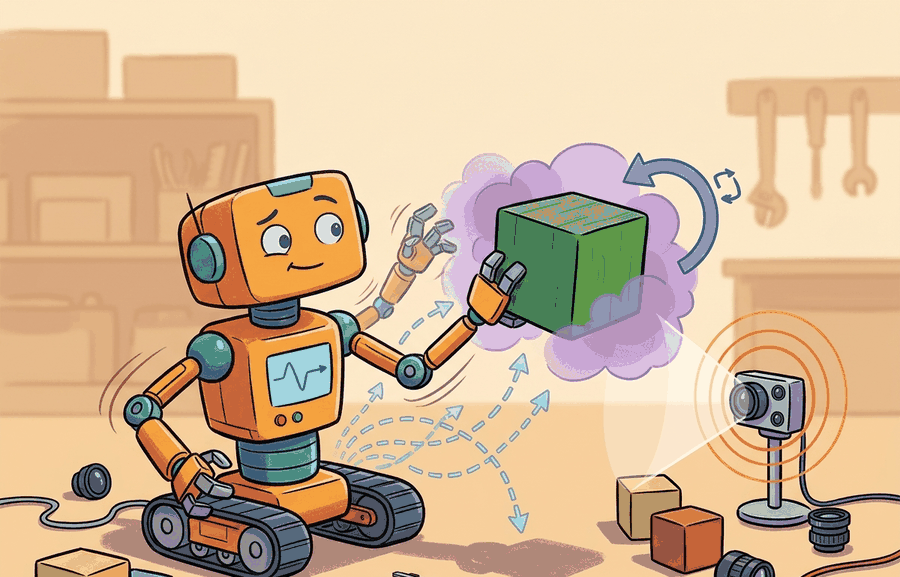
Why space is the substrate of embodiment matters because every useful action has a where. A policy can name an object, a detector can return pixels, and a planner can propose a path, but a robot needs spatial quantities with units, frames, timestamps, and uncertainty before it can act.
Embodied AI is not image classification with motors attached. A tabletop robot must decide whether the mug is left of the gripper, whether the camera estimate is fresh enough for control, whether a planned base motion keeps the arm inside reach, and whether the simulator pose agrees with the controller pose. Those questions are spatial before they are learned.
The central habit is to write every spatial claim as a quantity plus its frame. A point in the camera frame, a velocity in the body frame, a pose in the world frame, and a normal vector in an object frame are not interchangeable arrays. They are contracts between perception, state estimation, planning, and control.
A representation earns its place when it changes the measurable action interface. The practical question is not whether a model produced a plausible coordinate, it is whether that coordinate can be transformed, checked, logged, and consumed by the controller that will move the robot.
Theory
Write a point expressed in frame $A$ as $p^A$. Write a transform that maps coordinates from frame $B$ into frame $A$ as $T_{AB}$. Then the same physical target can be represented as $p^{camera}$ for perception, $p^{base}$ for reaching, and $p^{world}$ for navigation. The values differ because the basis differs; the target itself is the same:
$$p^A = T_{AB}\, p^B, \qquad p^B = T_{BA}\, p^A = (T_{AB})^{-1} p^A.$$
The transform is built from a rotation $R_{AB} \in SO(3)$ and a translation $t_{AB} \in \mathbb{R}^3$, the origin of frame $B$ expressed in frame $A$. Acting on a point this reads $p^A = R_{AB}\,p^B + t_{AB}$, so two frames give two coordinate triples for one physical target.
This notation is not decorative. It prevents a common production failure: an array crosses a subsystem boundary with no frame label, and the next subsystem silently assumes a different convention. The bug may survive unit tests because the numbers have the right shape.
A spatial interface should carry five fields: value, frame_id, timestamp, units, and validity. For probabilistic estimates, add covariance or another uncertainty description. For actuator commands, add limits and the controller frame.
Worked Example
Define two frames, a camera frame and a robot base frame, then represent one physical target in each. A camera detector reports the target in the camera frame; the gripper controller expects it in the base frame. The fragment prints both coordinate triples and confirms the round trip, exposing the contract that many full stacks hide under ROS 2 messages, simulator state, or library pose objects.
# Define two frames, represent one physical point in each, and print the transform.
# The round-trip back to the camera frame confirms the transform is consistent.
import numpy as np

# T_base_camera maps coordinates from the camera frame into the base frame.
T_base_camera = np.array([
    [0.0, -1.0, 0.0, 0.35],
    [1.0,  0.0, 0.0, 0.10],
    [0.0,  0.0, 1.0, 0.55],
    [0.0,  0.0, 0.0, 1.00],
])

p_camera = np.array([0.25, -0.10, 0.80, 1.0])   # target in the camera frame
p_base = T_base_camera @ p_camera               # same target in the base frame
p_camera_again = np.linalg.inv(T_base_camera) @ p_base  # round trip back

print("point in camera frame:", np.round(p_camera[:3], 3).tolist())
print("point in base frame:  ", np.round(p_base[:3], 3).tolist())
print("round-trip residual: ", round(np.linalg.norm(p_camera - p_camera_again), 12))The teaching fragment is about 14 lines. In a working stack, scipy.spatial.transform handles rotation conversion, spatialmath.SE3 gives named pose objects, and ROS 2 tf2 stores timestamped transforms. The shortcut is usually 3 to 6 lines plus model setup, and it handles convention checking, interpolation, and graph lookup.
Builder Recipe
- Name the physical quantity before choosing a representation.
- Attach a frame, timestamp, unit, and validity range to every spatial value.
- Compute the minimal NumPy version and test one invariant by hand.
- Replace the hand version with a maintained pose or transform library.
- Log both the raw observation and the transformed action target in simulator or robot runs.
A vision model can localize an object perfectly in image space and still fail the task if camera-to-base calibration is stale, if the controller consumes the wrong frame, or if the pose arrives after the object has moved.
For a pick-and-place system, log the detected object pose in the camera frame, the transformed pose in the base frame, the selected grasp pose, and the controller error after execution. A single failed grasp can then be classified as perception error, calibration error, planning error, or control error.
A robot log is a lab notebook that does not get tired. Give it frame names, timestamps, and residuals, and it will remember exactly where the story stopped making sense.
Large vision-language-action models increasingly predict spatial actions directly. Deployable systems still wrap those actions in calibrated frames, collision checks, state freshness tests, and controller-readable targets.
This section sets up Section 4.4 on SE(3), Chapter 5 on kinematics, and Chapter 8 on state estimation.
Can you name the frame, timestamp, unit, and consumer for every spatial value in a robot pipeline you have seen? If not, the interface is still too vague for reliable action.
Production Pattern
Why space is the substrate of embodiment sits inside the Part II robotics contract: geometry defines where things are, kinematics defines what motion is possible, dynamics defines what motion costs, control defines how errors are corrected, and sensing defines what the agent can know on time.
Anchor every spatial claim in the action it enables: reach, avoid, grasp, localize, or explain a failure. This makes the section useful to students, builders, and researchers at the same time: the idea has an intuitive role, a formal interface, a runnable check, and a failure mode that can be reproduced.
For Why space is the substrate of embodiment, a pose is a typed relationship between frames, not just a vector. The artifact should record parent frame, child frame, units, timestamp, and multiplication order before any transform is trusted.
| Tool or Library | What It Handles | Verification Check |
|---|---|---|
| SciPy Rotation | converts, composes, applies, and inverts 3D rotations in Python | Verify quaternion order, degrees versus radians, and matrix orthogonality. |
| ROS 2 tf2 | maintains time-buffered coordinate-frame relationships for robot systems | Verify parent-child frame names, lookup time, and transform direction. |
| spatialmath-python | supports practical work on Why space is the substrate of embodiment | Verify the library output against the hand-built baseline on one small case. |
| Drake | models dynamical systems, multibody plants, optimization, and controllers | Verify scalar type, plant finalization, frame convention, and solver status. |
| OpenCV calibration | handles camera models, calibration, projection, and vision preprocessing | Verify intrinsics, distortion, image timestamp, and frame-to-camera transform. |
Use this recipe when turning Why space is the substrate of embodiment into code, a simulator experiment, or a robot diagnostic. The point is not to use every library. The point is to keep the hand-built baseline and the maintained-tool path comparable.
- Name every frame with a parent, child, unit convention, and timestamp policy.
- Write one hand-checked transform chain and verify identity, inverse, and composition tests.
- Run the same transform through ROS 2 tf2 or SciPy Rotation, then compare one point and one direction vector.
- Record a frame audit with source sensor, latency, and expected sign convention.
- Debug failed behavior by replaying the transform tree before changing policy or controller code.
For Why space is the substrate of embodiment, compare methods only through one saved artifact that preserves the inputs, outputs, units, timestamps, latency budget, configuration, seed, metric definition, and failure labels relevant to this section. The comparison is meaningful only when the same script evaluates the same panel.
Extend the section exercise by adding one perturbation specific to Why space is the substrate of embodiment and one latency or uncertainty check. Save the result in the EvidenceRecord schema, then explain which library output you trust and why.
Frame bugs start when a point, vector, pose, or timestamp is used without naming the coordinate system. Reproduce one world-to-body transform by hand before diagnosing perception or control.
Section References
Core references for Why space is the substrate of embodiment: Modern Robotics; Murray, Li, and Sastry; Siciliano et al.; LaValle; and official documentation for Drake, MuJoCo, Pinocchio, CasADi, python-control, GTSAM, ROS 2, and OpenCV as applicable.
Use these references to check notation, frame conventions, units, solver assumptions, and maintained-library behavior.
Space is the substrate of embodiment because it is the shared contract between sensing, planning, control, simulation, and evaluation.
Instrument a simple simulator scene with camera, base, world, and object frames. Save one log row containing frame_id, timestamp, units, and a transformed action target, then explain which field would catch a stale-pose failure.