"I grade the artifact, the evidence, and the explanation, because copied code rarely survives questions."
A Rubric That Checks Understanding
Assessment, rubrics, and academic-integrity notes for code assignments gives Teaching with This Book a concrete systems role: grade task framing, evidence, implementation, failure analysis, and reflection separately. The section keeps asking what the agent observes, what it remembers or updates, which action changes, and what evidence would convince a skeptical reader.
This section develops the technical contract for assessment, rubrics, and academic-integrity notes for code assignments into a usable mental model. First we define the object of study, then we connect it to the agent loop, then we test it with a compact implementation.
The key question in Assessment, rubrics, and academic-integrity notes for code assignments is practical: what must the agent know, what can it observe, what action is available, and what evidence shows that the action worked under the stated conditions?
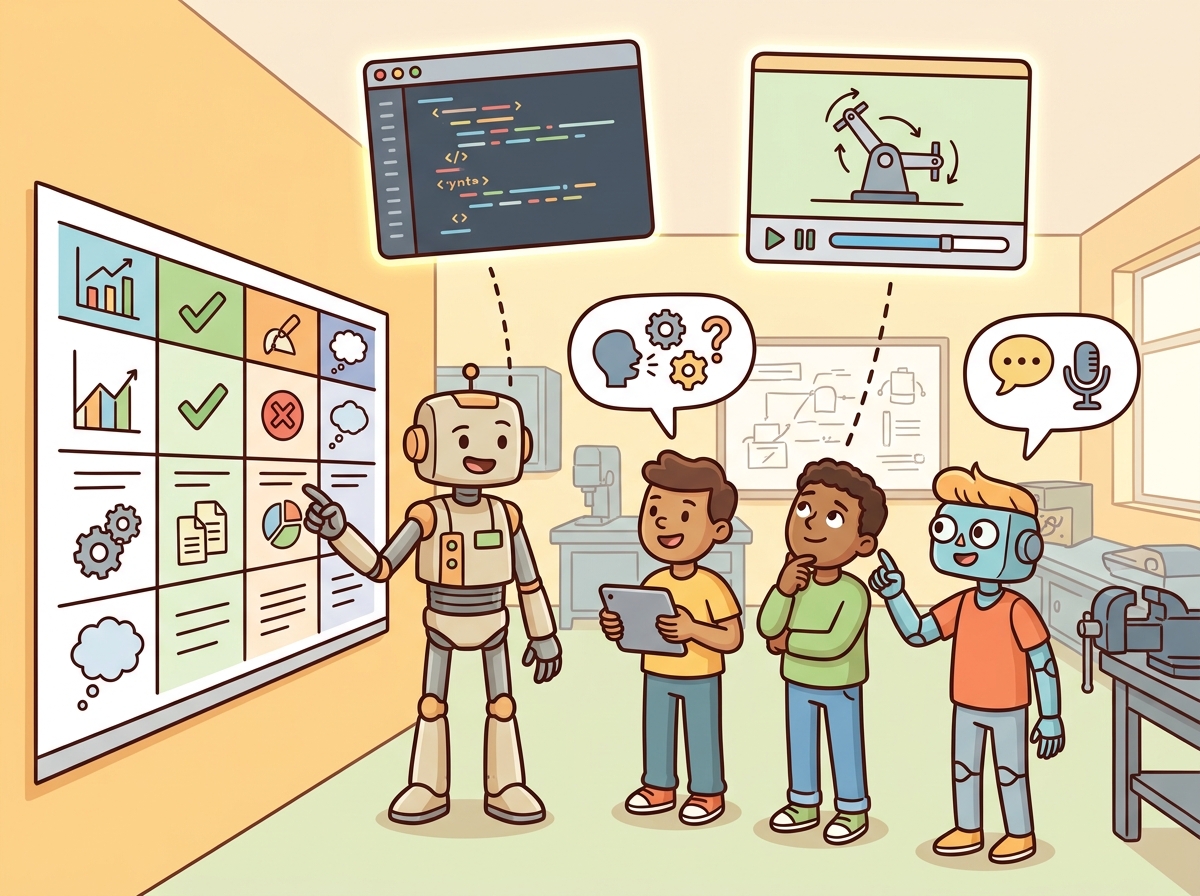
Figure 60.6A shows the intended grading surface: students should be evaluated through code, simulator evidence, reflection, and live explanation rather than through a single polished submission.
Rubrics and academic integrity should be judged by the action it improves. A section claim is strong when it names the decision, the measurement, and the failure mode before a larger model or simulator is introduced.
Theory
For Assessment, rubrics, and academic-integrity notes for code assignments, the practical design rule is to make the interface inspectable before optimization begins: inputs, outputs, units, latency, bounds, and failure labels should all be visible in the saved artifact.
The mechanism in Assessment, rubrics, and academic-integrity notes for code assignments is the contract between representation and action. Name what enters the module, what leaves it, which assumptions make that transformation valid, and which log would reveal a bad handoff.
Worked Example
For Assessment, rubrics, and academic-integrity notes for code assignments, keep one concrete rollout in view. A sensor reading becomes an estimate, the estimate constrains an action, the action changes the world, and the next observation confirms or contradicts the assumption. The section's idea is useful only if it improves that loop.
For Assessment, rubrics, and academic-integrity notes for code assignments, the small contract exists to expose the teaching artifact before tooling takes over. Use notebooks, simulators, shared logs, rubrics, and capstone studios only when they preserve the same observation, action, metric, and failure fields.
Practical Recipe
- Write the observation, action, and success metric before choosing a model.
- Build a baseline that is simple enough to debug by inspection.
- Add the library implementation only after the baseline behavior is understood.
- Record failures as structured cases: perception error, state error, planning error, control error, or evaluation error.
- Run at least one perturbation test before trusting the result.
The common mistake in Assessment, rubrics, and academic-integrity notes for code assignments is to trust a component score before checking the closed-loop interface. The failure usually appears where state, timing, authority, or evaluation context crosses a module boundary.
A team using Assessment, rubrics, and academic-integrity notes for code assignments starts by writing the task panel, not by picking the largest model. They keep a baseline run, a maintained-tool run, and a perturbation run in the same result folder. The comparison is accepted only when the action trace, metric, and failure labels come from one script.
A good embodied system makes assessment, rubrics, and academic-integrity notes for code assignments visible twice: once in the design sketch and once in the replay artifact. The second view keeps the first one honest.
For Assessment, rubrics, and academic-integrity notes for code assignments, the open research question is not whether a larger policy can produce a better demo. The sharper question is whether the method improves reliability across new scenes, new embodiments, delayed feedback, and rare failures under an evaluation protocol that another lab can reproduce.
For Assessment, rubrics, and academic-integrity notes for code assignments, can you name the observation, action, protected assumption, success metric, and one likely failure case? If any field is vague, rewrite the contract before adding model complexity.
Topic-Native Deepening
Assessment design determines what students actually learn. In embodied AI, grading only a final score or a polished video pushes students toward opaque hacks, while grading the evidence trail pushes them toward reproducible systems thinking.
The section therefore separates task framing, implementation, evidence quality, failure analysis, and reflection. Academic integrity is handled through artifact transparency and oral or written explanation checks rather than through brittle suspicion alone.
Assessment, rubrics, and academic-integrity notes for code assignments becomes teachable once the student can state the operative variables, the decision boundary, and the evidence artifact. The section should therefore be read together with Chapter 52 on evaluation and Chapter 59 on capstone deliverables, where the same loop is developed from adjacent angles.
A rubric can be written as $G = w_t T + w_i I + w_e E + w_f F + w_r R$, where $T$ is task framing, $I$ implementation, $E$ evidence quality, $F$ failure analysis, and $R$ reflection. Keeping the components separate prevents students from hiding weak understanding behind one high metric.
The failure-analysis term is especially important. Once it carries real weight, students gain incentive to document debugging clearly instead of treating errors as something to hide.
- Publish the rubric before the assignment starts, including evidence and reflection expectations.
- Require one common artifact bundle: code, config, metrics, replay, and a failure note.
- Sample oral or written spot checks that ask students to explain one design choice and one failure case.
- Permit assistance tools with disclosure, while grading the student's understanding of the resulting system.
- Penalize missing evidence and unexplainable code more heavily than modest performance gaps.
| Dimension | What To Specify | Why It Matters |
|---|---|---|
| Task framing | Clear contract, assumptions, and success definition | Shows whether the student understood the problem. |
| Implementation | Runnable code and correct interfaces | Checks engineering execution. |
| Evidence | Construct-matched metrics, replay, and logs | Rewards reproducibility and honesty. |
| Failure analysis | Specific diagnosis and next-step proposal | Builds research maturity. |
The expected output should reveal assessment priorities immediately. A rubric with no explicit evidence or failure-analysis weight will teach the wrong habits.
After the from-scratch contract is clear, the practical route uses GitHub Classroom, nbgrader, Gradescope-style rubrics, Jupyter, replay exporters, CI. The payoff is that standard interfaces, logging, batching, and replay support move from ad hoc glue code into maintained infrastructure, while the evidence schema stays the same.
A strong integrity policy allows disclosed use of coding assistants but requires students to defend the produced system. That shifts the course from policing text authorship to evaluating actual engineering understanding.
The frontier question is how assessment changes when students can obtain increasingly capable generated code. Embodied AI may be unusually resilient here because replay, failure explanation, and system integration remain hard to fake convincingly.
For Assessment, rubrics, and academic-integrity notes for code assignments, the artifact should show the course-design decision, the evidence students must produce, and the failure mode that would trigger a revised assignment or rubric.
- Assessment, rubrics, and academic-integrity notes for code assignments matters when it changes an embodied agent's action under a stated observation and metric.
- Grade task framing, evidence, implementation, failure analysis, and reflection separately.
- Strong evidence is saved as one artifact containing the baseline, the maintained-tool path, the metric panel, and labeled failures.
Design a method-matched experiment for Assessment, rubrics, and academic-integrity notes for code assignments. Specify the environment, observation schema, action interface, metric, and one perturbation that targets the section's core assumption.
Section References
Biggs, J. Teaching for Quality Learning at University. Open University Press, 1999.
Use for constructive alignment between learning outcomes, activities, and assessment.
Anderson, L. W. and Krathwohl, D. R. A Taxonomy for Learning, Teaching, and Assessing. Longman, 2001.
Use for designing assessments that move from recall to analysis, creation, and evaluation.
What's Next?
This closes Part XII. Continue into Appendix C for the tool catalog that supports the labs and capstones.